

SIMCom GNSS Modules for E-Bike, OBD & Dashcam BOMs
SIMCom GNSS Modules for E-Bikes, OBD and Dashcams: A Practical Architecture Around SIM65M-C, SIM66MD and SIM68AT
Author: Klaus·Fische | Category: Industry Applications & Solutions | Primary Parts: SIM65M-C, SIM66MD, SIM68AT | Manufacturer: SIMCom | RFQ: Submit request | Slug: simcom-gnss-modules-e-bike-obd-dashcam-architecture
Key Takeaways
- SIMCom GNSS module selection should start from the application lane, not from a loose part-number match. E-bike trackers, OBD dongles, dashcams, UAVs, and fleet gateways share location needs, but their antenna, update-rate, interface, power, and data-backhaul requirements are different.
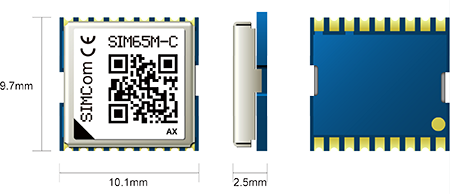
- SIM65M-C fits the compact L1 multi-GNSS tracker lane. SIMCom's official product page lists GPS, GLONASS, BDS, Galileo, and QZSS L1 support, 64 receiver channels, 5 Hz maximum update rate, -165 dBm tracking sensitivity, and 10.1 x 9.7 x 2.5 mm dimensions.
- SIM66MD belongs in the higher-precision lane. SIMCom positions it as an L1 + L5 dual-band GNSS module, and the hardware design file supports detailed planning around 18 LCC pins, UART/I2C/PPS interfaces, 2.1 V to 4.0 V VCC range, 10 Hz update rate, and active/passive antenna design.
- SIM68AT should be treated as a verified compact GNSS RFQ path, not as a blind replacement for SIM65M-C or SIM66MD. The live icallin page supports it as a real quotation target, but the final engineering call still depends on footprint, antenna, firmware, and qualification rules.
- SIM8260A is useful official technical context for designs that move from GNSS-only tracking into 5G plus location architecture, but it is not included in the 5-Model Matrix because a live icallin product detail page could not be verified.
- For fast sourcing, keep the RFQ structured: exact MPN first, acceptable review candidates second, application requirement third, and any cellular-data requirement clearly separated from GNSS-only location needs.
Why SIMCom GNSS Module Selection Is an Architecture Decision
A buyer can search for a SIMCom GNSS module and see a familiar cluster of model names: SIM65M-C, SIM66MD, SIM68AT, SIM65M-CB-L, SIM68D, SIM66MD-R, and sometimes a 5G part such as SIM8200EA-M2 or SIM8260A. At a glance, they all appear to live in the same positioning ecosystem. That is exactly where a weak RFQ can go wrong.
The real question is not "which SIMCom module is available today?" The better question is "which location architecture is the product trying to build?" An e-bike tracker may only need reliable L1 multi-GNSS positioning, low current, a simple host interface, and a compact antenna design. A dashcam may need stable cold-start behavior, predictable re-acquisition, and enough margin under windshield and cabin installation conditions. An OBD dongle may care more about system-level standby current, vehicle-voltage conversion, and fast fixes after ignition. A UAV or robotics design may push toward dual-band GNSS, better multipath behavior, higher update rate, and RTK readiness.
That is why this guide uses three headline paths. SIM65M-C represents the compact L1 multi-GNSS lane. SIM66MD represents the L1 + L5 dual-band lane for stricter accuracy and RTK-ready planning. SIM68AT is treated as another verified compact GNSS quote path that belongs in the same procurement conversation, but not as a guaranteed drop-in answer. For designs that also need cellular data, SIM8200EA-M2 and SIM8260A help define the boundary between GNSS-only and cellular-plus-location modules.
For procurement teams, that distinction matters because a quote request with only "SIMCom GNSS module alternative" is too vague. It invites substitutions that may look close in a distributor search result but fail at the PCB, antenna, firmware, certification, or customer-approval level. A better sourcing flow starts with the exact model, then names acceptable engineering-review candidates, and finally states the application requirements that cannot move.
| Application Lane | Typical Device | Location Requirement | Update-Rate Pressure | Antenna Constraint | Preferred Module Lane | RFQ Warning |
|---|---|---|---|---|---|---|
| Compact tracker | E-bike, scooter, logistics tag | Stable L1 multi-GNSS positioning | Low to medium | Small enclosure, limited ground plane | SIM65M-C / SIM65M-CB-L review lane | Do not accept a larger or different-interface module without mechanical review. |
| Vehicle accessory | OBD dongle, basic dashcam side-positioning | Fast fix after power-up and reliable re-acquisition | Medium | Vehicle cabin, windshield, cable routing | SIM65M-C or SIM68AT review lane | Confirm hot-start/cold-start expectations and antenna location. |
| Higher-precision location | UAV, robotics, premium navigation | Dual-band L1 + L5, better accuracy margin, RTK planning | Medium to high | More sensitive RF design and antenna quality | SIM66MD lane | Treat passive/active antenna choice as part of the BOM, not an afterthought. |
| Connected gateway | Fleet gateway, high-throughput tracker | Location plus cellular data | Application-dependent | Cellular and GNSS antenna coexistence | SIM8200EA-M2 / SIM8260A context | Do not replace a GNSS-only module with a cellular module unless the host and certification plan support it. |
| Redesign or platform refresh | New product generation | Location architecture may change | Open | Can redesign PCB and firmware | Architecture comparison lane | Quote exact modules separately from redesign candidates. |
Table 1: Application lane decision table for SIMCom GNSS and cellular-plus-location designs | Source: W26 plan row 22, SIMCom product pages, SIM66MD Hardware Design V1.01, and icallin verified product pages | Compiled by: icallin.com
SIM65M-C: Compact L1 GNSS for Trackers That Need Stable Positioning
SIM65M-C is the clean starting point for many compact tracker conversations. SIMCom's official product page describes it as a high-performance GNSS module that integrates GPS, GLONASS, BDS, Galileo, and QZSS in an LCC type package. The same page lists L1 reception, 64 GNSS receiver channels, 5 Hz maximum update rate, -165 dBm tracking sensitivity, 20 second cold start, 1 second hot start, 2 m automatic position accuracy, and -40 C to +85 C operating temperature. For a buyer, those numbers do more than fill a datasheet table. They define the minimum evidence needed to decide whether a module belongs in a compact tracker RFQ.
The local SIM65M-C CE Declaration also matters, but it should be used correctly. It identifies SIM65M-C as a GNSS module from SIMCom Wireless Solutions Limited, gives HW version V3.01 and SW version B02, and states a 3.3 V DC system component context. That is useful compliance context, but it is not a replacement for the product specification or the board-level hardware design review. The article should not over-read a CE Declaration as if it were a full electrical datasheet.
For e-bike trackers and OBD-adjacent products, SIM65M-C is attractive because the module is small and the location requirement is often practical rather than survey-grade. The design usually needs repeatable fixes, reasonable sensitivity, support for multiple constellations, and a power plan that works with a host MCU, backup battery, or vehicle-side power conversion. It may not need L5, raw observation data, or RTK. That keeps the design simpler, which can protect both engineering time and procurement flexibility.
Still, "compact L1 GNSS" does not mean "any compact GNSS module will do." SIM65M-CB-L has a verified icallin page and belongs in sourcing discussions, but it should be named as a review candidate. Procurement should ask the engineer whether the firmware, antenna, footprint, and approved vendor list can accept it. This is especially important in tracking products where the enclosure and antenna placement are already locked. A module that is close on paper can still change RF performance if the antenna feed, power rail, or host interface assumptions move.
| Parameter | SIM65M-C Source Data | Buyer Meaning | RFQ Guardrail |
|---|---|---|---|
| GNSS systems | GPS, GLONASS, BDS, Galileo, QZSS | Suitable for multi-constellation L1 tracking designs | State required constellations in the RFQ if the end product is region-specific. |
| Receiver channels | 64 channels | Enough for many compact tracker and vehicle accessory use cases | Do not compare only by channel count; sensitivity and antenna design still matter. |
| Max update rate | 5 Hz | Useful for devices that need more than a slow periodic fix but not high-dynamics RTK behavior | Ask whether 1 Hz, 5 Hz, or higher update rate is required. |
| Tracking sensitivity | -165 dBm | Important for weak-signal tracking after initial acquisition | Confirm antenna type and enclosure constraints. |
| TTFF | 20 s cold start, 1 s hot start, 3.5 s EPO assist | Helps estimate user experience after power-up or sleep recovery | Mention power cycling and standby behavior in the RFQ. |
| Package and size | LCC, 10.1 x 9.7 x 2.5 mm, 0.5 g | Strong fit for compact embedded devices | Confirm footprint and height limit before accepting alternatives. |
| Operating temperature | -40 C to +85 C | Covers many industrial and vehicle accessory environments | Align temperature requirement with actual installation location. |
| Local declaration context | GNSS module, HW V3.01, SW B02, 3.3 V DC system component context | Useful for compliance and document traceability | Do not treat the CE Declaration as a full electrical datasheet. |
Table 2: SIM65M-C quick data card and sourcing guardrails | Source: SIMCom SIM65M-C official product page, local SIM65M-C CE Declaration, and icallin SIM65M-C product page | Compiled by: icallin.com
SIM66MD: Dual-Band L1+L5 GNSS When Accuracy and RTK Readiness Matter
SIM66MD is the lane to study when the product cannot be treated as a basic tracker. SIMCom's official product page identifies SIM66MD as a standalone L1 + L5 dual-band GNSS module in an LCC package. It lists L1 support for BeiDou, GPS, GLONASS, Galileo, and QZSS, plus L5 support for BeiDou, GPS, Galileo, QZSS, and NAVIC. The official page also lists support for AGNSS, PPS, low-noise amplifier integration, DGPS/RTK context, 10 Hz maximum update rate, -165 dBm tracking sensitivity, hot start under 1 second, and 0.5 m automatic position accuracy.
The local SIM66MD Hardware Design V1.01 file gives the deeper engineering context. It describes electronic specifications, RF specifications, interfaces, mechanical characteristics, and test results. It also states that SIM66MD supports GPS, GLONASS, BDS, Galileo, NAVIC, QZSS, and SBAS-related functions. The same file describes L1+L5 dual-frequency multi-system raw observation data output for centimeter-level RTK positioning, and lists the module as an 18-pin LCC package with UART, I2C, PPS, RESET_N, RF_IN, VCC, V_BACKUP, and antenna-related pins.
Those details change the procurement conversation. SIM66MD is not just "a better SIM65M-C." It is a different technical lane. If the device is an entry e-bike tracker, the extra capability may not justify the engineering or supply-chain complexity. If the device is a UAV controller, outdoor robot, precision asset tracker, or premium vehicle positioning system, the dual-band and RTK-ready context may be exactly the reason to move away from a simple L1 module.
The hardware design file also makes antenna discipline hard to ignore. SIMCom recommends careful GNSS antenna selection and notes that active antenna use can improve weak-signal tracking versus passive antenna use. It lists L1 and L5 operating frequency ranges and instructs designers to control the RF trace from RF_IN to the antenna at 50 ohm impedance. These are not procurement details in the narrow sense, but they decide whether the purchased module performs as expected in the final product.
| Design Item | SIM66MD Source Data | Why It Matters | Buyer / Engineer Check |
|---|---|---|---|
| GNSS architecture | L1 + L5 dual-band GNSS | Better fit for accuracy-sensitive positioning than L1-only lanes | Confirm whether the product requirement justifies dual-band design effort. |
| Constellations | GPS, GLONASS, BDS, Galileo, NAVIC, QZSS, with SBAS-related context | Supports broader regional and performance planning | Match constellations to target shipping regions. |
| Update rate | Up to 10 Hz in SIM66MD source data | More useful for moving devices, UAVs, robotics, and premium navigation | Ask firmware team whether update rate is actually consumed. |
| Sensitivity | Tracking sensitivity around -165 dBm on official page and -166 dBm in hardware design table | Helps weak-signal tracking margin | Review antenna type, placement, and ground plane. |
| VCC operating range | 2.1 V to 4.0 V, 3.3 V typical in hardware design table | Drives power rail compatibility | Verify rail tolerance, ripple, and startup behavior. |
| Interfaces | UART, I2C, PPS, RESET_N, RF_IN and related LCC pins | Impacts host MCU and PCB routing | Do not approve alternates without interface mapping. |
| Antenna guidance | Active and passive antenna support; 50 ohm RF trace guidance; active antenna can improve weak-signal behavior | RF design can make or break GNSS performance | Include antenna type and RF constraints in the RFQ package. |
| Packaging logistics | 50 modules per tray, 1000 per small carton, 4000 per big carton | Useful when planning production buys, not just samples | Ask packaging, date code, and lot-splitting questions early. |
Table 3: SIM66MD hardware design guardrails | Source: SIM66MD Hardware Design V1.01, SIMCom SIM66MD official product page, and local SIM66MD CE Declaration | Compiled by: icallin.com

SIM68AT and Similar Compact GNSS Paths: When the BOM Needs Another LCC Option
SIM68AT is the third headline model in the selected W26 application article, and it deserves a careful role. The verified icallin product page positions SIM68AT as a SIMCom multi-GNSS positioning module for vehicle tracking, IoT asset tracking, wearable devices, industrial navigation, UAV systems, and smart city applications. That puts it in the same general sourcing conversation as SIM65M-C, especially when buyers are looking for compact GNSS options across multiple embedded products.
But SIM68AT should not be written as a universal replacement. In a real BOM, the question is whether the project can accept the electrical, mechanical, firmware, antenna, qualification, and compliance consequences of a change. A procurement team may see "SIMCom GNSS module" and assume that a verified page is enough. It is not. A verified page only means the model is a real quote path on the website. It does not prove drop-in compatibility.
This distinction is the practical heart of a good alternatives article. SIM65M-C can be the exact requested module for a compact tracker. SIM68AT can be an RFQ candidate when the engineering team has room to review fit. SIM66MD can be the upgrade lane when accuracy, dual-band operation, or RTK readiness matters. SIM8200EA-M2 can sit outside the GNSS-only lane when a connected gateway needs cellular throughput and location support. Mixing those lanes in one undifferentiated table is how buyers accidentally invite unusable quotes.
The same caution applies to SIM68D and SIM66MD-R. Both appear in planning and hot-model context, but their tested icallin product-detail routes rendered visible error pages during browser verification on July 5, 2026. That does not mean the models are technically irrelevant; it means they should not be presented as verified icallin quote links in this article. The matrix should reward what can be verified, and the exclusions should be transparent enough for the user to fix the pages later if those models need to be promoted.
When GNSS-Only Is Not Enough: SIM8260A and SIM8200EA-M2 as Cellular-Plus-Location Context
Some projects start as location devices and become connected gateways. A simple GNSS module can answer "where is it?" but not "how does the data move?" Once a device needs high-throughput cellular data, remote diagnostics, over-the-air updates, MQTT or HTTPS workflows, and multi-region wireless deployment, the BOM conversation changes.
SIM8260A is useful here because the official SIMCom product page and the local SIM8260A spec both describe a Multi-Band 5G NR/LTE-FDD/LTE-TDD/HSPA+ module that supports R16 5G NSA/SA. The source data lists LGA form factor, 41.0 x 43.6 x 2.8 mm dimensions, 3.3 V to 4.4 V supply voltage, GNSS support across GPS, GLONASS, Beidou, Galileo, and QZSS, and interfaces such as USB, PCM, I2C, and diversity receiver. It also lists data-transfer levels: Sub-6G NSA at 3.4 Gbps downlink and 600 Mbps uplink, Sub-6G SA at 2.4 Gbps downlink and 1 Gbps uplink, LTE at 1.6 Gbps downlink and 200 Mbps uplink, and HSPA+ at 42 Mbps downlink and 5.76 Mbps uplink.
That is powerful source material, but it does not make SIM8260A a valid icallin recommendation link. The tested simcom-sim8260a product-detail route and several slug variants rendered visible error pages during verification. So the article should use SIM8260A as official architecture context only. It can explain why a fleet gateway, industrial router, or high-bandwidth tracker might move beyond a GNSS-only module, but it should not appear in the 5-Model Matrix until a live icallin page exists.
SIM8200EA-M2 fills that gap as a verified quote path. Its icallin product page renders correctly, and SIMCom's official page identifies it as a 5G NR/LTE-FDD/LTE-TDD/HSPA+ M.2 module supporting R15 5G NSA/SA up to 4 Gbps data transfer. The official page lists M.2 form factor, Type 3052-S3-B, 52.0 x 30.0 x 2.3 mm dimensions, 3.135 V to 4.4 V supply voltage, and rich interfaces including UART, PCIe, USB 3.1, GPIO, USB, PCM, I2C, and diversity receiver. It is not a replacement for SIM65M-C or SIM66MD; it is a different lane for products where the location module and the connectivity module become one connected platform decision.

Verified icallin Quote Paths: 5-Model Matrix
For a sourcing article, a model is only useful if the buyer has a real quote path. That is why the 5-Model Matrix below contains only parts that rendered as valid icallin product detail pages during browser verification. It includes the three headline models from the article direction, plus two related models that help explain the sourcing boundaries.
The matrix is intentionally not a drop-in compatibility table. It is a controlled RFQ table. SIM65M-C is the compact L1 GNSS baseline. SIM66MD is the dual-band precision lane. SIM68AT is a verified compact GNSS candidate. SIM65M-CB-L is a nearby compact GNSS quote path. SIM8200EA-M2 is the cellular-plus-location escalation path. If a buyer sends all five models in one RFQ without context, the supplier may quote something that is available but not design-approved. If the buyer separates exact model, review candidate, and architecture lane, the response becomes far more useful.
| # | Model | icallin Quote Path | Architecture Lane | Best-Fit Use Case | Substitution Warning |
|---|---|---|---|---|---|
| 1 | SIM65M-C | Product detail | Compact L1 multi-GNSS | E-bike trackers, OBD side-positioning, logistics, compact IoT location | Benchmark lane; do not replace without footprint, antenna, and firmware review. |
| 2 | SIM66MD | Product detail | Dual-band L1 + L5 GNSS | UAVs, robotics, premium navigation, high-precision tracking | Upgrade lane; not automatically interchangeable with SIM65M-C. |
| 3 | SIM68AT | Product detail | Compact GNSS RFQ path | Vehicle tracking, asset tracking, UAV systems, embedded location devices | Valid quote path, but engineering must confirm compatibility. |
| 4 | SIM65M-CB-L | Product detail | Similar compact GNSS lane | Compact tracker fallback discussions | Treat as a review candidate, not a blind substitute. |
| 5 | SIM8200EA-M2 | Product detail | 5G cellular-plus-location lane | Fleet gateways, industrial routers, high-bandwidth trackers | Not a GNSS-only replacement; requires cellular, host, certification, and antenna review. |
Table 4: 5-model verified SIMCom sourcing matrix | Source: Browser-verified icallin product detail pages, SIMCom product pages, and W26 SEO Info verification log | Compiled by: icallin.com
The exclusions are as important as the included rows. SIM8260A has strong official source data, but no verified icallin page. SIM66MD-R appears in planning context, but the tested product-detail route rendered an error page. SIM68D appears as a possible alternative in planning notes, but the tested product-detail route also rendered an error page. SIM8202G-M2 appears as a possible 5G alternative in hot-model context, but its product-detail route failed verification. The safest editorial choice is to mention those models only as exclusions or future page-fix candidates, not as ready quote links.
RFQ Checklist for SIMCom GNSS and 5G Location Modules
The best RFQ for SIMCom GNSS modules is not long because it is bureaucratic. It is long because it protects the buyer from the wrong kind of speed. Fast quotes are only useful when they quote usable parts. A buyer asking for SIM65M-C can receive a fast response for a nearby SIMCom module, but if the design cannot accept the package, voltage, antenna, or firmware assumptions, the quote creates noise instead of solving the problem.
Start with the exact requested model and link it to the application. For example: "Please quote SIM65M-C for an e-bike tracker production build. Compact L1 GNSS is required. SIM65M-CB-L may be reviewed but is not pre-approved." That sentence is better than a broad request for "SIMCom GNSS modules" because it tells the supplier what can and cannot move.
For SIM66MD, add the precision context. If the design needs L1 + L5, PPS, or RTK-ready planning, write those terms directly. If the antenna will be active, say so. If the device has already passed a partial qualification with a specific antenna or enclosure, say that too. GNSS problems are often system problems, and a system-aware RFQ can save days of back-and-forth.
For cellular-plus-location designs, separate GNSS from connectivity. A product that uses SIM8200EA-M2 may need 5G bands, M.2 form factor, host driver support, USB 3.1, regulatory path, and antenna coexistence information. Those are not the same questions as a compact GNSS-only module. If the project is only exploring whether to move from GNSS-only to 5G plus GNSS, make that a design review topic rather than an immediate substitute request.
| RFQ Field | What to Write | Why It Matters | Example for This Article |
|---|---|---|---|
| Exact MPN | The primary model required | Prevents loose family substitutions | SIM65M-C, SIM66MD, or SIM68AT |
| Application | End product and use environment | Helps supplier judge realistic alternates | E-bike tracker, OBD dongle, dashcam, UAV, fleet gateway |
| Accepted candidates | Separate "review allowed" from "approved" | Keeps alternatives useful without overpromising | SIM65M-CB-L review allowed; SIM66MD not a blind replacement |
| Location requirement | L1, L1 + L5, RTK context, accuracy target | Drives module lane selection | L1-only tracker vs dual-band premium positioning |
| Interface requirement | UART, I2C, PPS, USB, M.2, host compatibility | Prevents electrical and firmware mismatch | SIM66MD UART/I2C/PPS; SIM8200EA-M2 USB/PCIe/M.2 |
| Antenna requirement | Active/passive, 50 ohm RF trace, enclosure limit | GNSS performance depends on antenna design | Active antenna required for weak-signal margin |
| Power requirement | Voltage range, current lane, sleep behavior | Important for battery and vehicle-powered devices | SIM66MD VCC 2.1 V to 4.0 V; SIM65M-C A0/DCDC current difference |
| Quantity and schedule | Prototype, pilot, mass production, target ship date | Determines whether spot stock or planned buy is needed | Prototype 200 pcs, production 5000 pcs, staged delivery |
| Packaging and traceability | Tray/carton, lot, date code, label, document needs | Supports incoming inspection and production control | SIM66MD tray/carton planning if buying production volume |
Table 5: SIMCom GNSS and 5G module RFQ checklist | Source: SIMCom source data, local official documents, icallin RFQ workflow, and module sourcing best practices | Compiled by: icallin.com
Frequently Asked Questions
1. Is SIM65M-C a drop-in replacement for SIM66MD?
No. SIM65M-C and SIM66MD should be treated as different architecture lanes. SIM65M-C is the compact L1 multi-GNSS tracker lane. SIM66MD is a dual-band L1 + L5 module with higher-precision positioning context, PPS, and RTK-ready discussion. A project can compare them, but it should not treat them as automatic substitutes.
2. When should I choose SIM66MD instead of SIM65M-C?
Choose SIM66MD when the product requirement pushes beyond basic L1 GNSS tracking. Typical reasons include dual-band L1 + L5 requirements, better accuracy margin, UAV or robotics motion requirements, RTK-ready planning, PPS timing needs, or a more demanding antenna and positioning architecture. If the product is a cost-sensitive compact tracker, SIM65M-C may be a cleaner starting point.
3. Can SIM68AT replace SIM65M-C or SIM66MD?
SIM68AT has a verified icallin quote page and belongs in the compact GNSS sourcing conversation, but it should be reviewed as a candidate, not accepted as a blind replacement. The engineering team should check footprint, host interface, firmware, antenna, certification, and qualification constraints before approving it.
4. Why is SIM8260A discussed if it is not in the 5-Model Matrix?
SIM8260A is discussed because the user provided an official SIM8260A source file, and SIMCom has an official SIM8260A product page. It is useful for explaining when a design moves from GNSS-only location into 5G plus GNSS architecture. It is excluded from the 5-Model Matrix because no live icallin product detail page could be verified during the article preparation.
5. What should I include in a SIMCom GNSS module RFQ?
Include the exact MPN, application, target quantity, delivery schedule, accepted review candidates, required constellations, L1 or L1 + L5 requirement, update rate, antenna type, host interface, voltage requirement, temperature requirement, packaging preference, and any compliance or traceability requirements. For plan-table blogs, use the verified product detail page plus the SIMCom manufacturer page and RFQ page to keep the buying path clear.
6. Should e-bike, OBD, and dashcam BOMs use the same GNSS module?
Not necessarily. They can share a sourcing family, but each application has different physical and electrical constraints. E-bike trackers may prioritize compact size and low power. OBD dongles may prioritize vehicle power behavior and fast fixes after ignition. Dashcams may need reliable reception under windshield and cabin placement. Use the same module only if the full system requirement is aligned.
Immediate Stock Alert
If your BOM currently lists SIM65M-C, SIM66MD, SIM68AT, SIM65M-CB-L, or SIM8200EA-M2, do not send a loose "SIMCom GNSS module" request and hope the right part comes back. Send the exact model first, then name review candidates separately.
For compact tracker, OBD, and dashcam sourcing, start from the live icallin product pages for SIM65M-C, SIM66MD, and SIM68AT. If the design can review nearby compact GNSS options, include SIM65M-CB-L. If the project is moving into cellular-plus-location architecture, quote SIM8200EA-M2 as a separate 5G module lane.
You can also review the broader SIMCom manufacturer page before sending the final BOM. When the quantity, schedule, and approved alternates are ready, submit the request through the icallin RFQ page. The cleanest RFQ will state the exact model, the application, the accepted review candidates, the antenna and interface requirements, and the date-code or packaging constraints.
Conclusion
SIMCom GNSS module selection is a small decision only when the product is still a sketch. Once the BOM is tied to a real enclosure, antenna, host interface, certification path, and production schedule, the difference between SIM65M-C, SIM66MD, SIM68AT, SIM65M-CB-L, SIM8200EA-M2, and SIM8260A becomes a system-level decision.
The practical framework is simple. Use SIM65M-C when the project needs a compact L1 multi-GNSS tracker lane. Use SIM66MD when the product needs dual-band L1 + L5 positioning, PPS, higher precision, or RTK-ready planning. Treat SIM68AT as a verified compact GNSS RFQ path that still requires engineering approval. Use SIM65M-CB-L as a nearby compact GNSS review candidate. Use SIM8200EA-M2 when the product has crossed into a 5G cellular-plus-location architecture. Keep SIM8260A in the technical discussion because the official source material is strong, but do not present it as a live icallin quote link until the product detail page is verified.
That discipline helps both sides of the table. Engineers get fewer unusable substitutions. Buyers get clearer quotes. Suppliers get enough context to respond with realistic stock, alternatives, and lead-time options. And the final BOM has a better chance of surviving the uncomfortable moment when a simple part-number search turns into a production constraint.
References
- SIMCom, SIM65M-C official product page: https://www.simcom.com/product/SIM65M-C.html
- SIMCom, SIM66MD official product page: https://www.simcom.com/product/SIM66MD.html
- SIMCom, SIM8260A official product page: https://www.simcom.com/product/SIM8260A.html
- SIMCom, SIM8200EA-M2 official product page: https://www.simcom.com/product/SIM8200EA_M2.html
- Local official document, SIM65M-C_CE_Declaration of Conformity_2024 (2).pdf
- Local official document, SIM66MD_CE_Declaration of Conformity_2024.pdf
- Local official document, SIM66MD_Hardware_Design_V1.01.pdf
- Local official document, SIM8260A_SPEC_20260630 (1).pdf
- icallin SIM65M-C product detail: https://icallin.com/product-detail/simcom-sim65m-c
- icallin SIM66MD product detail: https://icallin.com/product-detail/simcom-sim66md
- icallin SIM68AT product detail: https://icallin.com/product-detail/simcom-sim68at
- icallin SIM65M-CB-L product detail: https://icallin.com/product-detail/simcom-sim65m-cb-l
- icallin SIM8200EA-M2 product detail: https://icallin.com/product-detail/simcom-sim8200ea-m2
- icallin SIMCom manufacturer page: https://icallin.com/manufacturers/simcom
- icallin RFQ page: https://icallin.com/rfq


Top Recommended part