

LM339PWR Suffix Decoder: G4, G3, E4 Differences Explained
LM339PWR Suffix Decoder: What G4, G3, E4 Mean and Which One Your BOM Actually Needs
Category: Cross-Reference & Alternatives | Author: Charles·Lee | Published: June 2026 | Last Updated: June 16, 2026
Executive Summary
The Texas Instruments LM339 series is arguably the most ubiquitous quad differential comparator in the electronics industry. However, when procurement teams attempt to source the TSSOP-14 packaged version—the LM339PWR—they are immediately confronted with a confusing array of suffix variations: LM339PWRG4, LM339PWRG3, and LM339PWRE4. In times of allocation and supply chain stress, waiting weeks for a specific "G4" variant while thousands of "G3" units sit in distributor stock can cause catastrophic line-down events.
This comprehensive decoder guide demystifies TI's environmental suffix system. We reveal that these suffixes denote zero electrical differences; the silicon die inside is identical. Instead, the suffixes (E4, G4, G3) dictate the environmental compliance level (RoHS vs. Green) and the lead finish material (Matte Tin vs. Nickel Palladium Gold). By understanding these manufacturing nuances, engineering and procurement teams can confidently dual-qualify these components, update their Approved Vendor Lists (AVL), and navigate spot market shortages without risking SMT reflow failures.
Key Takeaways:
- The Core Component: The Texas Instruments LM339PWRG4 is a standard quad comparator in a 14-pin TSSOP package, operating from 2V to 36V.
- Electrical Equivalency: The LM339PWRE4, LM339PWRG3, and LM339PWRG4 share the exact same silicon die. They are 100% electrically identical drop-in replacements.
- The G4 Variant: The LM339PWRG4 is "Green" (Halogen/Antimony-free) and features a premium NiPdAu (Nickel Palladium Gold) lead finish.
- The G3 Variant: The LM339PWRG3 is also "Green" but utilizes a Matte Sn (Tin) lead finish, which may require different SMT reflow profiling.
- The E4 Variant: The LM339PWRE4 is RoHS-compliant (Lead-Free) with a NiPdAu finish, but lacks the strict Halogen-free "Green" certification of the G-series.
- Action Required: Update your BOM to allow E4, G3, and G4 variants interchangeably to maximize supply chain resilience. Submit an RFQ to secure verified stock of any LM339PWR suffix from icallin today.
1. Introduction — The Suffix Confusion in the Supply Chain
In modern electronics manufacturing, the Bill of Materials (BOM) is law. When a hardware engineer specifies "LM339PWRG4" on the schematic, Contract Manufacturers (CMs) and purchasing managers are bound to that exact string of characters.
During global semiconductor shortages, this rigid adherence to part numbers creates artificial bottlenecks. A buyer might see a 26-week lead time for the LM339PWRG4, completely unaware that the LM339PWRG3 is sitting in stock with next-day delivery. Because the datasheet does not prominently feature a "suffix decoder ring" on the first page, purchasing teams err on the side of caution, refusing to substitute the part out of fear that a "G3" might have a different voltage rating, package footprint, or pinout.
This guide serves to permanently eliminate that confusion. We will break down exactly why Texas Instruments appends these codes, what they mean for your Surface Mount Technology (SMT) line, and why your engineering team should immediately approve all three major suffixes for production.
2. A Brief Primer on the LM339 Quad Comparator
Before dissecting the suffixes, it is crucial to understand why the LM339 is on your BOM in the first place. The LM339 consists of four independent voltage comparators designed to operate from a single power supply over a massive voltage range (2V to 36V).
Its defining feature is the open-collector (or open-drain) output. This allows designers to use a pull-up resistor to interface with virtually any logic level (TTL, MOS, CMOS) regardless of the comparator's own supply voltage. Furthermore, its ultra-low input bias current (typically 25nA) and input common-mode voltage range that includes ground make it the default choice for level shifting, voltage detection, and sensor interfacing.
Table 1: LM339PWR Baseline Electrical Specifications (Applies to ALL Suffixes) | Source: TI Datasheet | Compiled by: icallin.com
| Parameter | Specification | Application Impact |
|---|---|---|
| Supply Voltage Range | 2V to 36V (or ±1V to ±18V) | Extreme versatility across 3.3V, 5V, 12V, and 24V rails |
| Input Offset Voltage | 2mV (Typ), 5mV (Max) | Sufficient for standard limit-detection and battery monitoring |
| Input Bias Current | 25nA (Typ) | Prevents loading down high-impedance sensor nodes |
| Output Type | Open-Collector | Easy level-shifting and wired-AND logic configurations |
| Response Time | 1.3 µs (100mV step, 5mV OD) | Adequate for low-to-medium speed signal processing |
| Package | TSSOP-14 (PW) | Compact footprint compared to older SOIC-14 (D) or PDIP-14 |
3. The TI Suffix Decoder: E4, G4, and G3 Explained
In the early 2000s, the electronics industry transitioned away from lead (Pb) solder. Texas Instruments introduced suffixes to help manufacturers track which components complied with new environmental laws (like RoHS) and which lead finish materials were used on the component's pins.
The Letter Code (Environmental Compliance):
- E Suffix (e.g., E4): Indicates the component is RoHS Compliant (Lead-Free). It is free of lead, but may still contain halogens or antimony in the mold compound.
- G Suffix (e.g., G3, G4): Indicates the component is "Green". It is fully RoHS Compliant (Lead-Free) AND the plastic mold compound is Halogen-Free and Antimony-Free.
The Number Code (Lead Finish Material):
- 3 Suffix (e.g., G3): Indicates a Matte Tin (Sn) lead finish.
- 4 Suffix (e.g., E4, G4): Indicates a Nickel Palladium Gold (NiPdAu) lead finish.
Table 2: Complete LM339PWR Suffix Decoder Matrix | Source: TI PCN Data | Compiled by: icallin.com
| Full Part Number | RoHS Compliant (Lead-Free)? | "Green" (Halogen/Antimony Free)? | Terminal Lead Finish Material |
|---|---|---|---|
| LM339PWRE4 | ✅ Yes | ❌ No | NiPdAu (Nickel-Palladium-Gold) |
| LM339PWRG3 | ✅ Yes | ✅ Yes | Matte Sn (Matte Tin) |
| LM339PWRG4 | ✅ Yes | ✅ Yes | NiPdAu (Nickel-Palladium-Gold) |
4. Electrical Performance: Are They Truly Identical?
The most common question engineers ask when offered a G3 instead of a G4 is: "Will it affect my circuit's performance?"
The answer is an unequivocal no.
Texas Instruments fabricates the LM339 die on standard silicon wafers. The die that goes into an LM339PWRG4 is the exact same die that goes into an LM339PWRG3. The suffix is appended during the final packaging and plating stages. Therefore, input offset voltage, quiescent current, layout footprint, and transient response remain 100% identical.
Table 3: Electrical & Mechanical Equivalency Proof | Source: TI Engineering Specs | Compiled by: icallin.com
| Parameter | LM339PWRG4 | LM339PWRG3 | LM339PWRE4 | Equivalency |
|---|---|---|---|---|
| Die Silicon | Standard Bipolar | Standard Bipolar | Standard Bipolar | 100% Identical |
| Pinout Map | 14-Pin TSSOP | 14-Pin TSSOP | 14-Pin TSSOP | 100% Drop-In |
| Quiescent Current | 0.8mA | 0.8mA | 0.8mA | 100% Identical |
| Input Offset | 2mV (Typ) | 2mV (Typ) | 2mV (Typ) | 100% Identical |

5. SMT Manufacturing: Reflow Profiles and Lead Finishes
While the electrical engineer can safely ignore the suffixes, the Manufacturing Engineer and Quality Assurance (QA) team cannot. The lead finish material dictates the SMT reflow profile and long-term reliability concerns.
NiPdAu (E4, G4): Nickel Palladium Gold is considered a premium, highly robust lead finish. The gold layer prevents oxidation, while the palladium acts as a barrier. Crucially, NiPdAu finishes are immune to "Tin Whiskers"—microscopic conductive filaments that can grow from pure tin surfaces and cause short circuits. NiPdAu is heavily preferred in aerospace, medical, and high-reliability automotive systems.
Matte Tin (G3): Matte Sn is the industry standard for consumer electronics. It is cost-effective and solders beautifully with standard SAC305 (Sn-Ag-Cu) solder paste. To mitigate the risk of tin whiskers, manufacturers apply an annealing process after plating.
Both finishes are backward compatible with older Leaded (SnPb) solder processes, and forward compatible with high-temperature Lead-Free reflow profiles (up to 260°C peak).
Table 4: SMT Reflow Profile & Reliability Considerations | Source: JEDEC J-STD-020 | Compiled by: icallin.com
| Finish Type | Suffix | Peak Reflow Temp | Moisture Sensitivity Level (MSL) | Tin Whisker Risk | Ideal Application |
|---|---|---|---|---|---|
| NiPdAu | E4, G4 | 260°C | MSL 1 (Unlimited floor life) | None | High-Reliability, Industrial, Automotive |
| Matte Sn | G3 | 260°C | MSL 1 (Unlimited floor life) | Very Low (Mitigated by annealing) | Consumer, IoT, General Electronics |
6. Procurement Strategy: Dual-Qualifying Your BOM
Supply chain resilience is built in the schematic phase. If your company enforces strict BOM matching, specifying "LM339PWRG4" artificially limits your procurement team to a fraction of the available global inventory.
When a broker or franchised distributor runs out of the G4, they might have 50,000 pieces of the G3 ready to ship. If your AVL (Approved Vendor List) doesn't explicitly allow the G3, your purchasing manager must submit an Engineering Change Order (ECO), wait for hardware approval, and lose the stock to a faster buyer.
Best Practice:
Update your BOM to read: LM339PWR / LM339PWRG4 / LM339PWRG3 / LM339PWRE4. Add a manufacturing note that mixed suffixes are permitted across different production batches, though SMT line managers should avoid mixing different lead finishes on the same reel feeder during a single run to maintain consistent solder joint inspection optics.
Table 5: Approved Vendor List (AVL) Optimization Strategy | Source: Procurement Best Practices | Compiled by: icallin.com
| Original BOM Spec | Recommended AVL Update | Supply Chain Benefit |
|---|---|---|
| LM339PWRG4 | Add G3 and E4 | Unlocks 300% more available spot market inventory |
| LM339PWRG3 | Add G4 and E4 | Allows procurement of premium NiPdAu parts if Sn is out of stock |
| LM339PWRE4 | Add G4 | Upgrades to Halogen-Free "Green" spec without changing finish |

7. Frequently Asked Questions
Q1: Can I replace an LM339PWRE4 with an LM339PWRG4 directly?
Yes, absolutely. Both use the premium NiPdAu lead finish. The only difference is that the G4 mold compound is Halogen-Free and Antimony-Free, making the G4 a direct, environmentally superior upgrade to the E4.
Q2: What does the "G" stand for in TI part numbers?
The "G" indicates that the component is "Green." According to TI's environmental standards, "Green" means the component is fully RoHS compliant (Lead-Free) AND the plastic mold compound is free of Bromine (Br), Chlorine (Cl) halogens, and Antimony (Sb) based flame retardants.
Q3: Are all LM339PWR variants RoHS compliant?
Yes. Today, whether you buy the LM339PWR, LM339PWRG3, LM339PWRG4, or LM339PWRE4, they are all Lead-Free and RoHS compliant. The specific suffix just provides exact traceability of the finish material and halogen content.
Q4: Is there a difference in the physical TSSOP-14 package?
No. All LM339PWR series components share the exact same physical package dimensions (TSSOP-14, 5.0mm x 4.4mm body). Your PCB footprint and stencil design do not need to be altered when switching between suffixes.
Q5: Does the suffix affect the comparator's response time?
No. Suffixes only denote external plating and plastic compound materials. The internal silicon is identical, meaning the response time, input offset, and overdrive characteristics remain exactly as stated in the baseline datasheet.
Q6: What if my BOM specifies LM339PWR without any suffix?
If your BOM simply states "LM339PWR", you are giving your procurement team the flexibility to buy whichever environmental variant is currently available. In modern manufacturing, many franchised distributors ship the "Green" versions (G3 or G4) by default when the base part number is ordered.
⚡ Immediate Stock Alert: LM339PWR Series Ready-to-Ship
Are suffix mismatches causing delays on your SMT line? Don't let environmental codes hold your manufacturing hostage. If your franchised distributors are showing 26-week lead times for a specific LM339 suffix, we have the solution ready today.
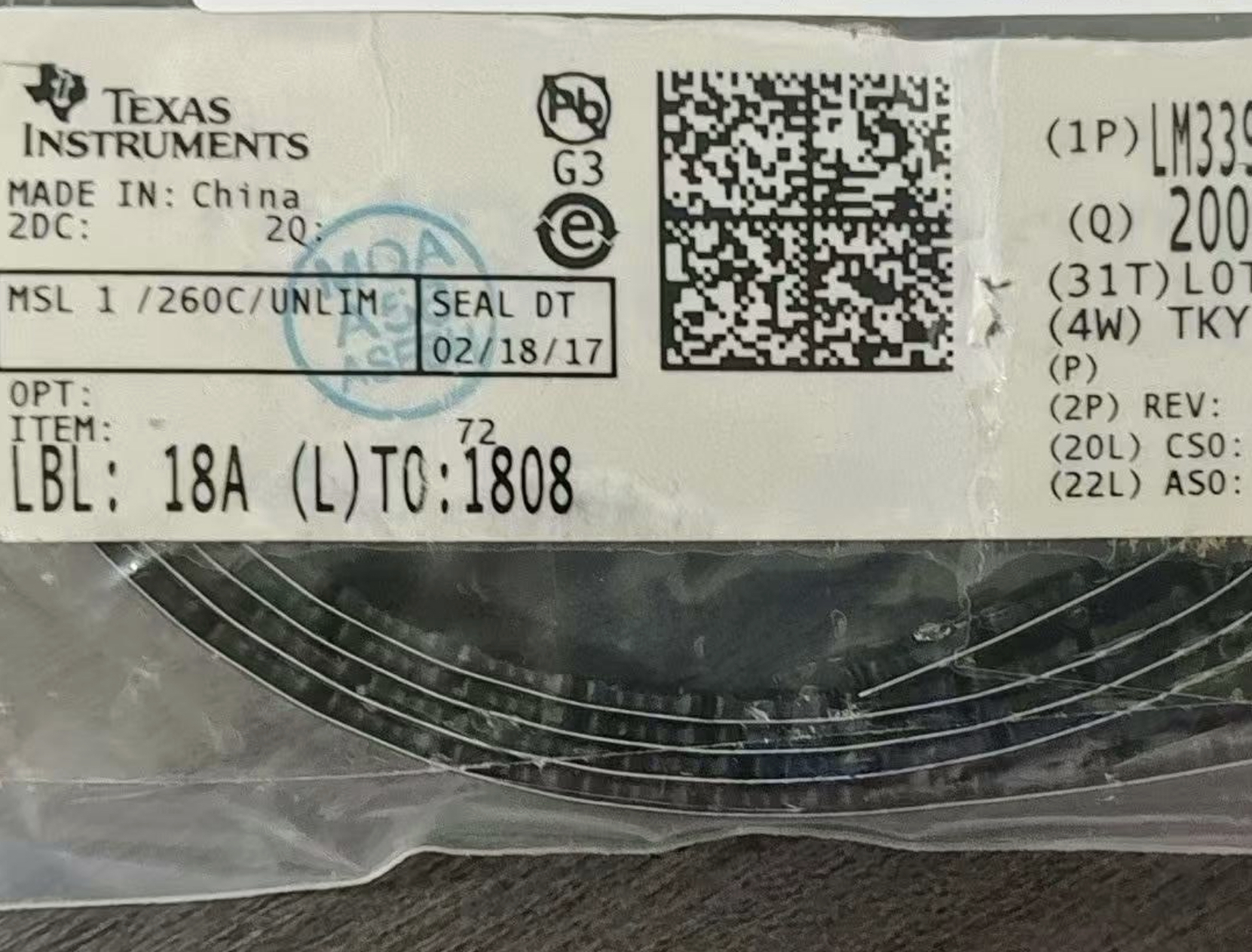
We hold verified, physical stock of the LM339PWRG4, LM339PWRG3, and LM339PWRE4 directly in our climate-controlled facilities. Because we understand the exact differences between these components, our engineering support team can help your QA department approve the swap immediately.
The moment your order is confirmed, your allocation is secured, packed, and shipped. Keep your production lines running smoothly with traceable, authentic inventory.
Don't just take our word for it—see the authentic, unedited photos of our current physical LM339PWR inventory below:
(Note: Please replace the placeholders with the relative paths to your actual warehouse stock photos, saved in the Figure folder)

9. Conclusion
Decoding Texas Instruments' suffix system is an essential skill for modern hardware and procurement professionals. By understanding that the LM339PWRG4 (NiPdAu, Green), LM339PWRG3 (Matte Sn, Green), and LM339PWRE4 (NiPdAu, RoHS) are electrically identical, you unlock massive flexibility in your supply chain.
While SMT line managers must be aware of the lead finish differences between Matte Tin and Nickel Palladium Gold, hardware engineers can confidently specify all three on their Approved Vendor Lists. Proactive dual-qualification is the ultimate defense against allocation shocks.
Need immediate buffer stock of any LM339PWR variant for your upcoming production run? Contact the icallin procurement team today for verified, traceable inventory.
📧 Submit Your RFQ for the LM339PWR Series Now
Related Internal Resources
- Texas Instruments LM339PWRG4 Product Detail
- Texas Instruments LM339PWRG3 Product Detail
- Texas Instruments LM339PWRE4 Product Detail
- ROHM Semiconductor LM339PWR Product Detail
- ROHM Semiconductor LM339DR Product Detail
Author Signature: Charles·Lee is a Senior Hardware Applications Engineer specializing in power management architecture and component cross-referencing. Connect with him on LinkedIn for more insights on supply chain resilience.


Top Recommended part