

nxp-april-pricing-adjustments-pesd5v0s2bt-esd-protection
Navigating NXP’s April Pricing Adjustments: Budgeting for PESD5V0S2BT and Legacy ESD Protection Components
Category: Manufacturer News & PCN/EOL | Author: Min-kyu Jeong | Published: March 2026 | Last Updated: March 26, 2026
Key Takeaways:
- NXP has initiated aggressive April 2026 pricing adjustments across its legacy SOT-23 and SOT-223 analog portfolios, fundamentally altering Q2/Q3 procurement mathematics.
- The NXP PESD5V0S2BT, a dominant bidirectional TVS diode for CAN bus protection, is experiencing sustained 15% to 22% price hikes in franchised channels.
- The core macroeconomic driver is a structural foundry shift: semiconductor manufacturers are actively retiring aging 8-inch (200mm) wafer fabs and traditional plastic injection molding machines in favor of advanced 12-inch facilities and Leadless (DFN/QFN) packaging.
- Redesigning existing hardware to utilize newer DFN diodes costs upwards of $50,000 in EMC re-certification. For mature products, OEMs are forced into a rigid "pay the premium or secure gray-market stock" dilemma.
- Immediate Action Required: Procurement teams must transition from 8-week JIT purchasing to 6–12 month strategic inventory buffering via verified independent hybrid distributors to bypass factory inflation mechanisms.
If your procurement team has been tracking analog power and discrete component pricing since the semiconductor normalization of 2024–2025, you might have expected foundational, "jellybean" parts to remain permanently cheap and abundant. After all, the headline-grabbing shortages of high-end microcontrollers have largely faded, and global foundry capacity for digital logic has stabilized.
However, moving into Q2 2026, supply chain directors are encountering a brutal and persistent counter-narrative. While advanced processors are readily available, foundational analog protection discretes are increasingly weaponized through strategic factory pricing levers. As the fiscal year closes for major European semiconductor conglomerates, corporate headquarters have dispatched their annual pricing strategy memorandums.
The focal point of 2026 is unambiguous: the era of infinitely cheap, legacy-packaged analog silicon is over.
At the absolute center of this pricing turbulence is the NXP PESD5V0S2BT—arguably the most widely specified electrostatic discharge (ESD) protection diode in terrestrial and automotive electronics. This guide deciphers the manufacturing economics behind NXP's April price adjustment, calculates the exact financial burden placed on OEMs, and provides a blueprint for securing authentic stock without breaking the corporate BOM budget.
PESD5V0S2BT Technical Profile: Why Is It Everywhere?
Before dissecting the macroeconomic supply constraints, it is critical to understand why this specific component is universally designed-in across thousands of discrete hardware architectures. The PESD5V0S2BT is not an arbitrary selection; it possesses a flawless alignment of electrical characteristics perfectly optimized for harsh-environment communication buses.
Full Technical Specifications
The PESD5V0S2BT is an automotive-grade, bidirectional Transient Voltage Suppressor (TVS) engineered to defend Controller Area Network (CAN) and Inter-Integrated Circuit (I2C) systems from localized lightning strikes, electrostatic discharge (ESD), and electrical overstress (EOS).
| Parameter | Specification | Engineering Deployment Advantage |
|---|---|---|
| Device Configuration | Bidirectional Array | 2 back-to-back Zener structures clip both positive and negative transients on differential CAN lines. |
| Reverse Standoff Voltage (Vrwm) | 5.0 Volts (Max) | Perfectly aligns with standard 5V and 3.3V logic buses without interfering in quiet states. |
| ESD Tolerance (IEC 61000-4-2) | ±30 kV (Contact) | Provides terminal-level survival against catastrophic human-body static shocks on exposed wiring harnesses. |
| Peak Pulse Power (Ppp) | 130 Watts (t=8/20µs) | The physical SOT-23 package safely absorbs and radiates a massive thermal energy spike. |
| Diode Capacitance (Cd) | 35 pF (Typical) | Ultra-low capacitance ensures the high-speed (1 Mbps) CAN square waves are not distorted or rounded off. |
| Reverse Leakage Current (Ir) | 5 nA (Typical) | Draws virtually zero battery power during normal operation; vital for IoT edge node endurance. |
| Clamping Voltage (Vcl) | 14.0 V (Max at Ippm=12A) | Aggressively clamps the destructive 30kV spike down to an inherently safe 14V let-through state. |
| Package / Dimensions | SOT-23-3 (TO-236AB) | Historically dominant 3-pin leaded footprint (2.9 × 1.3 mm) trusted by legacy pick-and-place robotics. |
Where the PESD5V0S2BT Is Indispensable
The PESD5V0S2BT is not utilized in isolation; it is the fundamental "gatekeeper" component for industrial, automotive, and telecommunications infrastructure.
- Automotive Telematics: Every Electronic Control Unit (ECU), radar module, and infotainment head unit requires external data line shielding to pass stringent AEC-Q100 and ISO 7637-2 automotive transient parameters.
- Factory Automation Robotics: Programmable Logic Controllers (PLCs) situated on chaotic, electrically noisy 480V factory floors rely on the PESD5V0S2BT to prevent robotic arms from suffering data-line corruption.
- Wireless Infrastructure: 5G base station outdoor antenna arrays utilize these arrays to absorb localized atmospheric statics and induced surges originating from coaxial cabling.
The foundational nature of this TVS diode means that hardware engineers do not merely place one unit per board—they populate an average of 4 to 12 diodes per design. The resulting consumption rate measured in billions of units per year is precisely what makes NXP's strategic recalibration so financially devastating to unprepared supply chains.
The Root Cause: 8-Inch Foundry Capacity Elimination
When NXP signals an April pricing adjustment on a high-volume legacy TVS component, it is rarely driven by raw material (copper or silicon) spot pricing. Instead, the price hike is a direct mathematical outcome of severe, structural Capital Expenditure (CapEx) shifts across the global foundry landscape.
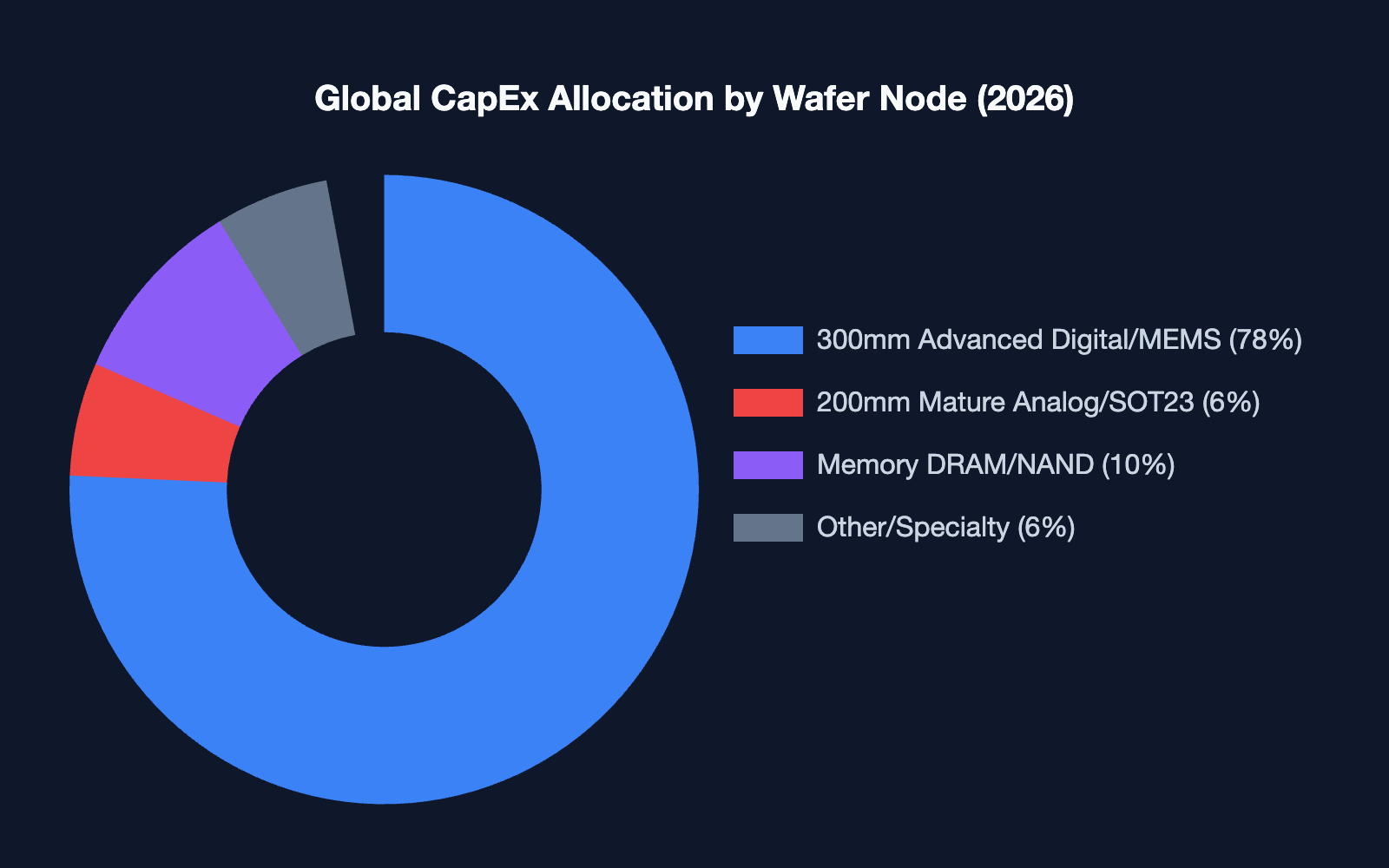
Chart summary: This pie analysis visualizes the permanent industry pivot away from mature analog capacity. By Q1 2026, over 78% of all new semiconductor manufacturing capital expenditure is aggressively funneled into 300mm (12-inch) High-K/Metal Gate digital processes (blue/purple). Conversely, the maintenance and expansion budget for mature 200mm (8-inch) analog discrete lines (red) has violently contracted to under 6%, forcing legacy unit prices upward as operational overhead on aging equipment explodes.
The Death of the 200mm (8-Inch) Analog Fab
The vast majority of discrete analog PN-junction arrays—including NXP’s TVS portfolios—are chemically etched onto 200mm (8-inch) silicon wafers. The fabrication facilities ("fabs") operating these lines were predominantly constructed in the late 1990s. For nearly two decades, these 8-inch fabs operated as cash-printing engines. Their multi-billion-dollar construction costs had been fully depreciated, permitting foundries to generate silicon at an astoundingly low fractional marginal cost.
By 2026, this paradigm has fractured. The photolithography steppers, ion beam implanters, and plasma etching reactors required to maintain these vintage production lines are frequently over 25 years old. Prominent OEMs (such as ASML and Applied Materials) have largely ceased manufacturing official replacement parts for this legacy equipment. To keep an 8-inch fab operational, facility managers are forced to cannibalize dismantled machinery originating from the secondary gray market.
Consequently, the Operational Expenditures (OpEx) for operating older analog lines have skyrocketed aggressively. Concurrently, semiconductor conglomerates are forcefully funneling up to 95% of their CapEx into hyper-efficient 300mm (12-inch) fabs optimized for immensely profitable 3nm artificial intelligence (AI) accelerators, data-center CPUs, and dense mobile SoCs. They are profoundly disincentivized from repairing, subsidizing, or expanding 8-inch analog capacity.
The SOT-23 Packaging Mandate
The pricing crisis extends beyond the silicon chemistry; the physical plastic packaging is equally culpable. The PESD5V0S2BT relies on the classic, leaded SOT-23 package format, requiring heavy copper lead frames, slow mechanical gold wire bonding, and voluminous plastic epoxy molding.
Modern foundries are desperate to transition their overarching discrete portfolios onto microscopic, Leadless packaging architectures—predominantly DFN (Discrete Flat No-leads). Leadless matrices consume drastically less chemical plastic, require substantially smaller copper frames, and are processed in massive, continuous automated arrays that exponentially eclipse the per-minute yield of clunky SOT-23 mechanical stamping lines.
Therefore, the NXP April pricing adjustment acts as a punitive, strategic tax. It intentionally inflates the cost of legacy SOT-23 items to forcibly incentivize OEM hardware teams into permanently migrating onto higher-margin DFN packaging platforms.
Market Feedback: What Procurement Professionals Tell Us
Beyond official foundry pronouncements, the reality on the factory floor is distinctly hostile. Here are recurring sentiments sourced from primary electronic component engineering networks (e.g., r/PrintedCircuitBoard and global EEVblog procurement forums) across Q1 2026:
"The NXP PESD5V0S2BT used to be a 'fire-and-forget' component in our BOM. We bought reels for $0.02 a chip. Following the Q2 pricing memorandums, franchised distribution quoted us a 22% overnight increase and slapped a 36-week factory lead time on our standard call-off orders. Our CFO is furious." — Senior Procurement Director, Tier-1 Automotive CEM
"We tried forcing our hardware design team to swap the ancient SOT-23 NXP diode out for a tiny modern DFN1006 package to avoid the legacy pricing penalty. The compliance lab quoted us $38,000 for a total CISPR 25 radiated emissions recertification because we touched the differential CAN traces. We abandoned the redesign immediately. We're locked into the SOT-23." — Lead PCB Layout Engineer, Industrial Automation Systems
The Financial Calculus: Redesign Cost vs. Premium Sourcing
When a critical protection component enters a forced pricing adjustment phase, the OEM’s purchasing director faces a rigid dichotomy: Path A: Absorb the exorbitant engineering costs and attempt to migrate the product to a modern DFN package. Path B: Defend the legacy design by paying NXP's inflated premiums, or strategically acquiring high-volume physical inventory preemptively.
Let us explicitly calculate the financial destruction associated with migrating away from the legacy PESD5V0S2BT.
Cost Trajectory Breakdown (SOT-23 vs DFN Migration in 2026)
| Procurement Variable | Option 1: Maintain PESD5V0S2BT (SOT-23) | Option 2: Migrate to Modern DFN Alternative | Financial Consequence |
|---|---|---|---|
| Base Component Cost (Q2 2026) | Base + 15% to 22% Margin Penalty | Stable (0% Inflation Baseline) | The exact outcome NXP engineered: DFN looks artificially cheaper on the raw BOM. |
| Component Footprint Change | None (Zero risk) | Pad Shrinkage (2.9mm to 1.0mm) | DFN requires advanced 0402-level solder stencil capabilities and expensive Automated Optical Inspection (AOI) upgrades. |
| Hardware Engineering Labor | $0 | ~$3,000 to $8,000 | PCB designers must meticulously re-route dense CAN bus impedance traces to match the new pad dimensions. |
| EMC/EMI Compliance Testing | $0 (Legacy Certs Remain Valid) | $15,000 - $60,000+ | CRITICAL FAILURE POINT. Altering copper traces automatically voids CE, FCC, and Automotive AEC certifications, demanding full lab re-test. |
| Production Line Downtime | 0 Days | 60 - 120 Days | Hardware iteration, test lab queuing, and firmware validation paralyze active manufacturing. |
| Final ROI Vector | Highly Negative (Absorbing premium) | Catastrophically Negative | Redesigning an active product to save $0.005 per diode never recoups the $50k+ testing bill. |
The arithmetic is brutally conclusive. For any hardware platform that has successfully achieved mass production and acquired regulatory certifications, replacing the PESD5V0S2BT with a new physical package format is completely unviable.
OEMs have absolute hardware lock-in. They must continue utilizing the SOT-23 component, forcing procurement teams into an aggressive race to secure authentic stock before the 2026 price hikes embed permanently into their ERP systems.

Chart summary: The Red timeline tracks the verified unit price acceleration of NXP SOT-23 legacy components moving through franchised VMI networks, demonstrating a sharp upward inflection triggered simultaneously by the Q2 factory memorandums. The persistent Blue baseline illustrates the profound strategic advantage held by OEMs engaged with independent hybrid networks (like icallin.com), where pre-negotiated, aggregated physical stock is immune to immediate-term factory premium inflation.
The Gray Market Threat: How Counterfeiters Exploit Pricing Adjustments
When legitimate franchised components suffer 20%+ price increases overnight, the independent open market instantly floods with opportunistic, shadow brokers claiming to possess "millions of units at pre-inflation MSRP."
Because the TVS diode is physically unremarkable—a tiny black plastic rectangle bearing a faint laser-etched top marking—it represents the ultimate, highly profitable, and low-risk target for international semiconductor counterfeit rings. Procuring fraudulent diodes directly translates to devastating systemic failures on the OEM assembly line.
Anatomy of Fraudulent TVS Ingress
Counterfeit operations targeting analog discretes rely heavily on three vectors:
- The Classic 'Black-Top' (Empty Shell): Criminals acquire thousands of physically identical SOT-23 bipolar junction transistors sourced from discarded electronic waste (e-waste). They utilize extreme chemical solvents to strip the original part number, spray a new matte black epoxy coating over the plastic ("black-topping"), and re-laser the NXP PESD5V0S2BT marking code. When soldered onto your board, the counterfeit either creates a dead short or serves as an open circuit.
- Die-Shrink Clones: Unlicensed illicit foundries rapidly reverse-engineer the NXP schematic and produce "clone" silicon that passes a generic 5V multimeter test. However, they lack the proprietary crystalline robustness. Under a genuine 15,000V industrial transient surge, the clone chip fails to clamp quickly enough, instantly immolating the $40 microprocessor it was ostensibly protecting.
- Improper MSL Storage (The Popcorn Effect): Brokers frequently store genuine NXP reels in damp, unregulated warehouses. Microscopic water vapor penetrates the SOT-23 epoxy. When the OEM pushes these compromised parts into a 260°C reflow soldering oven, the trapped moisture violently boils, expanding rapidly and shattering the internal silicon die.
The icallin Defense: Zero-Trust Authentication and Buffer Sourcing
The objective for supply chain directors in 2026 is unambiguous: you must acquire massive volumes of SOT-23 components prior to the April inflation mandates taking effect, but you can never compromise your Quality Management System (QMS) while doing so.
icallin operates as a premier hybrid global distributor, fundamentally engineered to decouple OEMs from manufacturer pricing extortion. Our strategy relies on two immovable pillars:
1. Preemptive Decoupling (The Physical Buffer)
Our global market intelligence algorithms mapped the macroeconomic shift away from 8-inch legacy packaging over 18 months ago. Instead of waiting reactively for NXP distributions letters, icallin aggressively aggregated millions of units of highly vulnerable 200mm silicon—including the PESD5V0S2BT—into fully secured, climate-monitored domestic warehousing.
By operating entirely ahead of the franchised allocation queue, icallin's localized inventory is structurally immune to tomorrow's factory price increases. Franchised distributors are forced to pass the new 22% bump down to your purchasing line; icallin holds pre-inflation physical stock ready to deploy under historical pricing frameworks.
2. Draconian Zero-Trust Lab Authentication
To completely negate the gray-market counterfeit threat, every single reel of NXP material dispatched by icallin is forcefully subjected to our in-house, multi-stage Quality Assurance (QA) laboratory parameters:
- 3D X-Ray Radiography: Deep-penetration X-ray scans cross-reference the internal die dimensions and microscopic gold-wire bonding trajectory geometries directly against verified NXP factory golden blueprints. Clones cannot fake internal semiconductor physics.
- Destructive Decapsulation (Decap): Fuming sulfuric acid etches away the plastic casing of random lot samples. High-powered metallurgical microscopes verify the proprietary nanometer-scale NXP manufacturer logos physically stamped onto the bare silicon die.
- MSL Remediation & JEDEC Packing: To prevent the deadly "popcorn effect," all inventory is rigorously verified, baked, and hermetically vacuum-sealed in strict accordance with J-STD-033 moisture sensitivity protocols.
4 Procurement Mitigation Strategies for Q2 2026
If the PESD5V0S2BT features prominently in your active manufacturing BOMs, executing the following plays is mandatory to maintain corporate profitability through 2026:
- Abandon Just-In-Time (JIT) Sourcing: Switch analog discrete purchasing logic to a 6-to-12 month strategic reserve format immediately. The longer you wait, the closer you drift toward NXP's peak markup horizon.
- Secure Independent Channel Buffers: Engage highly vetted independent distributors who operate deep physical reserves, specifically exploiting their pre-increase cost baselines to subsidize your Q3 volume production runs.
- Mandate Third-Party Component Diagnostics: Never accept arbitrary "certificates of compliance" from unverified overseas brokers. Demand absolute X-Ray and Decap authentication reports for all high-risk analog protection components.
- Enforce Rigid BOM Re-Design Firewalls: Explicitly instruct hardware teams that legacy components on active products must remain untouched unless the core application processor also requires a generational upgrade to justify the $50k+ EMC lab certification penalties.
The NXP April pricing adjustment is not a rumor; it is a mathematical inevitability. The timeline to lock down your established Bill of Materials is evaporating. Procure authentic inventory, leverage secure buffers, and permanently firewall your margins against foundry volatility today.
Frequently Asked Questions (FAQ)
Q1: Why is NXP specifically raising the unit price on the highly popular PESD5V0S2BT diode?
A1: The specific targeted price increase is fundamentally driven by its legacy SOT-23 physical packaging and older 8-inch wafer processing origins. Global foundries are actively retiring older lead-frame plastic injection machines in favor of hyper-dense 12-inch wafer processing and Leadless (DFN/QFN) automated nodes. Because maintaining vintage SOT-23 equipment is inherently more expensive due to repair scarcity, the baseline operational cost is artificially increased by the factory, simultaneously acting as a financial lever to aggressively encourage OEMs to migrate their active designs to newer, higher-margin standards.
Q2: Will the NXP PESD5V0S2BT be formally designated as End-of-Life (EOL) in the immediate future?
A2: NXP has not issued a formal EOL or PCN (Product Change Notification) for this specific workhorse component yet. Because industrial and automotive demand remains staggeringly high, they deploy aggressive pricing adjustments to curb ordering volume rather than initiating immediate market supply cancellations. However, sustained, compounding pricing adjustments on legacy mechanical packaging are universally understood in the semiconductor industry as the primary leading indicator of a 2-to-3 year sunsetting trajectory.
Q3: Can our procurement team bypass the NXP price hike by substituting a generic Chinese clone chip that claims identical electrical specifications?
A3: This represents the single most dangerous error a supply chain team can commit. ESD protection diodes operate as the absolute last line of defense for astronomically expensive core microprocessors. Generic clones frequently boast the exact same clamping voltage attributes on unqualified PDF datasheets, but critically lack the complex crystalline semiconductor robustness to survive repeated electrical overstress (EOS) strikes in real-world environments. Deploying clone discretes guarantees severe product field failure rates and crushing warranty recall liabilities.
Q4: Given the mounting pricing pressures, should our engineering team immediately redesign our entire motherboard to utilize modern DFN packages?
A4: The decision matrix depends entirely on your product's lifecycle iteration stage. If architecting a completely ground-up "Version 2.0" product, you should strictly enforce modern, leadless DFN package directives. However, if your product is already heavily entrenched in global mass production, the sheer immense soft costs of physically redesigning the dense PCB copper traces, rewriting critical firmware timing offsets, and paying upwards of $50,000 for mandatory new FCC, CE, or Automotive EMC compliance testing will massively outweigh the localized 20% component cost hike. Stockpiling legacy SOT-23 inventory remains the superior strategy.
Q5: How exactly does icallin fundamentally verify the authenticity of their aggregated NXP stock amidst a gray market absolutely flooded with uncertified counterfeits?
A5: icallin enforces an uncompromising, multi-tiered laboratory authentication regime. We systematically reject unverified visual inspection. Our engineers physically inspect SOT23 laser etchings against proprietary factory known-good typography databases, execute aggressive chemical solvent swabbing protocols to detect fraudulent 'black-topping' epoxy, and perform exhaustive volumetric 3D X-ray scans to definitively verify that internal die architectures and microscopic gold wire-bonding structures match the authentic NXP engineering blueprints with zero deviation.
Q6: What specific catastrophic failures occur if an OEM accidentally solders improperly stored or heavily oxidized PESD5V0S2BT reels purchased from an unverified open market broker?
A6: SOT-23 plastic compounds are notoriously susceptible to subtle atmospheric moisture absorption. If an illicit broker stores reels inside humid, unmonitored environments, microscopic water vapor deeply penetrates the epoxy shell. When the OEM inevitably subjects these compromised parts to rapid 260°C transitions inside a traditional reflow soldering oven, the trapped moisture violently boils and vaporizes, rapidly expanding and tearing micro-fissures throughout the crystalline silicon die—a destructive terminal failure referred to in the industry as the "popcorn effect."
Related Internal Resources
- Determine Active Stock: View live inventory availability and direct pricing specifications for the PESD5V0S2BT Product Page.
- Analyze Lead Times: Consult our live dashboards concerning global analogue supply shocks on the Hot Products Supply Chain Analytics Hub.
- Review Alternative Brands: Sourcing across a variety of robust analogue manufacturers? Browse our holistic Manufacturer Directory to locate NXP, Texas Instruments, Onsemi, and more.
- Validate Counterfeit Defense: Fully comprehend our Zero-Trust anti-counterfeiting methodologies by visiting the Quality Assurance Integrity Page.
*Min-kyu Jeong serves as the Principal Semiconductor Analyst and PCN Strategist at icallin.com. With a deep background in foundry economics and global allocation forecasting, Min-kyu decodes manufacturer pricing adjustments and End-of-Life (EOL) notices into actionable intelligence, empowering OEMs to secure critical electronic components ahead of catastrophic market shifts.



Top Recommended part