


X-NUCLEO-SAFEA1B
STMicroelectronics

Yes. X-NUCLEO-OUT16A1 by STMicroelectronics is available for RFQ. Submit your required quantity and our team will confirm real-time stock, lead time, and volume pricing.
Pricing for X-NUCLEO-OUT16A1 can vary by order quantity, market availability, date code, packaging, and delivery destination. Request a quote to receive the latest volume pricing.
X-NUCLEO-OUT16A1 is a STMicroelectronics Software with Core Product: IPS8200HQ and Packing Type: Not Applicable. Review the product details or submit an RFQ if you need confirmation before purchase.
Our sales team usually responds within 24 hours after receiving your RFQ. The quote may include stock status, unit price, lead time, shipping options, and available alternatives.
If stock is confirmed, in-stock parts can usually ship within 1–2 business days. Final lead time depends on quantity, stock source, and delivery destination.
Yes. If X-NUCLEO-OUT16A1 is unavailable, obsolete, or does not meet your required lead time, we can help check similar STMicroelectronics Software parts or compatible alternatives.
Looking for Pricing? Contact us for volume pricing.
IMPORTANT NOTICE
Quotations are subject to stock availability and may vary with market conditions. Prices and lead times are not guaranteed until a purchase order is confirmed. Ensure your contact details are correct to avoid delays in response.
The X-NUCLEO-OUT16A1 industrial digital output expansion board, for STM32Nucleo, provides a powerful and flexible environment for the evaluation of the driving and diagnostic capabilities of the IPS8200HQ octal high-side smart power solid state relay, in a digital output module connected to 0.7 A industrial loads.
The X-NUCLEO-OUT16A1 interfaces with the microcontroller on the STM32 Nucleo via STISO620 and STISO621 and Arduino® R3 connectors. The user can select which driving mode controls the IPS8200HQ: Parallel (SEL2 = L by JP21 = open) or SPI (SEL2 = H by JP21 = closed). In the case of SPI selection, the user can select the communication protocol between 8 bits (SEL1 = L by JP22 = open) or 16 bits (SEL1 = H by JP22 = closed).
The VCC supply pin of the IPS8200HQ is provided by the connector CN1, while the loads (driven by the eight output channels of the IPS8200HQ) can be connected between the connectors CN2, CN3, CN4, CN12, and the pin 2 of the connector CN1.
The on-board digital isolators (STISO620 and STISO621) feature the 2.8k VRMS (4k VPK) galvanic isolation between the two application sides: Logic and process sides.
The logic side is the application side of the MCU and it is supplied by the VISO_L rail (3.3 V or 5.0 V). VISO_L can be supplied by an external power supply connected to CN13 or, alternatively by the pin 4 (SW1 = close 1-2) or pin 5 (SW1 = close 2-3) of CN6.
The process side is the application side of the industrial loads and it is supplied by the VCC and VISO_P rails. The VISO_P (3.3 or 5.0 V) is usually supplied by the VREG rail (JP31 = closed) that can be generated by the step-down embedded in the IPS8200HQ (SW17 = close 1-2, JP20 = closed, JP15 = closed and JP28 = close 2-4 (VREG = 3.3 V) or JP28 = 1-3 (VREG = 5.0 V)). Alternatively, VREG can be provided by an external power supply connected to CN14 (SW17 = close 2-3, JP20 = open, JP15 = open).
In parallel driving mode (active with the default jumper and switch settings) the application board can work even without any Nucleo board: in this case, the user must provide the process side voltage (usually 24 V) by the CN1 and the VISO_L (usually 3.3 V) by the CN13. The INX signals, available on CN5[1, 2, 3], CN8[4] and CN9[3, 5, 7, 8], drive on/off the correspondent OUTX connected to the loads on the process side. The INX pins can be driven low/high swinging between 0V and VISO_L. The activation of each OUTX (OUT1… OUT8) can be monitored by the green LEDs DOX (DO1… DO8).
The activation of the three diagnostic pins (TWARN, PGOOD, FAULT) can be visualized on the correspondent red LEDs (D11, D12, D13, respectively) or monitored by an oscilloscope on TP6, TP7, and TP5.
Note: Although the pins CN8[5], CN5[9], CN5[10] are connected to the nets FAULT_L, PGOOD_L and TWARN_L, these pins cannot correctly report the status of the corresponding signals on the process side (FAULT, PGOOD, and TWARN) due to routing mistake on the same side.
The SPI driving mode can be set by changing the default configuration (JP21 = close; SW4, SW5, SW6, SW7, SW9, SW10, SW11, SW12, SW13, SW14, SW15, and SW20 = close 2-3, SW18 = close 1-2). The SPI-8bits is the default mode (JP22 = open), while the SPI-16bits mode can be activated by JP22 = close.
In SPI driving mode it is also possible to activate the MCU freeze detection feature by setting SW3 = close 2-3.
The expansion board can be connected to either a NUCLEO-F401RE or a NUCLEO-G431RB development board. In this case the companion firmware X-CUBE-IPS detects the selected configuration (GPIO, SPI-8bits, SPI-16bits) by reading the signals SEL2_L and SEL1 from CN8[1] and CN8[6]. The activation of the MCU freeze feature is detected by WDEN(in) on CN9[4].
It is also possible to evaluate a system composed of a X-NUCLEO-OUT16A1 stacked on other expansion boards. In fact, SPI driving mode allows the daisy-chaining communication with another X-NUCLEO-OUT16A1 stacked through the Arduino connectors: the two stacked boards must be configured with SW6, SW18 = close 2-3 on one board, and SW6, SW18 = close 1-2 on the other board.
Fast Dispatch: Ships in 5-7 days(in-stock parts within 1-2 days)
Unishop Global Export: 1-7 days, $40.00
Guaranteed Delivery: Door-to-door in 30 days
Compliant Worldwide Shipping: DHL, FedEx, SF, and UPS.


X-NUCLEO-SAFEA1B
STMicroelectronics
X-NUCLEO-NFC07A1
STMicroelectronics
SATEL-VL53L7CX
STMicroelectronics
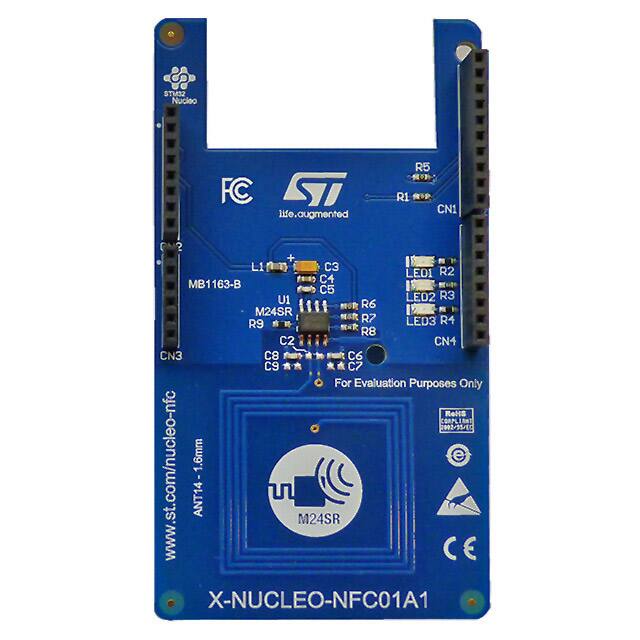
X-NUCLEO-NFC01A1
STMicroelectronics
P-NUCLEO-IOM01M1
STMicroelectronics
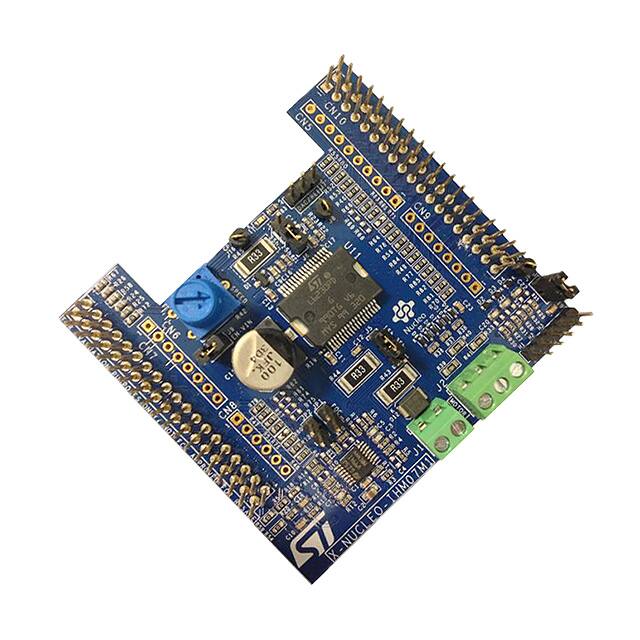
X-NUCLEO-IHM07M1
STMicroelectronics
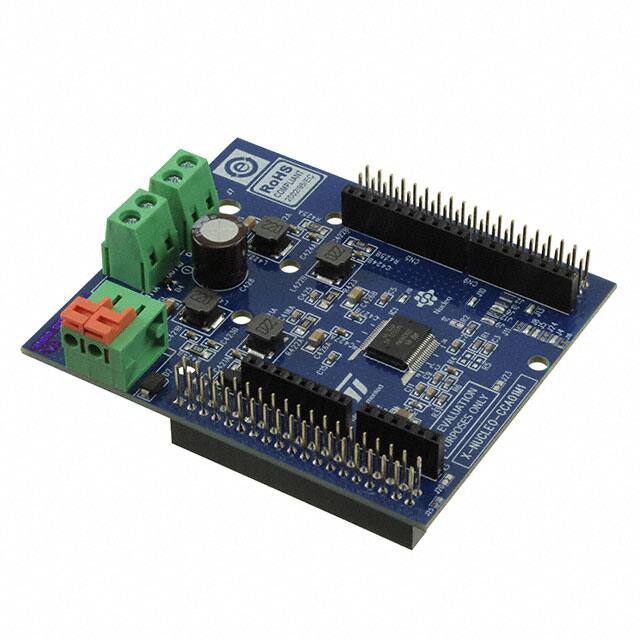
X-NUCLEO-CCA01M1
STMicroelectronics

X-NUCLEO-IDB05A2
STMicroelectronics

X-NUCLEO-NFC12A1
STMicroelectronics
X-NUCLEO-NFC08A1
STMicroelectronics
No recently viewed products
ATSAME70Q21B-CFN
Microchip

MT41K128M16JT-125 IT:KTR
Unknown
BQ27441DRZR-G1A
Texas Instruments

BAV99-7-F
DIODES

MT47H128M16RT-25E IT:C
Micron
PMEG4010CEGW-QJ
NEXPERIA
VN7050AJTR
STMicroelectronics

K4AAG165WA-BCWE
SAMSUNG
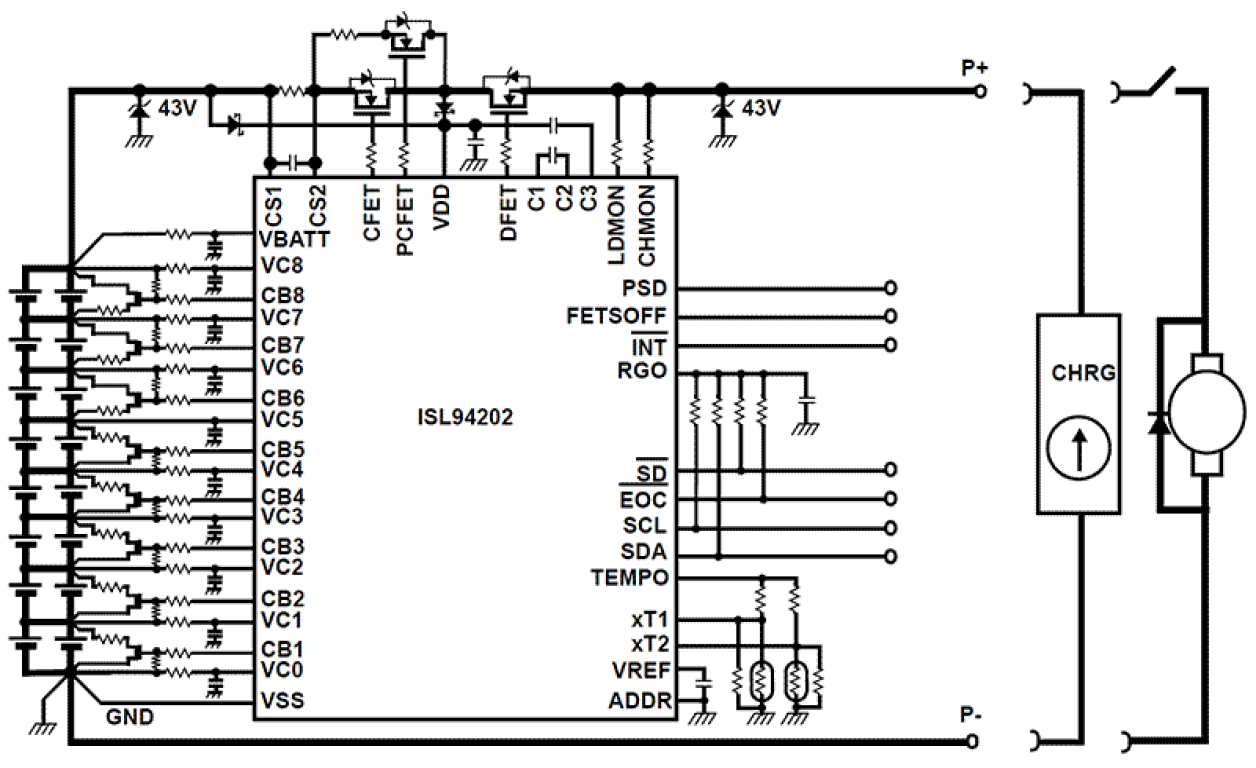
ISL94202IRTZ-T
RENESAS

K4A4G085WF-BCTD
SAMSUNG