Part number
This calculator analyzes the discharge of a capacitor through a fixed-value resistor. By entering the capacitance and the initial and final voltages, it can calculate the discharge time or required resistance, as well as the initial power dissipation in the resistor and the total energy released as the capacitor discharges to zero volts.
Introduction
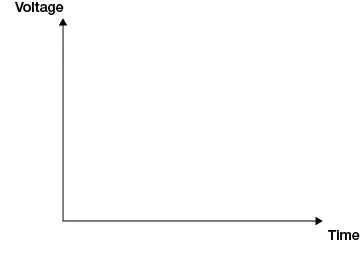
This calculator determines the remaining voltage across a capacitor discharging through a series resistor after a specific period of time. It is based on the fundamental RC circuit discharge formula.
The calculator uses the following exponential decay equation to estimate the voltage:
Where:
To measure the voltage across the capacitor, simply enter the known values for the circuit.
Three key factors influence how quickly the initial voltage drops to zero: Time, Resistance, and Capacitance.
Discharge of a capacitor through a resistor Capacitor discharge (voltage decay): V = Voe-(t/RC) Capacitor discharge (charge decay): Q = Qoe-(t/RC) V = Voe-(t/RC) and also I = Ioe-(t/RC) Q = Qoe-(t/RC) Capacitor charging (potential difference): V = Vo[1-e-(t/RC)]
Another way to discharge a capacitor would be to source an incandescent light bulb that can tolerate the voltage held in the capacitor. Hook this up and once the bulb is no longer lit, the capacitor is discharged. Again, you always want to measure the voltage after it's supposedly discharged just to be safe.
After 5 time constants, the capacitor will discharge to almost 0% of all its voltage. After 5 time constants, for all extensive purposes, the capacitor will be discharged of nearly all its voltage. A capacitor never discharges fully to zero volts, but does get very close.
To discharge a capacitor there must be a circuit, a loop, that passes through both terminals of the capacitor. In regard to the "health" of the capacitor, high discharge currents can damage it or reduce its lifespan, so it is favorable to discharge through a resistor.
A capacitor with capacitance 0.1F in an RC circuit is initially charged up to an initial voltage of Vo = 10V and is then discharged through an R=10Ω resistor as shown. The switch is closed at time t=0. Immediately after the switch is closed, the initial current is Io =Vo /R=10V/10Ω.
It's often safe to discharge a capacitor using a common insulated screwdriver; however, it is usually a good idea to put together a capacitor discharge tool and use that for electronics with larger capacitors such as household appliances.
Discharging means, the capacitor giving up the stored charge in it. Let us assume, the voltage of the capacitor at fully charged condition is V volt. As soon as the capacitor is short circuited, the discharging current of the circuit would be, – V / R ampere.
If a capacitor is discharging, current exits the more positive terminal rather than entering. That's really all there is to it. When current enters the more positive terminal, power is delivered to the capacitor and, thus, the stored energy increases.
A capacitor can be slowly charged to the necessary voltage and then discharged quickly to provide the energy needed. It is even possible to charge several capacitors to a certain voltage and then discharge them in such a way as to get more voltage (but not more energy) out of the system than was put in.
A fully charged capacitor discharges to 63% of its voltage after one time period. After 5 time periods, a capacitor discharges up to near 0% of all the voltage that it once had. Therefore, it is safe to say that the time it takes for a capacitor to discharge is 5 time constants.

ICAllIn’s Resistor Color Code Calculator is an interactive tool for identifying resistor values based on 4-band, 5-band, and 6-band color codes. Simply select the colors, and the calculator will display the resistance in Ohms (Ω), tolerance, and power rating. Whether you are building a circuit, repairing electronics, or sorting resistors in your lab, this calculator provides an accurate and efficient way to decode resistor values.

ICAllIn’s Ohm’s Law Calculator helps engineers and students quickly calculate resistance, current, voltage, and power in an electrical circuit. Simply enter any two known values, and the calculator will instantly compute the remaining parameters. This fast and easy-to-use online tool illustrates the fundamental relationship between voltage, current, and resistance, making it essential for circuit design, troubleshooting, and electronics learning.

The Op Amp Voltage and Gain Calculator is an easy-to-use tool for analyzing operational amplifier circuits. It calculates the output voltage, inverting gain, and non-inverting gain based on the input parameters. Simply enter the values of V1, V2, Vp, Vn, and the resistor values R1, R2, R3, and R4, and the calculator will instantly provide accurate results. This tool is suitable for both professional engineers and beginners learning op amp circuit design.