Part number
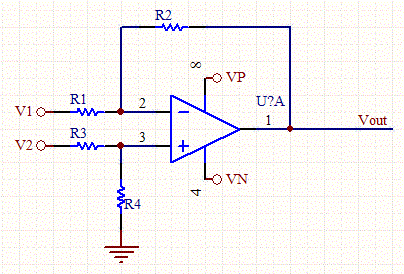
The Op Amp Voltage and Gain Calculator is an easy-to-use tool for analyzing operational amplifier circuits. It calculates the output voltage, inverting gain, and non-inverting gain based on the input parameters. Simply enter the values of V1, V2, Vp, Vn, and the resistor values R1, R2, R3, and R4, and the calculator will instantly provide accurate results. This tool is suitable for both professional engineers and beginners learning op amp circuit design.
Introduction
OP Amplifier calculator is an opamp calculation tool designed by Utmel Electronic, which is one of the best Electronic Components distributors. And with the help of this OP AMP Calculation tool, you can get the amplifier output power and Gain for an operational Amplifier. So OP AMP Calculator is also named OP AMP Gain Calculator (operational amplifier gain calculation tool) or OP AMP Voltage Calculator. And this OP AMP Calculator can work with not only inverting amplifier gain, but also non inverting amplifier gain. If you would like to calculate the values for differential amplifier, please refer to a differential amplifier calculator.
Maybe you have the question about how to calculate gain. The op amp equations are as the following:
And the above operational amplifier formulas are suitable for non inverting and inverting operational amplifier.
The op amp gain equation for an inverting op-amp is:
The gain of the non inverting op-amp can be determined using the Operational Amplifier Formula for amp:
You need to input the resistor values (R1-R4 in kΩ), input voltages (V1 and V2 in volts), and the op-amp's power supply voltages (Vp and Vn in volts). These parameters allow the tool to calculate the output voltage and gains accurately.
This occurs when the calculated Vout exceeds the op-amp's supply voltages (Vp or Vn). Real op-amps cannot output voltages beyond their supply rails, so the signal is clipped at ±Vp/Vn. Ensure your input signals and resistor ratios stay within the supply limits.
Inverting Gain: Gain = -R2/R1 (negative due to signal inversion). Non-Inverting Gain: Gain = 1 + R2/R1. The tool uses these formulas to compute gains based on your resistor values.
No, this tool is designed for basic inverting/non-inverting op-amp circuits. For differential amplifiers (e.g., using R3 and R4), refer to a dedicated differential amplifier calculator, as the formula involves additional resistor ratios.
In a non-inverting configuration, the input signal is applied directly to the op-amp's non-inverting terminal, resulting in a positive gain (1 + R2/R1). For inverting setups, the signal is fed through resistors to the inverting terminal, causing phase inversion and a negative gain (-R2/R1).

ICAllIn’s Resistor Color Code Calculator is an interactive tool for identifying resistor values based on 4-band, 5-band, and 6-band color codes. Simply select the colors, and the calculator will display the resistance in Ohms (Ω), tolerance, and power rating. Whether you are building a circuit, repairing electronics, or sorting resistors in your lab, this calculator provides an accurate and efficient way to decode resistor values.

ICAllIn’s Ohm’s Law Calculator helps engineers and students quickly calculate resistance, current, voltage, and power in an electrical circuit. Simply enter any two known values, and the calculator will instantly compute the remaining parameters. This fast and easy-to-use online tool illustrates the fundamental relationship between voltage, current, and resistance, making it essential for circuit design, troubleshooting, and electronics learning.

The Inverting Op Amp Resistor Calculator is a practical tool for analyzing operational amplifier inverting circuits. By entering parameters such as the desired gain, output voltage (Vout), R1 resistance, and the input voltages V1, V2, Vp, and Vn, the calculator automatically determines the required resistor values (R2, R3, and R4). Simply input the values and click “Calculate” to quickly design and verify inverting op amp configurations.