RFQ List


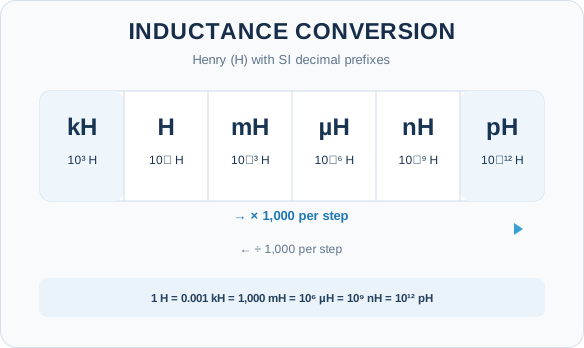
The Inductance Conversion Tool converts inductance values across different unit scales, from picohenries (pH) to kilohenries (kH) and all units in between. Simply enter a value into any unit field, and the equivalent inductance values will be displayed instantly in all other units.
Introduction
Inductance is the tendency of an electrical conductor to oppose a change in the electric current flowing through it. It does this by creating a voltage (electromotive force) across the conductor.
The concept was coined by Oliver Heaviside in February 1886. The SI unit for inductance is the Henry (H), named after Joseph Henry.
The relationship between induced voltage and current change is defined by the following formula:
Where:
While the Henry (H) is the standard unit, it is quite large for most electronics. We typically use prefixes to measure smaller values:
Below is a quick reference for converting between the most common inductance values.
| Unit | Value in Henry (H) | Conversion Example |
|---|---|---|
| Picohenry (pH) | H | 1,000 pH = 1 nH |
| Nanohenry (nH) | H | 1,000 nH = 1 H |
A complete list of inductance units used in various scientific fields.
| Unit Name | Symbol | Unit Name | Symbol |
|---|---|---|---|
| Henry | H | Exahenry | EH |
| Millihenry | mH | Petahenry | PH |
| Microhenry | H | Terahenry | TH |
| Nanohenry | nH | Gigahenry | GH |
| Picohenry | pH | Megahenry | MH |
| Femtohenry | fH | Kilohenry | kH |
| Attohenry | aH | Hectohenry | hH |
| Weber per Ampere | Wb/A | Dekahenry | daH |
| Abhenry | abH | Decihenry | dH |
| Stathenry | stH | Centihenry | cH |
| Microhenry (H) | H | 1,000 H = 1 mH |
| Millihenry (mH) | H | 1,000 mH = 1 H |
Henry, unit of either self-inductance or mutual inductance, abbreviated H, and named for the American physicist Joseph Henry. One henry is the value of self-inductance in a closed circuit or coil in which one volt is produced by a variation of the inducing current of one ampere per second.
Inductance is frequently expressed as micro-Henries, which represents 1,000,000 Henries. To convert to Henries, you would divide the number of micro-Henries by 1,000,000. Calculate reactance, in ohms, by using the formula: Reactance = 2 * pi * Frequency * Inductance. Pi is simply a constant, measured as 3.14.
The henry (symbolized H) is the Standard International ( SI ) unit of inductance. In audio-frequency ( AF ) and radio-frequency ( RF ) applications, units of millihenrys (mH), where 1 mH = 10 -3 H, and microhenrys (µH), where 1 µH = 10 -6 H, are common.
The formula is: The micro henrys of inductance in a coil = (N^2)(D^2)/(18D + 40L) where "N" equals the number of rings in the coil, "D" equals the diameter of the coil and "L" equals the length of the coil.
Inductance is measured in units called henrys. The definition of one henry is simple: One henry is the amount of inductance necessary to induce one volt when the current in coil changes at a rate of one ampere per second.
The unit of a inductance is a 1H - henry. So, to get Ohms divide by one second. That's only after you divide the applied voltage by the measured inductor current for a period of one second.
Henry Henry (symbol H) is the SI derived unit of self-inductance.
Inductance. An inductor is a passive electronic component that stores energy in the form of a magnetic field. The standard unit of inductance is the henry abbreviated H. This is a large unit and more commonly used units are the microhenry abbreviated μH (1 μH =10-6H) and the millihenry abbreviated mH (1 mH =10-3 H).
The unit of inductance in the SI system is the henry (H), named after American scientist Joseph Henry, which is the amount of inductance which generates a voltage of one volt when the current is changing at a rate of one ampere per second.
XL = inductive reactance on ohms, Ω π = Greek letter Pi, 3.142. f = frequency in Hz. L = inductance in henries.

ICAllIn’s Resistor Color Code Calculator is an interactive tool for identifying resistor values based on 4-band, 5-band, and 6-band color codes. Simply select the colors, and the calculator will display the resistance in Ohms (Ω), tolerance, and power rating. Whether you are building a circuit, repairing electronics, or sorting resistors in your lab, this calculator provides an accurate and efficient way to decode resistor values.

ICAllIn’s Ohm’s Law Calculator helps engineers and students quickly calculate resistance, current, voltage, and power in an electrical circuit. Simply enter any two known values, and the calculator will instantly compute the remaining parameters. This fast and easy-to-use online tool illustrates the fundamental relationship between voltage, current, and resistance, making it essential for circuit design, troubleshooting, and electronics learning.

The Op Amp Voltage and Gain Calculator is an easy-to-use tool for analyzing operational amplifier circuits. It calculates the output voltage, inverting gain, and non-inverting gain based on the input parameters. Simply enter the values of V1, V2, Vp, Vn, and the resistor values R1, R2, R3, and R4, and the calculator will instantly provide accurate results. This tool is suitable for both professional engineers and beginners learning op amp circuit design.