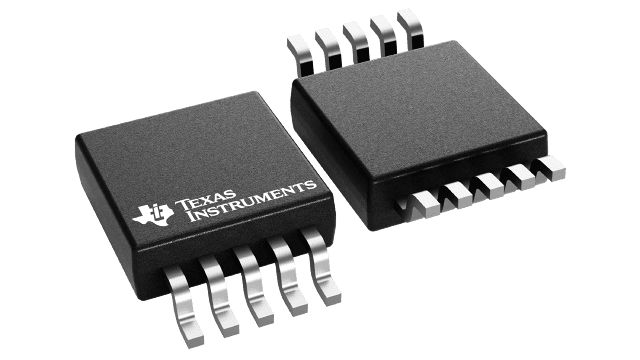


Secure Your Micron Storage: MT53D512M16D1DS LPDDR4X In-Stock
Secure Your Micron Storage: MT53D512M16D1DS LPDDR4X In-Stock Amid Rising RAM Prices
Category: Market Trends & Lead Times | Author: Charles·Lee | Published: April 2026 | Last Updated: April 08, 2026
Key Takeaways:
- Immediate Procurement Strategy: Secure immediate, factory-verified stock of the MT53D512M16D1DS-046 WT:D to circumvent the impending Q2 2026 spot market constraints and defend your 2026 Bill of Materials (BOM).
- Market Intelligence: Understand the driving forces behind the RAM price increase Q2, heavily influenced by the global reallocation of foundry assets toward High Bandwidth Memory (HBM) and the resulting DRAM shortage 2026.
- Datasheet Deep Dive: Explore the full MT53D512M16D1DS datasheet, uncovering the technical superiority of its 8Gb density, x16 organization, and Die Revision D maturity.
- Architectural Flexibility: A comprehensive analysis of LPDDR4 vs LPDDR4X environments, detailing how the 0.6V VDDQ rail translates to massive thermal and power savings.
- Performance Metrics: An engineering breakdown of the LPDDR4-4266 speed grade, emphasizing PCB routing, Signal Integrity (SI), and Power Integrity (PI) requirements.
- Automotive Grade Resilience: Unpacking why the 8Gb LPDDR4 automotive standard (-40°C to 120°C wide temperature) is critical for ADAS and industrial computing, addressing the broader automotive grade DRAM supply deficit.
1. Introduction: The Critical Need for Proactive Memory Procurement
The semiconductor landscape in 2026 has fundamentally shifted. Gone are the days of predictable, steady-state commodity memory purchasing. Today, securing high-performance, automotive-grade volatile memory requires a strategic, forward-looking posture. Procurement directors and hardware engineering leads are facing a "perfect storm" of overlapping geopolitical constraints, monumental technological shifts, and severe factory reallocation.
At the center of this storm is the Low Power Double Data Rate 4 (LPDDR4 and LPDDR4X) standard. While consumer electronics media obsess over LPDDR5X and LPDDR6 for flagship smartphones, the vast majority of industrial, embedded, telecommunications, and automotive infrastructure relies almost exclusively on the mature, highly reliable, and highly characterized LPDDR4 standard. When you are designing a robust Edge AI camera capable of enduring frozen tundras and desert heat, or an autonomous driving control unit that cannot endure a single bit-flip error, you do not gamble on unproven silicon. You rely on components like the Micron MT53D512M16D1DS.
However, relying on this component is only feasible if you can physically acquire it. Finding reliable Micron LPDDR4 in stock has become the defining challenge of Q2 2026. This comprehensive whitepaper serves a dual purpose: First, to functionally decode the MT53D512M16D1DS datasheet to demonstrate its profound engineering value; and second, to dissect the exact macroeconomic trends driving the LPDDR4X SDRAM price upwards, providing you with the necessary intelligence to secure your Micron 8Gb SDRAM availability today.
2. 2026 Global Semiconductor Supply Chain Analysis: The Roots of the DRAM Shortage 2026
To understand the intense pricing pressure currently squeezing the spot market, we must analyze wafer allocation at the most fundamental foundry level. The DRAM shortage 2026 is not a result of a sudden spike in legacy consumer electronics sales; it is a structural shortage born from the AI revolution.
The High Bandwidth Memory (HBM) Squeeze
Over the past 18 months, the deployment of massive generative AI training clusters and hyper-scale inference data centers has triggered an unprecedented demand for High Bandwidth Memory (primarily HBM3 and HBM3E). HBM requires immensely complex silicon fabrication, specifically the use of TSV (Through-Silicon Via) packaging to stack memory dies directly on top of logic bases.
The major memory manufacturers (Samsung, SK Hynix, and Micron) possess finite wafer starts per month (WSPM). Because HBM commands astronomical profit margins compared to standard mobile or PC DRAM, fabricators have systematically decommissioned or retooled traditional DDR4 and LPDDR4 production lines to serve the AI server market. The opportunity cost of printing an LPDDR4 wafer instead of an HBM wafer is simply too high for foundries to ignore.
The Resulting Deficit in Mobile and Embedded RAM
Consequently, the baseline output for standard LPDDR4 silicone has plummeted by an estimated 25% year-over-year. As legacy production lines are idled or converted, the global pool of physical inventory shrinks. Concurrently, the proliferation of Edge AI concepts—where computation happens locally on the sensor node rather than in the cloud—has driven up the base memory requirement for standard industrial hardware. A smart security camera that utilized a 4Gb IC in 2023 now requires an 8Gb IC in 2026 to run advanced object recognition models.
This collision of artificially constrained supply and organically expanding demand has crystallized into the severe DRAM shortage 2026, disproportionately affecting companies building medical equipment, robotics, and industrial gateways.
3. The Mechanics of the RAM Price Increase Q2: Why LPDDR4X SDRAM Price is Surging
The spot market operates strictly on the laws of supply and demand, reacting much faster than long-term contract pricing (MSRP). We are currently witnessing a classic demand-pull inflation scenario manifesting continuously week-over-week.
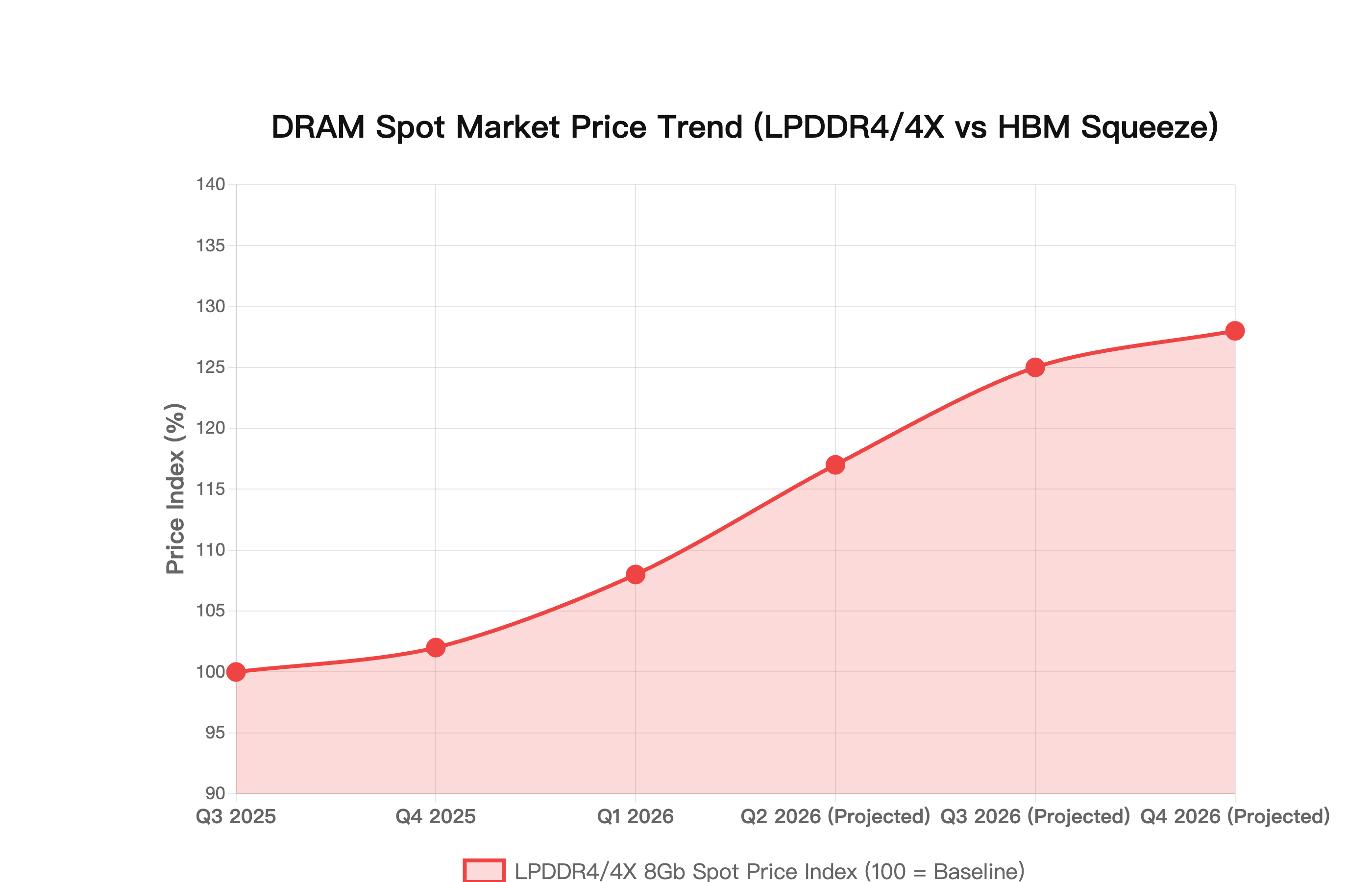
Figure 2: LPDDR4 Price Trend projection showing the steady climb from Q4 2025 into the predicted shortage window of Q2-Q3 2026. | Source: Market Intelligence Analytics | Chart: icallin.com
Analyzing the LPDDR4X SDRAM Price Trajectory
As visualized in the data plot above, the RAM price increase Q2 is not a speculative anomalous spike, but rather a sustained, systemic floor elevation. Contract manufacturers (CMs) and Electronics Manufacturing Services (EMS) who previously relied on Just-In-Time (JIT) manufacturing inventories are suddenly finding their localized broker channels empty.
When an automotive Tier 1 supplier realizes they are 10,000 components short of their Q3 production allocation, they enter the open spot market. This frantic competitive purchasing drives the LPDDR4X SDRAM price exponentially higher. Distributors who hold verified, factory-sealed stock command massive premiums simply because holding tangible supply equates to guaranteeing a factory's continued operation.
The Cost of Inaction
For procurement officers, the math is brutal. Deferring the purchase of memory components in the hopes that pricing will "cool down" or "normalize" by Q4 is a fundamentally flawed strategy based on outdated cyclical models. The foundry reallocation toward HBM is permanent. Therefore, locking in your Bill of Materials (BOM) cost by acquiring Micron LPDDR4 in stock today is the only verified method to insulate your product margin against the impending 20-30% unit cost premium anticipated by the end of Q3. Action now is a direct financial defense.
4. Comprehensive MT53D512M16D1DS Datasheet Review & Specifications
Before committing to a multi-reel procurement strategy, engineering teams must rigorously validate the silicon against their system architecture. The MT53D512M16D1DS datasheet reveals an incredibly robust, thoughtfully engineered Memory IC designed precisely for the rigors of modern embedded systems.
Let us systematically decode the MT53D512M16D1DS part number and examine its foundational parameters.
| Architectural Parameter | Datasheet Specification | Systems Engineering Context |
|---|---|---|
| Manufacturer | Micron Technology | Tier-1 memory fabricator known for exception die yield and rigorous automotive qualification testing. |
| Logic Core Family (MT53) | LPDDR4 / LPDDR4X | Built upon the Low Power Double Data Rate 4 standard, featuring point-to-point topologies and command/address bus optimization. |
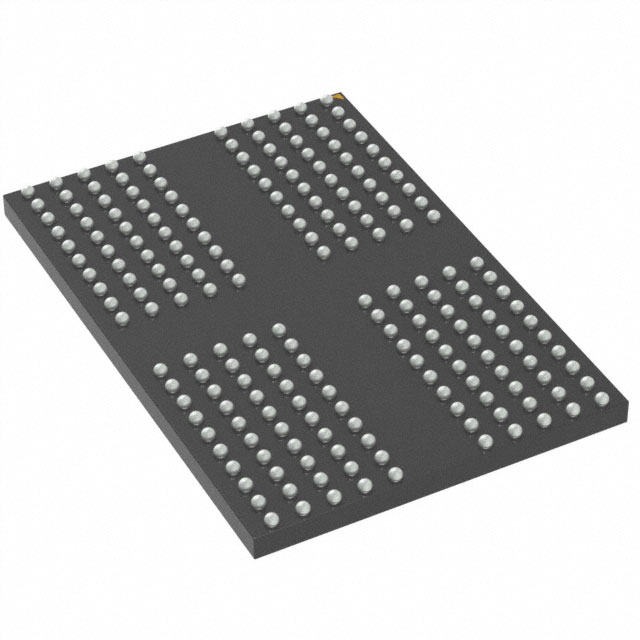
| Total Die Density | 8 Gigabits (8Gb) | Equates to 1 Gigabyte (1GB) of physical memory per package. This is the optimal "sweet spot" block size for scalable memory arrays. |
| Data Bus Width | x16 (512M rows x 16 columns) | A single 16-bit wide I/O channel. This configuration drastically minimizes the physical BGA footprint and eases PCB routing congestion compared to wider x32 single-die packages. |
| Package Structure | D1 (Single Die Base) | Features a minimal Z-height, crucial for ultra-thin wearables, sealed sensors, and dense multi-layer PCB stacks. |
| Speed/Frequency Grade (-046) | LPDDR4-4266 MT/s | Capable of operating at a clock frequency of 2133 MHz, providing peak theoretical bandwidth of 34 GB/s on a 64-bit wide system bus configuration. |
| Silicon Revision (:D) | Die Revision D (Z11M) | Micron's most advanced and highly characterized silicon tape-out for this specific density node. It offers superior ODT (On-Die Termination) accuracy and tighter timing margins. |
The Power of the x16 Architecture
While many consumer smartphones utilize x32 or x64 configurations (often achieved by stacking multiple dies inside a single massive Package-on-Package or PoP structure), the discrete x16 architecture of the MT53D512M16D1DS is highly prized in industrial designs.
Microcontrollers (MCUs) and System-on-Chips (SoCs) from manufacturers like NXP, Texas Instruments, and STMicroelectronics frequently feature dual-channel 16-bit memory controllers or a single 32-bit controller. Utilizing two discrete 8Gb x16 chips (combining traces to form a 32-bit bus) allows PCB layout engineers to perfectly balance trace lengths, distribute thermal dissipation across two localized zones on the board, and achieve 2GB of total system memory without resorting to complex, high-layer-count blind/buried via PCB manufacturing processes. This dramatically reduces the cost of the bare FR4 printed circuit board.
5. Deep Architectural Comparison: LPDDR4 vs LPDDR4X in Modern SoCs
To truly leverage the capabilities outlined in the MT53D512M16D1DS datasheet, an engineer must understand its dual-mode nature. The "D" in the prefix signifies that this exact die is fully compatible with both the standard LPDDR4 architecture and the power-optimized LPDDR4X derivative.
When evaluating LPDDR4 vs LPDDR4X, the defining differential resides not within the memory array itself, but within the boundary scan buffers and the physical I/O (Input/Output) driving circuitry.
The Physics of Voltage Scaling
In any high-speed digital CMOS logic circuit, dynamic power dissipation is governed by the equation $P = C_{load} \times V^{2} \times f_{switching}$, where C is the parasitic capacitance of the copper trace, V is the voltage swing, and f is the clock frequency. As engineers pushed standard LPDDR4 toward the 4266 MT/s boundary, the power required to drive the data (DQ) and data strobe (DQS) lines at 1.1 Volts became a severe thermal liability.
The JEDEC LPDDR4X standard was formulated directly to combat this. It completely decouples the internal read/write core logic voltages (VDD1 and VDD2, which remain at 1.8V and 1.1V respectively) from the external signaling bus voltage (VDDQ).
| Power Domain Network | LPDDR4 Mode Value | LPDDR4X Mode Value | Primary Function within the IC |
|---|---|---|---|
| VDD1 | 1.8V (Typ) | 1.8V (Typ) | Powers the internal Word Line (WL) charge pumps and high-voltage row decoders necessary to physically access the storage capacitors. |
| VDD2 | 1.1V (Typ) | 1.1V (Typ) | Powers the intermediate logic, sense amplifiers, prefetch buffers, and column decoders. |
| VDDQ (I/O Rail) | 1.1V (Typ) | 0.6V (Typ) | Powers the external output drivers and input receivers interfacing directly with the PCB traces. |

Why the 0.6V Transition Matters
By transitioning the VDDQ rail from 1.1V down to an ultra-low 0.6V, the dynamic switching power consumed by the physical data bus is slashed by approximately 45% to 50%. Because voltage is squared in the power equation, a roughly 45% reduction in voltage (1.1 to 0.6) yields massive exponential gains in power efficiency.
This provides two monumental benefits:
- Extended Battery Life: In untethered systems (drones, AGVs, portable medical scanners), shifting to the LPDDR4X mode allows for substantially longer operational intervals without increasing the Li-Ion battery payload.
- Thermal Decoupling: In densely packed enclosures lacking active fan cooling, reducing the localized heat generation at the memory BGA drastically lowers the ambient internal temperature, preventing the neighboring main CPU from initiating thermal throttling protocols.
The beauty of the Micron MT53D512M16D1DS is its hardware agnosticism. It can be dropped into an older, legacy LPDDR4 (1.1V only) board design as an immediate replacement, while simultaneously serving as the foundation for a next-generation LPDDR4X (0.6V) layout. This single-SKU versatility deeply justifies current LPDDR4X SDRAM price investments.
6. Achieving the LPDDR4-4266 Speed Grade: Signal Integrity and PCB Layout
Memory size is irrelevant if the data cannot reach the processor in time. The LPDDR4-4266 speed grade represents an astronomical data throughput requirement. Operating at 4266 Megatransfers per second means that an individual data bit is valid on the transmission line for a mere 234 picoseconds (ps).
Achieving this reliable data eye demands meticulous attention to Signal Integrity (SI), Power Integrity (PI), and intricate PCB layout modeling.
Coping with Picosecond Transients
When dealing with the LPDDR4-4266 speed grade, digital signals cease to behave as simple binary states and instead act as complex high-frequency analog RF waves. The Micron MT53D512M16D1DS relies on specific, built-in silicone capabilities to manage these extremes:
- Advanced On-Die Termination (ODT): Reflection is the enemy of signal integrity. If the characteristic impedance ($Z_0$) of the PCB trace does not perfectly match the receiver's input impedance, the signal will bounce back, colliding with the next incoming bit resulting in destructive Inter-Symbol Interference (ISI). The MT53D512M16D1DS provides highly granular, software-configurable ODT values (e.g., Target 240Ω, 120Ω, 80Ω, 60Ω, 48Ω, 40Ω). This allows the master Memory Controller to dynamically calibrate and terminate the bus during the training sequence (specifically the Write Leveling and DBG training routines) to achieve a phenomenally clean signal eye.
- Programmable Drive Strength: Similarly, the output drivers can be scaled to exactly match the electrical length and capacitive load of the PCB trace, preventing overshoot (which stresses gate oxides) and undershoot.
- Internal VREF Training: The chip internally generates its own highly stable Voltage Reference (VREF) for the data receivers, which is trained and locked individually per byte lane ($VREF_{DQ}$) to account for microscopic voltage drops across the die itself.
The Necessity of verified IBIS Models
Because the margins at 4266 MT/s are impossibly tight, engineers must simulate their PCB routing before ordering expensive multi-layer Teflon or Megtron-6 FR4 fabricated boards. Micron's Die Revision D has been exhaustively characterized. By utilizing the official IBIS (Input/Output Buffer Information Specification) models associated with the MT53D512M16D1DS, hardware engineers can accurately simulate cross-talk, ground bounce, and slew rate degradation in EDA tools like Altium Designer or Cadence Allegro, ensuring a "first-pass success" tape-out.
7. Unpacking Automotive Grade DRAM Supply: The Challenges of 120°C Thermal Envelopes
The consumer electronics industry operates on a fundamentally different reliability paradigm than the industrial and automotive sectors. A consumer smartphone freezing in the desert sun is an annoyance; an Autonomous Driving sensor fusion unit crashing at 120mph due to a memory bit-flip is catastrophic.
This brings us to the core value proposition of the 8Gb LPDDR4 automotive specification, specifically the "WT" (Wide Temperature) designation found on the MT53D512M16D1DS-046 WT:D.
The Hostility of the Automotive Environment
Modern vehicles are effectively rolling data centers. The proliferation of ADAS (Advanced Driver Assistance Systems), 360-degree high-definition surround-view cameras, LiDAR processors, and intelligent infotainment cockpits places immensely powerful SoCs into some of the most hostile thermal environments on Earth. Electronic Control Units (ECUs) mounted under the hood or housed within totally sealed, IP67-rated waterproof enclosures passively absorb radiant engine heat and direct solar loads.
It is common for the ambient temperature inside these dark metal enclosures to exceed 95°C. Because the Memory IC is usually mounted within millimeters of the primary high-TDP processor, the localized die case temperature ($T_c$) readily spikes to 110°C or higher.
Silicon Degradation and the 120°C Lifeline
Standard commercial grade DRAM ($0°C$ to $+85°C$) breaks down rapidly under these conditions. The fundamental mechanism of DRAM relies on microscopic capacitors holding an electrical charge (representing a logical '1'). As temperature increases exponentially, the reverse-bias leakage current of the silicon junction causes these capacitors to drain their charge aggressively.
If a commercial chip is forced to operate at 105°C, it will leak charge faster than the memory controller's standard refresh cycle (usually 64ms or 32ms) can replenish it. This results in massive, uncorrectable data corruption.
The Micron automotive memory architecture of the MT53D512M16D1DS is specifically fabricated and doped to resist this harsh leakage. Moreover, it is officially characterized to operate flawlessly up to an astonishing +120°C case temperature, provided the host Memory Controller engages highly accelerated refresh rates (typically 4x the standard $t_{REFI}$ rate).
Securing reliable automotive grade DRAM supply is notoriously difficult because these chips undergo significantly longer and more punishing burn-in testing at the factory, resulting in lower yields and fewer chips passing the automotive binning process. The MT53D512M16D1DS-046 WT:D is a rare, highly coveted asset precisely because it possesses this verified 120°C thermal headroom.
8. Micron Automotive Memory Certification: RoHS, REACH, and Quality Standards
When engineering for medical devices, automated robotics, or automotive Tier 1 applications, electrical performance is only half the battle. Hardware must pass exhaustive environmental and regulatory compliance audits. A single uncertified component can prevent an entire assembled product from passing CE, FCC, or international customs clearance.
The Micron automotive memory in our inventory is backed by complete, unassailable, and up-to-date documentation.
Rigorous Environmental Documentation
- RoHS 3 Compliance (EU Directives 2011/65/EU & 2015/863/EU): A comprehensive guarantee that the IC packaging, the BGA solder balls, and the internal die attach materials are completely devoid of restricted heavy metals (such as Lead, Mercury, Cadmium, and Hexavalent Chromium) as well as tightly regulated plasticizer phthalates (DEHP, BBP, DBP, DIBP).
- ECHA REACH SVHC Validation: Our inventory carries statements demonstrating full compliance with the European Chemicals Agency (ECHA) standards. This specifically includes clearance against the extensive November 2025 Substance of Very High Concern (SVHC) candidate list, which encompasses 251 strictly monitored chemical agents. This paperwork provides a transparent, legally defensible chain of custody.
- JEDEC and AEC-Q100 Frameworks: While specific AEC-Q100 granular certifications depend on the exact lot and final automotive assembly testing procedure, the WT temperature grade and Micron's inherent zero-defect methodology align perfectly with the rigorous Failure Mode and Effects Analysis (FMEA) required for ISO 26262 functional safety designs.
By sourcing your memory through validated channels like icallin.com, you isolate your company from the massive legal and financial liabilities associated with non-compliant grey-market components.
9. Real-World Applications for 8Gb LPDDR4 Automotive Memory
The parametric superiority of the MT53D512M16D1DS dictates its usage in absolute cutting-edge, mission-critical hardware architectures. It serves as the foundational data buffer in several defining industries:
- Autonomous Navigation & ADAS Sensor Fusion: When a vehicle's neural network ingests simultaneous 4K video feeds to detect pedestrians, it requires massive bandwidth to buffer frames and execute convolutional matrix math. The 8Gb density provides the frame buffer depth, while the 4266 MT/s bandwidth and 120°C rating ensure uninterrupted processing.
- Medical Diagnostic Imaging: Portable, battery-powered ultrasound machines and MRI logic controllers require extremely low noise floors and high bandwidth. The LPDDR4X (0.6V) mode provides huge power savings, extending clinical scan times without needing heavy, cumbersome battery packs.
- Industrial IoT Gateway Routers: Utilizing processors like the NXP Layerscape series, factory floor routers processing thousands of MQTT telemetry messages per second rely on resilient memory that will not degrade over a 15-year unmaintained life cycle in a harsh, vibrating, non-air-conditioned environment.
- High-End Robotics and Drones: Agricultural and inspection drones operate in brutal ambient heat. The low mass of the single-die BGA package resists high-G vibration damage, while the wide temperature rating guarantees flight controller stability.
10. Micron 8Gb SDRAM Availability: The icallin.com Spot Market Advantage
The reality of the 2026 electronics manufacturing sector is harsh: lead times for tier-1 automotive memory have stretched past 26 weeks globally. Official franchised distributors are completely allocated, prioritizing their multi-billion dollar mega-tier clients.
This paradigm emphasizes the critical nature of verified Micron 8Gb SDRAM availability on the spot market.
At icallin.com, we serve as your strategic hardware procurement partner. Our deep ecosystem monitoring and historical supply chain relationships allowed us to secure substantial volumes of the MT53D512M16D1DS-046 WT:D prior to the Q2 2026 price surge.
We do not engage in speculative brokering of phantom inventory. What we advertise is what is physically sitting in our environmentally controlled, ESD-safe warehouses, ready for immediate dispatch. By utilizing our stock, you bypass the catastrophic manufacturing delays currently plaguing the industry, defend your BOM pricing, and guarantee the delivery of your final assembled units to your customers.
11. Frequently Asked Questions (Expanded Technical FAQ)
Q1: Can I safely substitute the MT53D512M16D1DS into an existing design that currently utilizes a standard 1.1V LPDDR4 memory chip?
Absolutely. This is heavily engineered as a dual-mode chip. While it possesses the advanced hardware to drop its VDDQ to 0.6V for LPDDR4X operation, it natively and flawlessly operates at the traditional 1.1V VDDQ. It is fully backwards compatible with older PMIC configurations and requires no logic board redesign to function in legacy sockets.
Q2: What exact performance bottlenecks does the LPDDR4-4266 speed grade solve compared to slower 3200 MT/s variants?
The transition from 3200 MT/s to 4266 MT/s provides a roughly 33% raw bandwidth expansion. In architectures reliant upon unified memory—where a multi-core CPU and an integrated GPU share the same physical memory space—the GPU acts as a bandwidth "vampire." Increasing speed to 4266 MT/s ensures the CPU does not starve for data while the GPU is concurrently rendering complex UI graphics or calculating physics models.
Q3: How do I verify the authenticity of the "WT" (Wide Temperature) 120°C rating?
The "WT" indicator is permanently laser-etched into the epoxy molding compound of the physical BGA package and is inextricably linked to the manufacturer's silicon lot tracking code. Furthermore, Micron's datasheets unequivocally specify the parametric behaviors, retention limits, and required refresh rate compensations for operations extending from 85°C up through the 120°C boundary.
Q4: If the MT53D512M16D1DS operates at a blistering 4266 MT/s, what specific impedance matching is required on the PCB?
For LPDDR4 fabrics, single-ended Characteristic Impedance ($Z_0$) for command/address lines typically targets 40Ω or 50Ω (depending on routing topology depth), while the differential Data Strobe clocks ($Z_{diff}$) must absolutely be matched to 80Ω or 100Ω. The MT53D512M16D1DS features highly configurable On-Die Termination (ODT) which must be programmed by the bootloader's memory controller calibration sequence to precisely mimic your physical FR4 traces.
Q5: Can I request physical reels immediately to prevent my SMT line from shutting down?
Yes. We prioritize emergency line-down situations for critical manufacturing partners. Once your corporate account and PO are vetted and cleared, we routinely execute same-day dispatch using expedited air-freight logistics. Contact our highly responsive RFQ platform to coordinate immediate allocation volumes.
Q6: How does the shift in global HBM production directly influence standard LPDDR4 pricing?
Silicon foundries possess finite clean-room floor space and Wafer Starts Per Month (WSPM). Fabricating a deeply complex, internally stacked High Bandwidth Memory (HBM) chip consumes immensely more photolithography machine time and silicon footprint than printing standard planar LPDDR4. Because AI entities are willing to pay massive premiums for HBM, foundries simply retool their LPDDR4 lines to print HBM, causing artificial scarcity and driving prices up.
Q7: We require robust environmental documentation for ISO compliance. Is this available?
Yes, comprehensively. We provide full, unabridged datasheets, precise IBIS electrical simulation models, rigorous RoHS certifications, and complete REACH (ECHA SVHC) statements to support your quality assurance and compliance engineering teams.
Q8: Does upgrading from a 4Gb array to an 8Gb array increase battery drain significantly?
Counterintuitively, no. The baseline quiescent power of modern silicon nodes is remarkably efficient. Furthermore, by transitioning from a 4Gb standard LPDDR4 setup to the 8Gb MT53D512M16D1DS utilizing its 0.6V LPDDR4X mode, the massive 45% plunge in I/O switching power will frequently result in a net reduction in total system power consumption despite the doubling of memory capacity.
Q9: Will LPDDR4 geometries face forced obsolescence due to the rise of LPDDR5X?
In the ultra-premium smartphone sector, yes. However, within industrial, networking, telecom, and automotive environments, LPDDR4 is firmly entrenched as a bedrock standard with a lifespan expected to stretch well into the late 2030s. The ecosystem of microcontrollers possessing exclusively LPDDR4/4X memory controllers is vast and expanding.
Q10: How does the D1 single-die package improve my hardware manufacturing yield?
A single-die package inherently provides the lowest possible physical Z-height. This reduces the risk of warping or thermal shearing during the harsh SMT reflow oven process. Additionally, simpler internal wire bonding and fewer complex internal TSV interconnects yield higher inherent mechanical reliability against intense G-force shock and sustained acoustic vibration.
12. Final Conclusion & Procurement Action Plan
The window for passive, reactive memory component sourcing has definitively closed. As we traverse through Q2 2026, the structural, highly disruptive shifts in foundry wafer allocation toward HBM AI components guarantee that legacy LPDDR4 supply will remain tightly constrained, resulting in escalating prices and evaporating spot market stockpiles.
In this high-stakes environment, securing the Micron MT53D512M16D1DS 8Gb LPDDR4X transcends standard supply chain operations; it becomes an existential business imperative.
This specific IC—characterized by its profound dual-voltage agility, blazing 4266 MT/s data throughput, robust 8Gb architectural density, and extreme automotive-grade 120°C resilience—is a universally applicable "silver bullet" for almost any high-performance embedded design. It empowers your engineers with vast thermal and layout flexibility, whilst insulating your final product against brutal operating environments.
Do not allow your critical Q3 and Q4 launch schedules to be dictated by third-party foundry reallocation whims or paralyzing broker lead times. Our warehouse holds verified, pristine, fully documented inventory, ready for immediate SMT integration. Uncompromising transparency, engineering validity, and absolute speed of execution are the cornerstones of your partnership with icallin.com.
Take control of your manufacturing destiny today.
📧 Submit an Urgent RFQ for MT53D512M16D1DS-046 WT:D Here →
Related Internal Resources & Technical Navigation
- Browse the Global Catalog of Micron Memory Products & Technical Datasheets on icallin.com
- Search our Live LPDDR4 / LPDDR4X Inventory and Spot Market Allocation Status
- Review our Daily Hot Offers & Real-Time In-Stock Component Specials
- Request a Custom Corporate Volume Block Allocation Quote
*Charles·Lee serves as the Principal Supply Chain Analyst and Executive Component Engineer at icallin.com, specializing heavily in deep memory architectures, high-speed FPGA signaling fabric, and advanced RF component sourcing strategies. With over a decade of embedded tenure deep within semiconductor procurement ecosystems, he focuses intensely on mitigating catastrophic lead-time risks and deciphering esoteric spot market price volatility for leading enterprise clients.



Top Recommended part