

STM32F405RGT6 Alternatives: 5 Pin-Compatible Replacements 2026
STM32F405RGT6 Alternatives: 5 Pin-Compatible Replacements When Lead Times Hit 52 Weeks
Category: Product Cross-Reference & Selection Guide | Author: Charles·Lee | Published: March 2026 | Last Updated: March 30, 2026
Key Takeaways:
- Supply Crisis is Structural, Not Cyclical: The STM32F405RGT6 factory lead time has officially breached 52 weeks in Q1 2026. Mature-node (40nm/65nm) wafer capacity is being permanently absorbed by AI-driven demand—this is not a temporary blip.
- "Pin-Compatible" ≠ "Firmware-Compatible": The EEVblog engineering community has documented that GD32 and APM32 alternatives, while sharing identical LQFP-64 footprints, exhibit critical behavioral differences in USB enumeration, clock tree configuration, and DMA access paths that can cause silent production failures.
- The HAL Licensing Trap: STMicroelectronics' HAL library license explicitly prohibits use on non-ST hardware. Commercial products running ST HAL on GD32/APM32 chips carry unquantified legal exposure (source: EEVblog forum, user az1).
- Counterfeit Risk is Surging: Hackaday's forensic chip decapsulation analysis confirmed that GD32 uses a dual-die architecture (MCU + SPI Flash), making it trivially distinguishable from genuine STM32 dies under X-ray—yet gray-market sellers routinely re-label these as authentic ST parts.
- 5 Validated Alternatives: This guide provides parametric comparison and firmware migration checklists for the APM32F405RGT6, GD32F405RGT6, AT32F435RGT7, STM32F407VET6, and STM32F446RET6—all available for immediate RFQ at icallin.com.
1. Why the STM32F405RGT6 Is in Crisis
The STM32F405RGT6 has been the embedded industry's workhorse for over a decade. Its combination of a 168 MHz ARM Cortex-M4F core with hardware FPU, 1 MB Flash, 192 KB SRAM (plus 4 KB backup), dual USB OTG interfaces, and 2× CAN 2.0B controllers made it the default choice for everything from Betaflight drone flight controllers to Klipper 3D printer mainboards to industrial FOC motor drives.
But in Q1 2026, specifying the STM32F405RGT6 as a single-source component is no longer an engineering decision—it is a supply chain liability.
The Numbers Tell the Story
| Supply Chain Metric | Official (ST) | Real-World (Industry Reports) |
|---|---|---|
| Factory Lead Time | 20 weeks | 52+ weeks (EEVblog, ST Community) |
| April 2026 Price Action | Announced increase | TI +85%, NXP/Infineon/ST follow |
| ST-Huahong Local Production | H7/H5/C5 first wave | F4 series NOT in first wave |
| Gray Market Counterfeit Rate | N/A | Significantly elevated (Hackaday) |
Why This Shortage Is Different
Previous STM32 shortages (2020–2022) were demand-driven—the pandemic created a global semiconductor supply shock that eventually self-corrected. The 2025–2026 shortage is structurally different:
-
AI Absorbs Mature Nodes: The explosive growth of AI inference chips is consuming 40nm and 65nm wafer capacity at TSMC, GlobalFoundries, and SMIC. These are the exact process nodes used for STM32F4 production. Unlike advanced-node capacity (which is being aggressively expanded for 3nm/5nm AI processors), mature-node fabs are receiving zero incremental capital investment.
-
ST's Dual Supply Chain Doesn't Help F4 (Yet): STMicroelectronics' partnership with Huahong (华虹) to locally produce STM32 in China prioritizes the newer H7, H5, and entry-level C5 series. The legacy F4 series is conspicuously absent from the first production wave, meaning there is no near-term supply relief from this strategic initiative.
-
Industry-Wide Price Escalation: In April 2026, Texas Instruments initiated price increases of up to 85% on selected product lines. NXP, Infineon, and ST have followed with their own coordinated increases. The era of sub-$5 high-performance MCUs is ending.
STM32F405RGT6 Core Parameter Quick Reference
| Parameter | Value |
|---|---|
| Core | ARM Cortex-M4F @ 168 MHz |
| Flash | 1024 KB |
| SRAM | 192 KB + 4 KB Backup |
| Package | LQFP-64 (10×10 mm, 0.5 mm pitch) |
| ADC | 3× 12-bit (up to 24 channels) |
| DAC | 2× 12-bit |
| USB | OTG FS + HS (with internal PHY) |
| CAN | 2× CAN 2.0B |
| Timers | 12× 16-bit + 2× 32-bit |
| Operating Voltage | 1.8 V – 3.6 V |
| Temperature Range | -40°C to +85°C |
Table 1: STM32F405RGT6 Core Parametric Summary | Source: ST Datasheet DS8626 | icallin.com
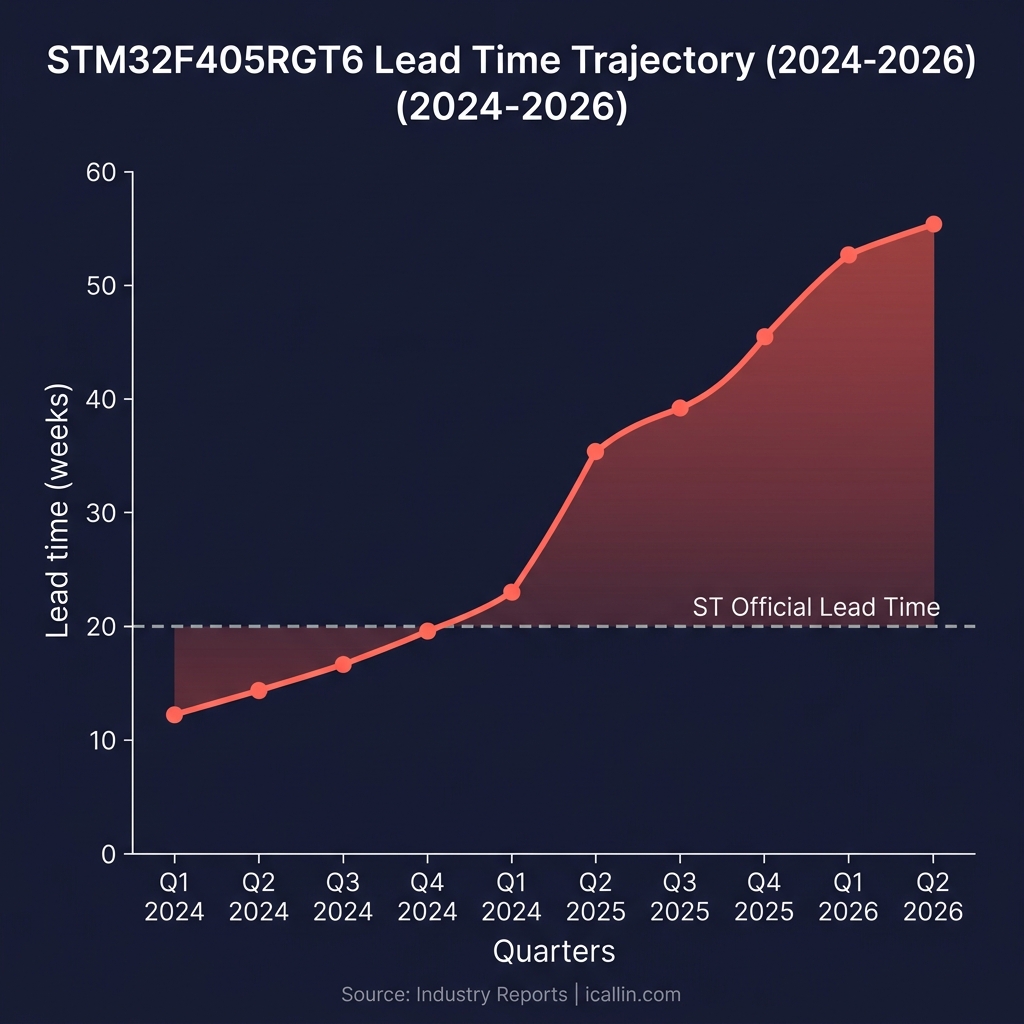
Figure 1: STM32F405RGT6 Lead Time Trajectory (2024–2026) — Real-world procurement data shows lead times climbing from ~12 weeks in early 2024 to 52+ weeks by Q1 2026, far exceeding ST's official 20-week estimate. The shaded area above the dashed reference line represents the growing gap between official and actual lead times. | Source: Industry Reports, EEVblog Forum, ST Community | Chart: icallin.com
2. The 5 Alternatives: Parametric Head-to-Head Comparison
Choosing the right alternative depends on your specific constraints: firmware migration budget, PCB redesign tolerance, and production timeline. The following matrix evaluates five validated alternatives across the parameters that matter most in a production BOM decision.
Full Parametric Cross-Reference Matrix
| Parameter | STM32F405RGT6 | APM32F405RGT6 | GD32F405RGT6 | AT32F435RGT7 | STM32F407VET6 | STM32F446RET6 |
|---|---|---|---|---|---|---|
| Manufacturer | STMicroelectronics | Geehy (极海) | GigaDevice (兆易) | ArteryTek (雅特力) | STMicroelectronics | STMicroelectronics |
| Core | Cortex-M4F | Cortex-M4F | Cortex-M4 | Cortex-M4F | Cortex-M4F | Cortex-M4F |
| Max Clock | 168 MHz | 168 MHz | 168 MHz | 288 MHz | 168 MHz | 180 MHz |
| Flash | 1024 KB | 1024 KB | 1024 KB | 1024 KB | 512 KB | 512 KB |
| SRAM | 192 KB | 192 KB | 192 KB | 384 KB | 192 KB | 128 KB |
| Package | LQFP-64 | LQFP-64 ✅ | LQFP-64 ✅ | LQFP-64 ⚠️ | LQFP-100 ❌ | LQFP-64 ✅ |
| Pin Compatible | — | ✅ Direct | ✅ Direct | ⚠️ Verify AF map | ❌ PCB redesign | ✅ Verify AF map |
| USB OTG | FS + HS | FS + HS | FS + HS | FS + HS | FS + HS | FS + HS |
| CAN | 2× CAN 2.0B | 2× CAN 2.0B | 2× CAN 2.0B | 2× CAN 2.0B | 2× CAN 2.0B | 2× CAN 2.0B |
| Ethernet MAC | No | No | No | No | Yes | No |
Table 2: Full Parametric Cross-Reference of STM32F405RGT6 and 5 Alternatives | Source: Manufacturer Datasheets & icallin Supply Chain Intelligence | icallin.com
Figure 2: Parametric Radar Comparison — 5 alternatives evaluated across Performance, Pin Compatibility, Firmware Compatibility, Price Value, Availability, and Ecosystem maturity. The white dotted hexagon represents the STM32F405RGT6 baseline. Note the AT32F435's dominance in Performance and Availability, while the APM32F405 leads in Pin and Firmware Compatibility. | Source: icallin.com Cross-Reference Analysis
⚠️ Critical Note on Operating Voltage: The GD32F405 and AT32F435 have a minimum operating voltage of 2.6 V, compared to the STM32F405's 1.8 V. Any design operating below 2.6 V—particularly battery-powered IoT or wearable applications—cannot use these alternatives without hardware-level power supply modifications.
3. Deep-Dive on Each Alternative
Alternative 1: Geehy APM32F405RGT6 — The Closest Pin-for-Pin Match
Compatibility Rating: ⭐⭐⭐⭐⭐ (Pin-for-pin, same LQFP-64)
The APM32F405RGT6 from Geehy Semiconductor is the closest parametric match to the STM32F405RGT6 in the market today. At 168 MHz, 1 MB Flash, and 192 KB SRAM in an identical LQFP-64 package, the specifications sheet reads almost identically.
Where It Excels:
- Direct pin-for-pin drop-in for existing PCB layouts
- Identical peripheral address map in most registers
- Shortest firmware migration path among all Chinese alternatives
- Lead times of 4–8 weeks vs. ST's 52+ weeks
Where It Diverges (Migration Risks):
- NVIC Interrupt Priority: Implementation differences in interrupt priority grouping can cause subtle, hard-to-debug behavioral changes in complex RTOS-based applications.
- USB Enumeration Timing: The r/embedded community reports that USB descriptor handling timing differs just enough to cause intermittent enumeration failures on certain host controllers—particularly older Windows USB stacks.
- SDK Requirement: You must use Geehy's native SDK rather than STM32 HAL. As EEVblog user az1 documented with direct links to ST's license terms: the STM32Cube HAL is legally restricted to ST silicon only. Using it on APM32 in a commercial product creates unquantified legal exposure.
Best For: Industrial control, IoT gateways, and applications where USB is not mission-critical.
Alternative 2: GigaDevice GD32F405RGT6 — High Performance, Deep Adaptation Required
Compatibility Rating: ⭐⭐⭐⭐ (Pin-compatible, different internal architecture)
The GD32F405RGT6 is perhaps the most well-known STM32 alternative globally, thanks to GigaDevice's aggressive market presence. However, beneath its pin-compatible exterior lies a fundamentally different silicon architecture that demands respect.
The Dual-Die Secret: In 2020, Hackaday published a forensic analysis citing Zeptobars' chip decapsulation laboratory, which physically confirmed that GD32 MCUs use two separate dies inside a single package: one for the Cortex-M4 core and one for an external SPI Flash ROM. At startup, the Flash contents are copied into on-die SRAM before execution begins. This architecture is why GD32 achieves zero wait-state Flash execution (because the code actually runs from fast SRAM), but it also introduces:
- A measurable boot delay during the SPI ROM → SRAM copy phase
- Higher power consumption in sleep modes (SRAM retention vs. Flash retention)
- A fundamentally different thermal and power profile
Critical Warnings:
- Operating Voltage Floor: 2.6 V minimum (vs. ST's 1.8 V). Low-voltage battery designs are immediately disqualified.
- USB/DFU: The single most frequently reported migration failure. Reddit user okm1123 confirms: "GD32 is almost exactly similar, consistently available on LCSC—but USB can be flaky if timing isn't perfect."
- Betaflight: Not officially supported. The FPV community has explicitly moved to AT32 instead.
- Legal Risk: The HAL licensing restriction documented by EEVblog users az1 and voltsandjolts applies here equally. Commercial products must use GigaDevice's native SDK or open-source alternatives like
libopencm3.
Best For: Cost-sensitive consumer products, non-USB-dependent industrial designs, and prototyping where price (10–30% cheaper than ST) is the primary driver.
Alternative 3: ArteryTek AT32F435RGT7 — The Performance Leap
Compatibility Rating: ⭐⭐⭐ (Not strict pin-compatible; verify AF mapping per pin)
The AT32F435RGT7 represents a generational performance upgrade rather than a like-for-like replacement. At 288 MHz with 384 KB SRAM, it shatters the STM32F405's 168 MHz ceiling while maintaining a compatible LQFP-64 footprint.
The Betaflight Validation: The most powerful real-world proof of the AT32F435's viability comes from the FPV drone community. Betaflight 4.5+ has native AT32 support, and the AT32F435 has undergone large-scale field validation across thousands of commercial and racing flight controllers. This is not theoretical compatibility—it is combat-tested in the most demanding real-time control application imaginable: autonomous flight at 200+ km/h with sub-millisecond gyroscope loop times.
Migration Considerations:
- Requires Artery's native SDK (AT32 IDE / AT32 Work Bench)
- Pin-level Alternate Function mapping may differ from STM32F405—must verify on a per-pin basis against the AT32F435 datasheet before PCB commitment
- Smaller ecosystem than STM32, but rapidly growing (supported by Keil, IAR, and GCC)
Best For: Next-generation drone flight controllers, high-compute real-time systems, and designs where the 288 MHz headroom enables future feature expansion.
Alternative 4: STM32F407VET6 — The Same-Family Upgrade (Different Package)
Compatibility Rating: ⭐⭐⭐⭐ (Same ST family, but LQFP-100 package)
The STM32F407VET6 is the STM32F405's bigger sibling. It shares the same STM32F4 HAL, the same CubeMX configuration workflow, and the same peripheral register architecture. Firmware migration effort is minimal—often requiring only a device target change in the IDE.
What You Gain:
- Integrated Ethernet MAC (with MII/RMII interface) for industrial IoT connectivity
- DCMI camera interface for machine vision applications
- Maximum firmware compatibility within the entire STM32 product line
What You Sacrifice:
- LQFP-100 package requires a complete PCB redesign from LQFP-64
- Lead times, while potentially shorter than the F405, are still constrained (30–40 weeks)
- Be aware of efton.sk Gotcha #161: in the STM32F407, Ethernet and OTG-HS cannot directly access FLASH for const data transmission. DMA from FLASH to ETH/USB-HS is blocked by the bus matrix architecture.
Best For: Industrial Ethernet controllers, computer vision systems, and next-generation PCB designs where the package change is already planned.
Alternative 5: STM32F446RET6 — Same Footprint, Higher Clock
Compatibility Rating: ⭐⭐⭐⭐ (Same LQFP-64, same ST ecosystem)
The STM32F446RET6 is the official upgrade path recommended by STM32CubeMX's Cross Selector tool. It shares the LQFP-64 footprint with high pin-level compatibility, operates at 180 MHz (vs. 168 MHz), and benefits from the complete STM32 ecosystem.
Migration Notes:
- Timer count and SDIO configuration differ slightly—verify your specific peripheral usage
- Alternate Function mapping for some pins may differ—use CubeMX's pin comparison view
- May have a different procurement window than the F405, potentially offering shorter lead times (20–30 weeks)
- 512 KB Flash (vs. 1024 KB)—ensure your firmware image fits
Best For: Emergency same-footprint replacement where staying within the ST ecosystem is non-negotiable.
4. The Firmware Migration Checklist: 7 Critical Steps
Migrating from the STM32F405RGT6 to any alternative MCU is not a "solder and ship" operation. Based on 306 documented STM32 behavioral gotchas (catalogued at efton.sk/STM32/gotcha/), real-world forum reports from EEVblog and r/embedded, and our own cross-reference engineering, we have distilled the migration process into 7 critical verification steps.
The 7-Step Verification Protocol
| Step | Action | Risk | Source / Reference |
|---|---|---|---|
| 1 | Verify LQFP-64 pinout against target datasheet pin-by-pin. Do not assume identical AF mapping. | 🟢 Low | Manufacturer datasheets |
| 2 | Switch IDE target and use vendor-native SDK, NOT ST HAL (legal risk for commercial products). | 🟢 Low | EEVblog user az1; ST license terms |
| 3 | Audit clock tree & PLL. Timer clock = 2× APB bus clock when APB prescaler > 1. Incorrect configuration causes 50% or 200% timing errors. | 🟡 Medium | efton.sk Gotcha #2 |
| 4 | Validate USB OTG enumeration & DFU bootloader. The F4/F7 bootloader may start unreliably with certain crystal frequencies. GD32/APM32 USB timing differs from ST. | 🔴 High | efton.sk Gotcha #125; Reddit |
| 5 | Test SPI in Master mode. The hardware NSS pin is "unusable" for most master configurations—use manual GPIO toggle instead. | 🟡 Medium | efton.sk Gotcha #21; EEVblog jnk0le |
| 6 | Run ADC/DAC accuracy regression. Verify CCM RAM is not used for DMA buffers—CCM is NOT DMA-accessible on STM32F4. GD32's memory map differs. | 🟡 Medium | efton.sk Gotcha #5 |
| 7 | Verify Advanced Timer output. TIM1/TIM8 require TIMx_BDTR.MOE (Main Output Enable) bit set—without it, zero output signal regardless of other configuration. | 🔴 High | efton.sk Gotcha #3 |
Table 3: Firmware Migration 7-Step Verification Protocol | Source: efton.sk STM32 Gotchas (306 items), EEVblog Forum, GigaDevice AN194 | icallin.com
🔴 Critical: Do not assume that STM32 silicon errata workarounds are valid on alternative chips—or that they are needed at all. Each manufacturer has their own errata. The errata for GD32, APM32, and AT32 must be read independently.
The GigaDevice AN194 Migration Guide
GigaDevice publishes Application Note AN194 specifically for STM32-to-GD32 migration. This document explicitly lists register-level behavioral differences including:
- Flash wait-state configuration differences
- GPIO output drive strength variations
- Unique DMA channel conflict resolution behavior
Download and study AN194 before committing any GD32 migration to production.
5. The Counterfeit STM32 Threat: How to Source Safely
When lead times stretch past 52 weeks, the gray market doesn't just grow—it metastasizes. Counterfeit STM32F4 chips are surging across secondary market channels, and the technical sophistication of forgeries has increased dramatically.
Anatomy of a Fake STM32
Hackaday's 2020 investigative report documented multiple classes of STM32 forgeries:
| Forgery Type | Detection Method | What It Conceals |
|---|---|---|
| Re-labeled GD32/CKS/WCH | DBGMCU_ID check via STM32CubeProgrammer | Non-ST die reporting wrong CPUTAPID (e.g., 0x2ba01477 instead of ST's 0x1ba01477) |
| Sanded & Re-coated | Acetone/IPA solvent swab on package surface | Inferior or obsolete die with new laser-etched ST markings |
| Flash Size Fakers | Program beyond advertised boundary | 64 KB die falsely advertising 1024 KB; programming beyond 64 KB causes silent data corruption |
| Dead/Defective Stock | Basic Blinky test + USB enumeration test | Chips that fail to execute even minimal firmware; USB crashes on initialization |
| Thermal Rejects | X-ray internal die inspection | Dies that failed factory testing, repackaged and sold as passing units |
Table 4: Counterfeit STM32 Detection Matrix | Source: Hackaday, GitHub keirf/Greaseweazle STM32 Fakes Wiki | icallin.com
The icallin Zero-Trust Counterfeit Defense
At icallin.com, every incoming reel of STM32F405RGT6 undergoes our AS6081-aligned Zero-Trust inspection protocol:
- X-Ray Die Imaging: Internal die topology compared against STMicroelectronics reference architecture. A genuine STM32F405 has a single integrated die; a GD32 fake immediately reveals its dual-die MCU+Flash architecture.
- DBGMCU_ID Verification: Programmable connection test via ST-Link to confirm the CPU TAP ID matches the expected value for the specific STM32 part number.
- Solvent Blacktop Testing: Heated chemical swab applied to package surface to detect sanding, re-coating, or re-marking of the IC package.
- Flash Boundary Testing: Automated write/read verification across the full advertised Flash range to catch size-faking forgeries.
→ Learn more about icallin's Quality Assurance protocols
6. Frequently Asked Questions
Q1: What is the best pin-compatible replacement for the STM32F405RGT6?
For the lowest firmware migration effort with direct LQFP-64 pin compatibility, the APM32F405RGT6 from Geehy Semiconductor is the strongest candidate. It matches the STM32F405's 168 MHz / 1 MB Flash / 192 KB SRAM specification and shares the highest degree of register-level compatibility. However, you must use Geehy's native SDK for commercial production—the STM32 HAL is legally restricted to ST hardware.
Q2: Can I run existing STM32F405 firmware on a GD32F405 or APM32F405 without modification?
No. While basic GPIO, UART, and timer functions will often compile and run without source code changes, the firmware is not binary-compatible. You must recompile targeting the new device. More critically, USB enumeration, DFU bootloader behavior, clock PLL configuration, and DMA channel assignments may produce silent failures without explicit verification. As the Reddit r/embedded community summarizes: "Don't assume that because the code compiles, the system will behave exactly as it did on the STM32."
Q3: Why is the AT32F435 gaining popularity over the STM32F405 in drone flight controllers?
The AT32F435RGT7 offers a 288 MHz clock speed (72% faster than the STM32F405's 168 MHz) with 384 KB SRAM (2× the STM32F405). Combined with Betaflight 4.5+ native support and significantly shorter lead times (2–6 weeks), the AT32F435 has undergone massive real-world validation across thousands of FPV racing and commercial drone flight controllers. Its superior processing headroom supports higher gyro loop rates, more complex filtering algorithms, and future protocol expansions.
Q4: How do I detect counterfeit STM32F405 chips?
The most reliable field-level test is a DBGMCU_ID check using STM32CubeProgrammer or OpenOCD. Genuine STM32F405 chips report a specific CPU TAP ID; re-labeled GD32 or CKS chips report 0x2ba01477 instead of the expected ST value. For higher confidence, perform a Flash boundary write test (fake chips often misreport Flash size) and a USB enumeration stress test (counterfeit chips frequently crash during USB initialization). For guaranteed authenticity, source from distributors like icallin.com that perform AS6081 X-ray and decapsulation testing.
Q5: What is the current lead time for the STM32F405RGT6 in 2026?
As of March 2026, the official STMicroelectronics factory lead time is stated as 20 weeks, but multiple procurement sources (EEVblog forum, ST Community, LinkedIn supply chain professionals) report actual lead times exceeding 52 weeks for new orders without existing Long-Term Agreements (LTAs). ST's partnership with Huahong for localized Chinese production prioritizes H7/H5/C5 series; the F4 series has no announced local production timeline.
Q6: Does icallin.com have genuine STM32F405RGT6 in stock?
Yes. icallin maintains warehouse-verified, authentic STM32F405RGT6 inventory with full lot traceability. Every incoming reel undergoes our AS6081 Zero-Trust inspection protocol, including X-ray die verification, DBGMCU_ID confirmation, and Flash boundary testing. We also stock verified alternatives including the APM32F405RGT6, GD32F405RGT6, and AT32F435RGT7 for engineers executing a dual-source BOM strategy.
📧 Submit an RFQ for STM32F405RGT6 →
7. Conclusion: Build Supply Chain Resilience, Not Single-Source Dependence
The STM32F405RGT6 remains an exceptional microcontroller—its decade of ecosystem maturity, exhaustive documentation, and battle-tested reliability are genuinely difficult to replicate. But the 2026 supply chain reality demands that engineers and procurement teams stop treating it as an irreplaceable single-source component.
The Strategic Playbook
-
Dual-Footprint PCB Design: If you are in the design phase for a new product, adopt a dual-footprint strategy that accommodates both the original STM32F405RGT6 and at least one validated alternative (APM32F405 or STM32F446) without requiring a board revision.
-
Vendor-Native SDK Validation: Never deploy firmware built with STM32 HAL on non-ST hardware in a commercial product. Invest the engineering hours upfront to validate your application on the alternative manufacturer's native SDK.
-
Trusted Independent Distribution: In a market flooded with counterfeit chips and constrained by franchise-level allocation freezes, align your procurement with an independent distributor like icallin that combines physical inventory control with AS6081 forensic authentication.
The engineers and procurement officers who thrive in 2026 will not be the ones who found a workaround for this quarter's shortage. They will be the ones who engineered permanent supply chain resilience into their product architecture.
📧 Submit an RFQ for STM32F405RGT6 →
📧 Request Cross-Reference Alternatives →
Related Internal Resources
- STM32F405RGT6 Product Search — Check real-time inventory availability and request pricing
- STMicroelectronics Manufacturer Directory — Browse the complete ST product portfolio
- Hot Products Supply Chain Analytics — Monitor global lead time trends for high-demand MCUs
- Submit an RFQ — Get competitive quotes for STM32F405RGT6 or any alternative
- Quality Assurance & AS6081 Testing — Learn about our Zero-Trust counterfeit defense protocols
*Charles·Lee is a Senior Semiconductor Supply Chain Analyst at icallin.com, specializing in MCU cross-reference analysis, Cortex-M migration strategy, and production BOM risk mitigation. With over a decade of experience navigating STM32 ecosystem availability crises, Charles provides engineers with forensic-grade parametric intelligence to maintain production continuity when lead times make the impossible feel routine.


Top Recommended part