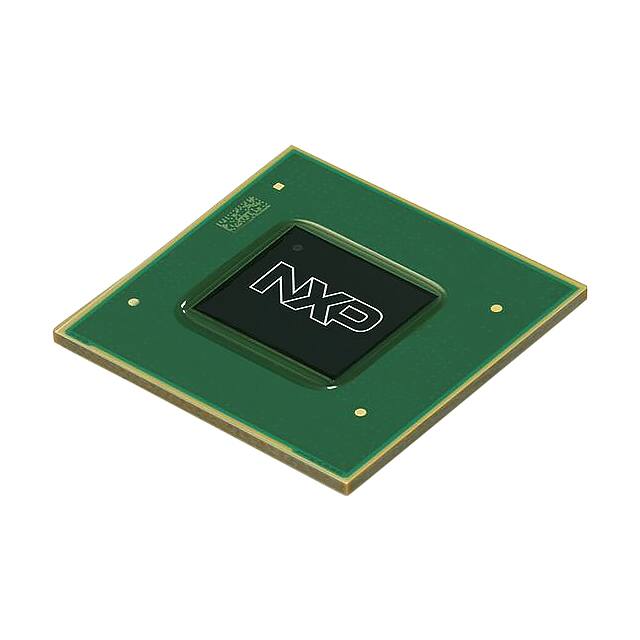


BQ40Z50RSMR-R2 In Stock: Drone Battery Management IC for UAV OEMs
Drone Battery Management ICs: BQ40Z50RSMR-R2 Bulk Stock for UAV OEMs
Category: Hot Stock & Featured Parts | Author: Charles·Lee | Published: April 2026 | Last Updated: April 29, 2026
Key Takeaways:
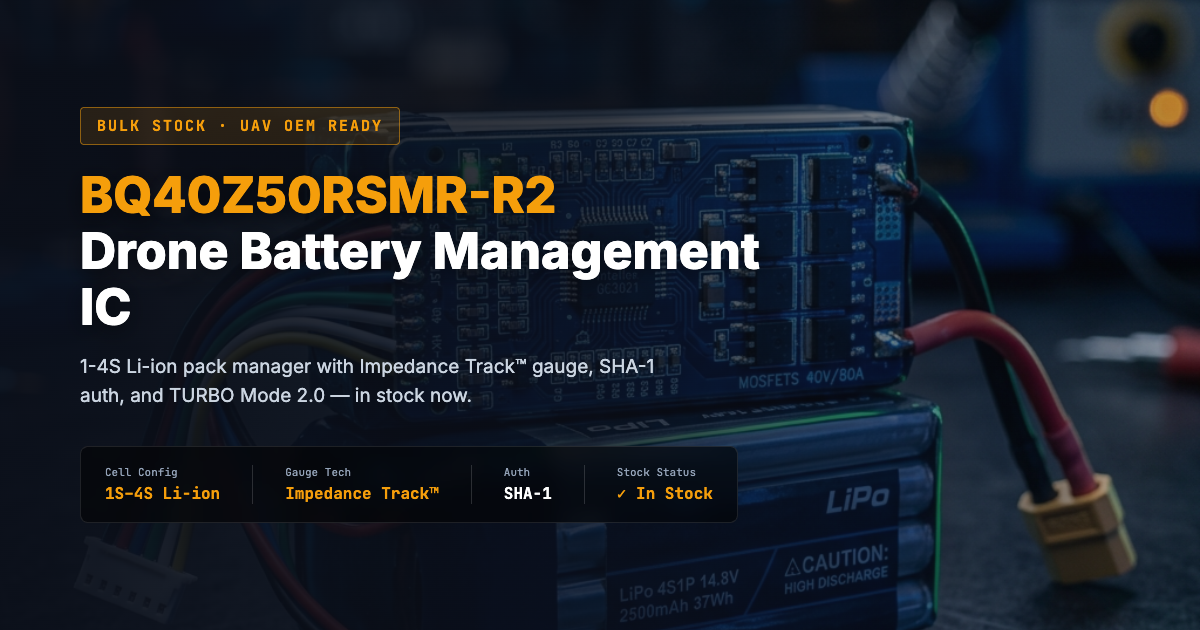
- All-in-One Battery Intelligence: The Texas Instruments BQ40Z50RSMR-R2 integrates a precision Impedance Track™ fuel gauge, 1-4S cell protection engine, SHA-1 authentication, and passive cell balancing into a single 32-pin QFN package — eliminating three discrete ICs from the drone battery pack BOM.
- Flight-Critical Accuracy: Impedance Track™ technology delivers State-of-Charge accuracy within ±1% across the full operating temperature range (–40°C to +85°C), providing flight controllers with reliable remaining-flight-time estimates that prevent mid-air battery depletion events.
- Verified Bulk Inventory: icallin.com maintains factory-sealed, lot-traceable BQ40Z50RSMR-R2 stock in 3,000-unit Tape & Reel packaging, ready for immediate dispatch to UAV OEMs and battery pack assembly houses.
- Anti-Counterfeit Protection: Integrated SHA-1 authentication enables drone OEMs to cryptographically verify battery pack authenticity, rejecting unauthorized third-party cells that lack validated safety certifications.
- Complete Battery Ecosystem: A verified 5-model procurement matrix spanning fuel gauges, charger ICs, and multi-cell monitors from Texas Instruments and Renesas provides full supply chain resilience for drone smart battery programs.
- 📧 Submit an RFQ for BQ40Z50RSMR-R2 Inventory →
Chapter 1 — Why Smart Battery Management Is Critical for Commercial UAV Operations
The global commercial drone industry is entering an inflection point in 2026. Agricultural spraying platforms, infrastructure inspection fleets, last-mile delivery vehicles, and photogrammetric mapping systems are transitioning from hobbyist-grade lithium polymer packs to intelligent battery management systems that meet the safety, reliability, and regulatory standards demanded by civil aviation authorities worldwide. The Federal Aviation Administration (FAA) Part 107 regulations in the United States, the European Union Aviation Safety Agency (EASA) drone regulations, and China's Civil Aviation Administration (CAAC) Type Certification requirements are all converging on a common mandate: commercial UAV battery packs must incorporate active monitoring, protection, and reporting capabilities.
At the center of this mandate sits the battery management IC — the silicon brain responsible for continuously measuring cell voltage, pack current, and temperature; calculating accurate State-of-Charge (SoC) and State-of-Health (SoH) metrics; enforcing programmable safety thresholds against overcurrent, overvoltage, and thermal runaway events; and communicating this critical telemetry to the flight controller over a standardized digital bus. Without an intelligent BMS IC, a drone battery pack is essentially a time bomb: the flight controller has no visibility into remaining energy reserves, no ability to detect degraded cells approaching failure, and no mechanism to reject counterfeit battery packs that bypass thermal safety testing.
The Texas Instruments BQ40Z50RSMR-R2 represents the state of the art in single-chip battery pack management for commercial UAV applications. By integrating the gas gauge, protector, cell balancer, and authenticator functions that traditionally required three or four discrete ICs, the BQ40Z50-R2 dramatically reduces battery pack PCB complexity, assembly cost, and qualification time — critical advantages for UAV OEMs racing to certify and ship smart battery packs in an increasingly competitive market.
| Feature | BQ40Z50-R2 Capability |
|---|---|
| Cell Configuration | 1S, 2S, 3S, 4S Li-ion / Li-polymer |
| Capacity Range | 100 mAh to 29 Ah |
| Fuel Gauge Technology | Impedance Track™ (patented) |
| Protection | OV, UV, OCC, OCD, SCD, OTC, OTD, UTC, UTD |
| Cell Balancing | Passive, during charge or rest |
| Authentication | SHA-1 (anti-counterfeit) |
| Communication | SMBus v1.1 (SBS 1.1 compliant) |
| Special Modes | TURBO Mode 2.0, Battery Trip Point (BTP) |
| Diagnostics | Lifetime data monitor, black box recorder |
| Package | 32-QFN (RSM), 5mm × 5mm |
| *Table 1: BQ40Z50-R2 Key Feature Summary | Source: Datasheet SLUUBD4C |
Chapter 2 — BQ40Z50-R2 Architecture Deep-Dive: Gas Gauge + Protector + Authenticator
The BQ40Z50-R2 is not merely a battery monitoring IC — it is a fully integrated battery pack manager that combines four traditionally separate functional blocks into a single monolithic device. Understanding the architecture of each functional block is essential for drone battery pack designers who must maximize both safety margin and energy utilization under the extreme demands of aerial operations.
Impedance Track™ Fuel Gauging
The cornerstone of the BQ40Z50-R2's value proposition is Texas Instruments' patented Impedance Track™ technology. Unlike simple coulomb-counting algorithms that accumulate measurement errors over time and cannot account for battery aging, Impedance Track™ continuously models the electrochemical impedance of each cell in the pack, dynamically adjusting its capacity predictions based on real-time temperature, discharge rate, and cell degradation state.
For UAV applications, this distinction is mission-critical. A drone flight controller relying on a coulomb-counter-based fuel gauge may display 25% remaining capacity when the actual usable energy — accounting for the cell's increased internal resistance after 200 charge cycles and the high discharge rate during a return-to-home climb — is closer to 8%. Impedance Track™ eliminates this dangerous discrepancy by computing the remaining capacity as a function of the cell's actual instantaneous impedance, not merely the accumulated charge flow.
The BQ40Z50-R2 supports battery packs from 100 mAh to 29 Ah, covering the full spectrum of commercial drone platforms: from lightweight inspection quadcopters with 3S 2200mAh packs to heavy-lift agricultural hexacopters with 4S 22000mAh configurations.
Integrated Protection Engine
The protection subsystem monitors all critical electrical and thermal parameters in real time, with programmable thresholds that can be configured via the BQ Studio development tool during battery pack design and locked during production programming:
| Protection Function | Abbreviation | Typical Threshold Range | Response |
|---|---|---|---|
| Overvoltage (per cell) | OV | 4.20V – 4.50V (programmable) | Disable CHG FET |
| Undervoltage (per cell) | UV | 2.00V – 3.20V (programmable) | Disable DSG FET |
| Overcurrent Charge | OCC | 1A – 32A (programmable) | Disable CHG FET |
| Overcurrent Discharge | OCD | 2A – 64A (programmable) | Disable DSG FET |
| Short Circuit Discharge | SCD | 10A – 200A (programmable) | Immediate DSG FET disable |
| Overtemperature Charge | OTC | 40°C – 70°C (programmable) | Disable CHG FET |
| Overtemperature Discharge | OTD | 50°C – 80°C (programmable) | Disable DSG FET |
| Undertemperature Charge | UTC | –20°C – 10°C (programmable) | Disable CHG FET |
| Undertemperature Discharge | UTD | –40°C – 0°C (programmable) | Disable DSG FET |
| Charge Timeout | CT | Programmable duration | Disable CHG FET |
| *Table 2: BQ40Z50-R2 Programmable Protection Thresholds | Source: Technical Reference Manual SLUUBK0B | Compiled by: icallin.com* |
The integrated high-side N-channel FET drive eliminates the need for a separate protection IC and FET driver, directly controlling the external charge and discharge MOSFETs. This architecture reduces the total battery pack component count by approximately 15–20 parts compared to a discrete gauge + protector + FET driver topology.
SHA-1 Authentication
The BQ40Z50-R2 incorporates a hardware SHA-1 authentication engine that enables drone OEMs to cryptographically verify battery pack authenticity. During the pack manufacturing process, a unique authentication key is programmed into the gauge IC using TI's BQKEYPROGRAMMER tool. When the battery pack is inserted into the drone, the flight controller issues a challenge to the BQ40Z50-R2 over the SMBus interface; the gauge computes the SHA-1 hash response using its stored key, and the flight controller verifies the response against its own copy of the key. If the authentication fails, the flight controller can refuse to arm the motors, display a counterfeit battery warning, or log the event for fleet management review.
This capability is particularly critical in the commercial drone industry, where third-party battery packs of unknown provenance — often assembled with cells that have not undergone proper capacity matching, impedance screening, or thermal safety testing — represent a significant crash and fire risk.

Chapter 3 — TURBO Mode 2.0 & Advanced Power Management for Flight Profiles
Commercial drone operations impose uniquely demanding power profiles on battery packs. Unlike consumer electronics that draw relatively steady currents, a drone battery must deliver massive current spikes during takeoff and aggressive climb maneuvers, sustain moderate current during cruise flight, and then absorb regenerative energy during autorotation or rapid descent. The BQ40Z50-R2's TURBO Mode 2.0 is specifically designed to accommodate these dynamic load profiles.
TURBO Mode 2.0 Operation
Under normal operating conditions, the BQ40Z50-R2's overcurrent discharge (OCD) protection will disable the discharge FET if pack current exceeds the programmed threshold for a defined duration. This behavior, while appropriate for steady-state consumer applications, would catastrophically interrupt power during a drone's takeoff sequence — a moment when motor current demand routinely exceeds 2× the steady-state cruise current.
TURBO Mode 2.0 addresses this by implementing a multi-tier current limit architecture. The system defines a sustained current limit (the standard OCD threshold for continuous cruise flight) and a separate TURBO current limit (a higher threshold permitted for a programmable burst duration). During takeoff, aggressive yaw corrections, or return-to-home climb maneuvers, the flight controller can signal the BQ40Z50-R2 to temporarily elevate its current limit to the TURBO threshold, ensuring uninterrupted power delivery during these safety-critical flight phases.
Battery Trip Point (BTP)
The Battery Trip Point feature enables the flight controller to program a specific remaining capacity threshold into the BQ40Z50-R2. When the gauge's Impedance Track™ algorithm determines that remaining usable capacity has fallen below this threshold, the device asserts an interrupt to the host controller — triggering an automated return-to-home sequence or forced landing procedure. This hardware-level capacity alert is more reliable than software-only implementations, as it operates independently of the flight controller's processing load and cannot be overridden by application firmware bugs.
Diagnostic Black Box Recorder
The BQ40Z50-R2 continuously logs critical operational data throughout the battery pack's lifetime, including cumulative charge throughput, maximum and minimum cell voltages encountered, peak discharge currents, and thermal excursion events. This diagnostic data — accessible via SMBus commands — serves as a flight-recorder-equivalent for battery pack forensics, enabling drone operators to identify degraded packs before they cause in-flight incidents and supporting post-incident root cause analysis.
| SMBus Command | SBS Code | Data Returned | UAV Application |
|---|---|---|---|
| RemainingCapacity() | 0x0F | mAh remaining | Remaining flight time estimation |
| FullChargeCapacity() | 0x10 | mAh at full charge | Pack health / degradation tracking |
| BatteryStatus() | 0x16 | Status flags | Pre-flight health check |
| CycleCount() | 0x17 | Total charge cycles | Maintenance scheduling |
| StateOfHealth() | 0x4F | Percentage | Fleet-level aging analysis |
| SafetyStatus() | 0x51 | Protection flags | Real-time fault monitoring |
| Voltage() | 0x09 | Pack voltage (mV) | Power system telemetry |
| AverageCurrent() | 0x0B | Average current (mA) | Energy consumption analysis |
| Temperature() | 0x08 | Pack temperature (0.1°K) | Thermal management |
| ManufacturerAccess(0x0010) | 0x00 | SHUTDOWN command | Deep storage / shipping mode |
| *Table 3: Key SMBus Commands for UAV Flight Controller Integration | Source: Technical Reference Manual SLUUBK0B | Compiled by: icallin.com* |
Chapter 4 — Hardware Design Guide: From Schematic to Production Battery Pack
Integrating the BQ40Z50-R2 into a production drone battery pack requires careful attention to external component selection, FET sizing, sense resistor placement, and PCB layout practices. The following guidance is synthesized from the official TI Technical Reference Manual (SLUUBK0B) and validated production designs.
External FET Selection
The BQ40Z50-R2 drives external high-side N-channel MOSFETs for charge and discharge path control. FET selection criteria include:
- Voltage Rating: Minimum 1.5× maximum pack voltage (e.g., ≥25V for 4S Li-ion at 4.2V/cell)
- Current Rating: Minimum 2× maximum continuous discharge current, accounting for thermal derating
- RDS(on): Minimize for power efficiency; typical selections range from 1–5 mΩ per FET for drone packs
- Gate Charge: Low Qg preferred to minimize FET driver power consumption
- Package: PowerPAK SO-8 or TOLL packages for high-current drone applications
Sense Resistor
A precision current sense resistor (typically 1–10 mΩ, ±1% tolerance, low TCR) is placed in series with the battery pack's discharge path. The BQ40Z50-R2's integrated coulomb counter and Impedance Track™ algorithm rely on accurate current measurement through this resistor. For high-current drone applications (>20A continuous), a 1–2 mΩ sense resistor is recommended to minimize I²R power loss while maintaining adequate signal-to-noise ratio on the current measurement inputs.
Cell Balancing
The BQ40Z50-R2 supports passive cell balancing through external bleed resistors connected to each cell tap. During charging or at rest, the gauge activates internal FET switches to shunt current around higher-voltage cells through the bleed resistors, equalizing cell voltages across the pack. Balancing current is typically 50–100 mA, determined by the external resistor value. For drone applications where rapid turnaround between flights is essential, higher balancing currents (up to 200 mA) can be achieved with appropriately rated resistors and adequate thermal management.
| Component | Specification | Notes |
|---|---|---|
| CHG FET | N-CH MOSFET, ≥25V, ≤5 mΩ | High-side charge control |
| DSG FET | N-CH MOSFET, ≥25V, ≤5 mΩ | High-side discharge control |
| Sense Resistor | 1–10 mΩ, ±1%, low TCR | Series in discharge path |
| Cell Balance Resistors | 33Ω–100Ω, 0.5W | Per-cell bleed path |
| Thermistor (Pack) | 10kΩ NTC, B=3435K | Pack temperature monitoring |
| Thermistor (FET) | 10kΩ NTC, B=3435K | FET temperature monitoring |
| PVCC Decoupling | 100nF + 10µF ceramic | Power supply filtering |
| REGSRC Decoupling | 1µF ceramic | Internal regulator bypass |
| SMBus Pull-ups | 10kΩ to VPULLUP | I²C/SMBus bus termination |
| *Table 4: Recommended External Components for BQ40Z50-R2 Battery Pack Design | Source: Technical Reference Manual SLUUBK0B | Compiled by: icallin.com* |
Chapter 5 — The 5-Model Battery IC Procurement Matrix
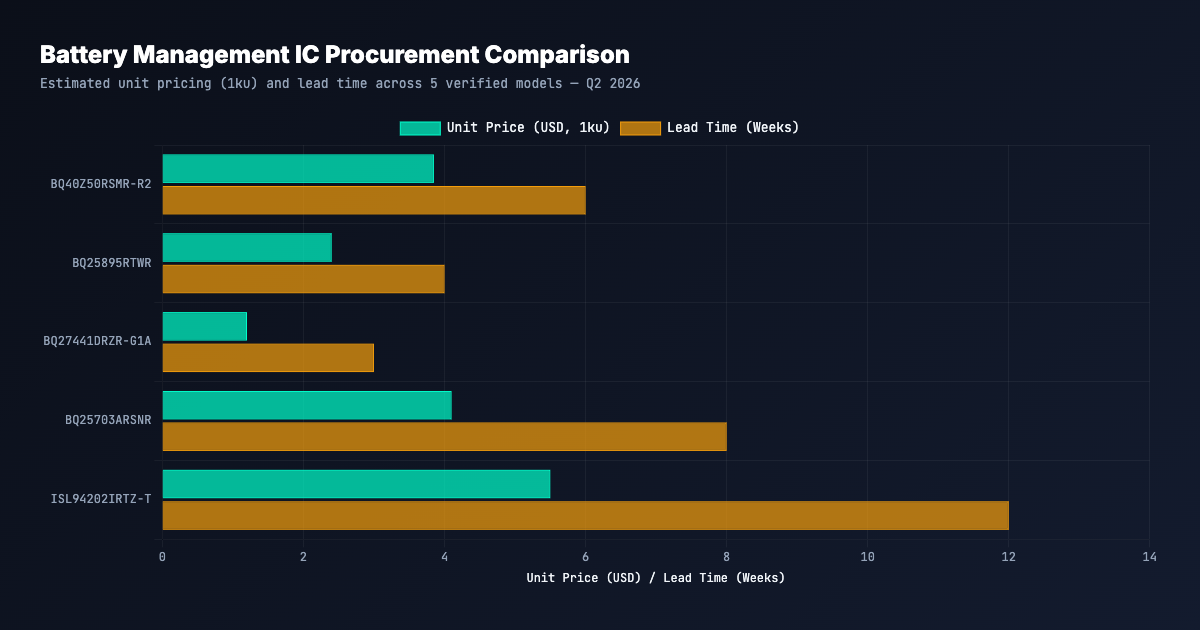
Building a resilient supply chain for drone smart battery programs requires procurement teams to qualify multiple battery management ICs across different functional categories. The following matrix presents five verified components spanning the complete battery management signal chain — from fuel gauging to charge management to multi-cell monitoring — across two manufacturers.
| Qualified Model | Manufacturer | Function | Cell Support | Package | Strategic Role |
|---|---|---|---|---|---|
| 🟢 BQ40Z50RSMR-R2 | Texas Instruments | Gauge + Protector + Auth | 1-4S | 32-QFN | Primary Push — All-in-one pack manager |
| 🟢 BQ25895RTWR | Texas Instruments | Buck-Boost Charger | 1S | 24-QFN | Charger Companion — 5A I²C charger |
| 🟢 BQ27441DRZR-G1A | Texas Instruments | Standalone Fuel Gauge | 1S | 12-SON | Simple Gauge — IoT / wearable packs |
| 🟢 BQ25703ARSNR | Texas Instruments | NVDC Buck-Boost Charger | 1-4S | 32-QFN | Multi-Cell Charger — UAV charging docks |
| 🟡 ISL94202IRTZ-T | Renesas | Standalone BMS Monitor | 3-8S | 48-QFN | Cross-Brand Monitor — Multi-vendor AVL |
| *Table 5: 5-Model Battery IC Procurement Cross-Reference Matrix | Source: Manufacturer Datasheets, icallin.com Verification | Compiled by: icallin.com* |
When to Use Each Device
BQ40Z50-R2 is the optimal choice when the battery pack requires a single-chip solution combining fuel gauging, protection, cell balancing, and authentication — the standard architecture for smart drone battery packs where BOM cost and PCB area are primary constraints. Its 1-4S support covers the vast majority of commercial UAV battery configurations.
BQ25895RTWR pairs with the BQ40Z50-R2 in systems where the charger resides inside the battery pack rather than in the charging dock. Its 5A maximum charge current, I²C programmability, and integrated boost mode for OTG (USB power delivery) make it suitable for drone battery packs that also serve as portable power sources for onboard accessories (cameras, sensors, communication modules).
BQ25703ARSNR is specified for UAV charging dock designs — standalone charging stations that accept multiple drone battery packs simultaneously. Its NVDC (Narrow Voltage DC) buck-boost topology efficiently charges 1-4S packs from a wide input voltage range (3.5V to 24V), supporting both AC-powered base stations and solar-powered field charging systems.
ISL94202IRTZ-T from Renesas provides multi-vendor supply chain diversification for drone OEMs who cannot accept single-manufacturer dependency on TI. While it lacks the integrated fuel gauging of the BQ40Z50-R2 (requiring a separate gauge IC), its 3-8S cell support makes it suitable for higher-voltage drone platforms (6S and 8S heavy-lift configurations) that exceed the BQ40Z50-R2's 4S limit.
Chapter 6 — UAV Battery Market Dynamics & Supply Chain Intelligence
The commercial drone market is experiencing unprecedented growth, with global shipments projected to exceed 8 million units in 2026 across agriculture, infrastructure, logistics, and public safety verticals. Each drone platform requires between one and four intelligent battery packs, creating an addressable market of 15–30 million smart battery management ICs per year — a demand signal that is straining the capacity of TI's battery gauge fabrication lines.
Simultaneously, the electric vehicle (EV) industry's insatiable demand for battery management silicon is creating a resource allocation conflict within semiconductor manufacturers. TI, the dominant supplier of battery fuel gauge ICs, is prioritizing automotive-grade (AEC-Q100) BMS components for EV traction battery packs, where the revenue per unit and contract volumes dwarf the commercial drone market. This allocation pressure is manifesting as extended lead times and periodic allocation constraints on commercial/industrial-grade devices like the BQ40Z50-R2.
For UAV OEMs, the strategic implication is clear: early procurement of battery management ICs from verified inventory sources is essential to prevent production line disruptions. Relying on just-in-time ordering from authorized distributors — where lead times can stretch to 16–20 weeks during allocation events — is an unacceptable risk for drone manufacturers with aggressive production ramp schedules.
| Application Segment | Primary BMS IC | Est. 2026 IC Demand | Growth Driver | Supply Risk |
|---|---|---|---|---|
| Agricultural UAVs | BQ40Z50-R2 (3S/4S) | ~5M units | Precision agriculture expansion | Medium-High |
| Inspection & Mapping | BQ40Z50-R2 (3S/4S) | ~3M units | Infrastructure monitoring mandates | Medium |
| Delivery Drones | BQ40Z50-R2 (4S) | ~2M units | Last-mile logistics pilots | High |
| Consumer Camera Drones | BQ27441 (1S) | ~8M units | Hobbyist market recovery | Low |
| Heavy-Lift / eVTOL | ISL94202 (6S-8S) | ~1M units | Urban air mobility R&D | High |
| *Table 6: 2026 Battery Management IC Demand by UAV Application Segment | Source: Industry Analysis | Compiled by: icallin.com* |
Frequently Asked Questions
Q1: How many cells does the BQ40Z50-R2 support?
The BQ40Z50-R2 supports 1-series, 2-series, 3-series, and 4-series lithium-ion and lithium-polymer cell configurations. This covers the most common commercial drone battery pack architectures: 3S (11.1V nominal) for lightweight inspection quadcopters and 4S (14.8V nominal) for high-performance agricultural and delivery platforms. The cell configuration is set during the initial device programming via TI's BQ Studio development environment. For drone platforms requiring more than 4S (e.g., 6S heavy-lift hexacopters), consider the Renesas ISL94202IRTZ-T which supports up to 8 cells in series.
Q2: What is Impedance Track™ technology and why is it important for drones?
Impedance Track™ is TI's patented battery fuel gauging algorithm that continuously models the electrochemical impedance of each cell to predict remaining capacity under real-world operating conditions. Unlike simple coulomb counting (which accumulates errors over time), Impedance Track™ accounts for cell aging, temperature effects, and discharge rate variations to maintain SoC accuracy within ±1%. For drones, this accuracy directly translates to reliable remaining-flight-time estimates — the difference between a safe automated landing and a mid-air power depletion crash.
Q3: Does the BQ40Z50-R2 support lithium polymer (LiPo) batteries?
Yes. The BQ40Z50-R2 supports both lithium-ion (Li-ion) and lithium-polymer (Li-polymer/LiPo) cell chemistries. LiPo cells are the dominant chemistry in commercial drone battery packs due to their high discharge rate capability (10C–30C), lightweight pouch packaging, and favorable energy density. The device's protection thresholds (OV, UV, OC, temperature) are fully programmable to match the specific voltage and current characteristics of the selected LiPo cell.
Q4: How does TURBO Mode 2.0 benefit UAV applications?
TURBO Mode 2.0 implements a multi-tier current limit architecture that allows temporary current bursts above the normal overcurrent discharge (OCD) threshold. During drone takeoff, aggressive climb maneuvers, or emergency evasion, motor current demand can spike to 2–3× the steady-state cruise current. Without TURBO Mode, the standard OCD protection would disable the discharge FET during these critical flight phases, causing an immediate power loss and crash. TURBO Mode 2.0 permits these controlled current bursts for a programmable duration while maintaining underlying safety protection.
Q5: Can the BQ40Z50-R2 authenticate battery packs to prevent counterfeits?
Yes. The BQ40Z50-R2 integrates a hardware SHA-1 authentication engine. During battery pack manufacturing, a unique cryptographic key is programmed into the device using TI's BQKEYPROGRAMMER tool. When the pack is connected to a drone, the flight controller issues a random challenge over SMBus; the BQ40Z50-R2 computes the SHA-1 hash response, and the flight controller verifies it. If authentication fails, the system can refuse to arm, display a warning, or log the event. This prevents the use of counterfeit or unauthorized battery packs that lack proper safety certifications.
Q6: What is the difference between BQ40Z50-R2 and a standalone fuel gauge like BQ27441?
The BQ40Z50-R2 is a fully integrated battery pack manager that combines fuel gauging, multi-cell protection (OV/UV/OC/SC/OT), charge/discharge FET drive, cell balancing, and SHA-1 authentication in a single IC. The BQ27441DRZR-G1A is a standalone single-cell fuel gauge that provides only capacity measurement — it has no integrated protection, no FET drive, and no authentication. The BQ27441 is suitable for simple 1S battery packs (wearables, IoT sensors) where a separate protection IC is already present. For multi-cell drone battery packs requiring integrated protection and authentication, the BQ40Z50-R2 is the appropriate device.
Conclusion
The Texas Instruments BQ40Z50-R2 has established itself as the industry-standard battery pack management solution for commercial UAV smart battery programs. Its unique integration of Impedance Track™ fuel gauging, comprehensive 1-4S cell protection, SHA-1 authentication, passive cell balancing, and TURBO Mode 2.0 dynamic current management — all within a compact 32-QFN package — delivers the safety, accuracy, and regulatory compliance that modern drone operations demand.
As the commercial drone market accelerates toward 8 million annual unit shipments in 2026, and as EV-driven allocation pressure continues to strain battery management IC supply chains, proactive inventory procurement is no longer optional — it is a production continuity imperative. The verified 5-model procurement matrix presented in this analysis provides UAV OEMs with the multi-source strategy needed to maintain uninterrupted smart battery pack production through any supply chain disruption.
Secure your BQ40Z50-R2 inventory position before the next allocation cycle begins.
📧 Submit an RFQ for BQ40Z50RSMR-R2 Today →
Related Internal Resources
- BQ40Z50RSMR-R2 — Product Detail
- Texas Instruments Manufacturer Page
- Battery Management ICs Category
- Submit RFQ
- Hot Products
*Charles·Lee is a Senior Battery Systems & UAV Procurement Specialist at icallin.com, specializing in lithium-ion battery management IC sourcing for commercial drone and industrial IoT applications. With deep expertise in TI Impedance Track™ gauge integration and multi-cell BMS design, Charles helps UAV OEMs navigate the increasingly constrained battery semiconductor supply chain.



Top Recommended part