

STM32F103RCT6 & STM32F405RGT6 In Stock — Genuine ST Parts
Hot Stock Alert: STM32F103RCT6 & STM32F405RGT6 — Genuine ST Parts, Warehouse-Verified
Category: Hot Stock & Featured Parts | Author: Charles·Lee | Published: April 2026 | Last Updated: April 1, 2026
Procurement Alert (Q2 2026): STMicroelectronics has officially announced broad price increases effective April 26, 2026, joining TI, NXP, Infineon, and onsemi in the most aggressive Q2 pricing reset in two years. Simultaneously, factory lead times for the STM32F1 and STM32F4 families have stretched to 52 weeks at authorized channels. Counterfeit STM32 parts — including relabeled GD32, CS32, and completely dead silicon — are flooding the secondary market at rates not seen since the 2021-2022 chip crisis. Below, we document the full risk landscape and present warehouse-verified, AS6081-inspected inventory ready for immediate dispatch.
Key Takeaways:
- icallin currently holds warehouse-verified inventory of both the STM32F103RCT6 and STM32F405RGT6, inspected under AS6081 Zero-Trust protocols — ready for immediate shipment.
- STM32F4 series lead times have reached 52 weeks at major authorized distributors. STM32F1 series is tracking at 42-48 weeks and accelerating.
- ST's price increase (effective April 26, 2026) follows TI (up to 85% on select parts), NXP, Infineon (5-15%), and onsemi — a synchronized industry-wide pricing event.
- Counterfeit STM32 failure rates on unverified sourcing channels exceed 12-18% according to ERAI and industry AS6081 audit aggregates.
- Every unit shipped by icallin includes full lot traceability, X-Ray bond-wire imaging, parametric curve tracing, and chemical decapsulation spot-checks on high-risk date codes.
1. The Triple Squeeze: Why STM32 Procurement Has Never Been Harder
The first quarter of 2026 has fundamentally altered the risk calculus for every procurement team with STM32 microcontrollers on their Bill of Materials. Three structural forces — each dangerous in isolation — have converged simultaneously, creating the most hostile buying environment for Arm Cortex-M MCUs since the pandemic-era allocation crisis.
Force 1: 52-Week Factory Lead Times
When EEVblog forum users began reporting STM32F4 lead times exceeding 40 weeks in early January 2026, many dismissed it as localized allocation noise. By March, the evidence became undeniable. Multiple independent reports — from DigiKey backorder data to ST Community Forum responses from official FAEs — confirmed that standard factory lead times for the STM32F405RGT6 had reached a staggering 52 weeks.
The root cause is structural, not cyclical. STMicroelectronics manufactures the F4 series on 90nm and 40nm mature process nodes. These same nodes are now being aggressively consumed by the global AI infrastructure build-out. As Nvidia, AMD, and Broadcom push demand for supporting power management, analog front-ends, and interface ICs — all manufactured on 28nm-65nm nodes — the upstream wafer capacity for "boring" MCUs is being systematically cannibalized.
The STM32F103 series, fabricated on older 180nm nodes, has fared slightly better but is trending in the same direction: current lead times sit at 42-48 weeks and climbing. The ST-Huahong collaboration to locally manufacture STM32 series in China is a long-term structural fix, but the initial production runs are focused on STM32H7 and STM32C5 series. The F1 and F4 families are not in the first wave of Huahong localization, meaning no supply relief is coming before Q1 2027 at the earliest.
Force 2: Synchronized Industry Price Increases
On April 1, 2026, Texas Instruments implemented price increases reaching up to 85% on selected product families. On the same date, NXP Semiconductors and onsemi executed their own targeted adjustments. Infineon Technologies raised prices by 5-15% across power management and automotive-grade products.
STMicroelectronics has communicated its own broad pricing adjustment effective April 26, 2026, citing rising operational costs (energy, transportation, material supplier allocation fees) and sustained demand pressure.
For procurement teams managing STM32-heavy BOMs, this creates an immediate cost optimization window: every STM32F103RCT6 or STM32F405RGT6 purchased before April 26 represents a direct saving against the incoming price structure. After that date, the same silicon costs more — permanently.
Force 3: Counterfeit Flood
The laws of economics are merciless. When genuine STM32 parts become scarce and expensive, counterfeit operations scale their output to fill the vacuum. Industry anti-counterfeiting databases (ERAI, GIDEP) have recorded a measurable spike in confirmed counterfeit STM32 incidents throughout Q1 2026.
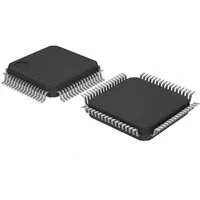
The STM32F103 series is one of the most counterfeited microcontrollers on Earth. Its ubiquity (found in everything from $2 "Blue Pill" development boards to $50,000 industrial PLCs), its simple LQFP-64 package (easy to remark), and its massive secondary market demand make it an irresistible target for gray market operators.
We will dissect the specific counterfeit typologies and detection methodologies in Section 4 below.
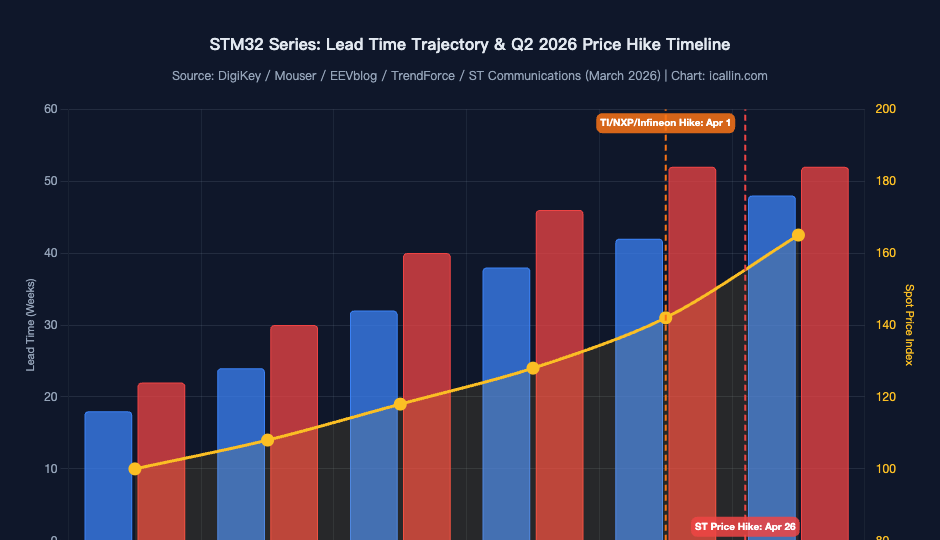
The chart above illustrates the relentless escalation. Three critical takeaways: First, the F405RGT6 hit the 52-week wall faster than the F103RCT6, reflecting the higher-value Cortex-M4 die's greater exposure to mature-node capacity competition. Second, the spot price index has already priced in roughly 42% of the anticipated ST increase, meaning buyers who wait until April 26 will face the full official markup on top of an already inflated baseline. Third, the gap between F103 and F405 lead times is narrowing — suggesting that the 180nm F1 production lines are beginning to experience the same capacity siphoning that crippled the F4 family.
2. STM32F103RCT6: The Industrial Workhorse That Powers Millions of Designs
The STM32F103RCT6 is arguably the most deployed 32-bit microcontroller in the history of embedded systems. Based on the Arm Cortex-M3 core running at 72 MHz, it occupies the sweet spot between cost efficiency and computational capability that has made it the default choice for an extraordinarily wide range of industrial and consumer applications.
Why F103RC Specifically?
The "RC" variant within the STM32F103 family denotes a specific combination of memory density and package that has proven optimal for mid-complexity designs:
| Parameter | STM32F103RCT6 Specification |
|---|---|
| Core | Arm Cortex-M3, 32-bit, single-precision |
| Max Clock | 72 MHz (1.25 DMIPS/MHz) |
| Flash | 256 KB |
| SRAM | 48 KB |
| Package | LQFP-64 (10×10 mm, 0.5mm pitch) |
| Operating Voltage | 2.0V – 3.6V |
| Temperature Range | -40°C to +85°C (Industrial) |
| ADC | 3× 12-bit (up to 16 channels, 1 µs conversion) |
| Timers | 7 (including 2 advanced-control for motor/PWM) |
| Communication | 3× USART, 2× SPI, 2× I²C, 1× USB 2.0 FS, 1× CAN |
| DMA | 7 channels |
| GPIO | 51 I/O ports (5V-tolerant) |
With 256 KB of Flash and 48 KB of SRAM, the "RC" variant provides enough headspace for moderate firmware stacks (FreeRTOS, LWIP) without the cost premium of the 512 KB "RE" or "RG" parts. Its 5V-tolerant GPIO lines make it particularly valuable in industrial environments where legacy 5V logic levels persist.
Where You'll Find It
The STM32F103RCT6 is deeply embedded across industries that demand reliable, cost-optimized embedded control:
- Industrial motor control and stepper drivers — leveraging the advanced timer peripherals (TIM1/TIM8) with complementary PWM outputs and dead-time insertion
- Data acquisition and environmental monitoring — utilizing the triple 12-bit ADCs with DMA for continuous, CPU-free sampling
- Communication gateways and protocol converters — bridging CAN bus networks to UART/SPI in factory automation and building management systems
- Medical device controllers — powering infusion pumps, diagnostic instruments, and patient monitoring peripherals
- Smart home and HVAC controllers — managing thermostat logic, sensor fusion, and motor-driven valve actuators
When a procurement manager receives a BOM with "STM32F103RCT6" on it, it almost always represents a mature, production-validated design that has been running for years. Replacing it isn't an engineering exercise — it's a re-qualification nightmare involving firmware changes, EMC re-testing, and potentially safety certification re-work. That is precisely why genuine, verified stock matters.
3. STM32F405RGT6: The Performance Flagship for DSP, Drones, and Advanced Embedded
The STM32F405RGT6 represents a fundamentally different performance tier. Built on the Arm Cortex-M4 core with a hardware Floating Point Unit (FPU) and DSP instruction extensions, it delivers 210 DMIPS at 168 MHz — nearly three times the raw computational throughput of the F103.
The F405RG Advantage
| Parameter | STM32F405RGT6 Specification |
|---|---|
| Core | Arm Cortex-M4F (with FPU + DSP instructions) |
| Max Clock | 168 MHz (210 DMIPS) |
| Flash | 1024 KB (1 MB) |
| SRAM | 192 KB + 4 KB backup |
| Package | LQFP-64 (10×10 mm, 0.5mm pitch) |
| Operating Voltage | 1.8V – 3.6V |
| ART Accelerator™ | Yes (0-wait-state Flash execution) |
| ADC | 3× 12-bit (up to 16 channels) |
| Timers | 14 (including advanced motor control) |
| Communication | 4× USART, 3× SPI, 3× I²C, 2× CAN, 1× USB OTG HS/FS, 1× SDIO |
| DMA | 16 streams (dual DMA controllers) |
| Crypto Acceleration | Hardware RNG |
Table 1: STM32F103RCT6 vs. STM32F405RGT6 — Head-to-Head Specification Comparison
| Feature | STM32F103RCT6 | STM32F405RGT6 | Why It Matters |
|---|---|---|---|
| Core Architecture | Cortex-M3 (no FPU) | Cortex-M4F (FPU + DSP) | F405 handles floating-point sensor fusion natively; F103 requires software emulation |
| Clock Speed | 72 MHz | 168 MHz | 2.3× clock advantage for real-time control loops |
| Flash | 256 KB | 1024 KB | F405 accommodates complex firmware stacks (USB Host, FAT32, Bluetooth stack) |
| SRAM | 48 KB | 192 KB (+4 KB backup) | 4× memory for audio buffers, image processing pipelines, or RTOS task stacks |
| ART Accelerator | No | Yes | Zero-wait-state Flash execution eliminates the performance hit from slow Flash read cycles |
| USB | FS Device only | OTG HS + FS | F405 can act as USB Host (connecting mass storage, HID devices) |
| CAN Buses | 1× CAN | 2× CAN | F405 supports dual CAN for automotive/industrial gateway applications |
| Package | LQFP-64 | LQFP-64 | Identical footprint — the same PCB pad layout accommodates both parts |
| Unit Price (pre-hike) | ~$3.50-4.50 | ~$6.50-9.00 | F405 commands a significant premium reflecting its performance tier |
A critical detail for board-level flexibility: both parts share the exact same LQFP-64 (10×10 mm) footprint. Some engineering teams deliberately design their PCBs with dual-compatibility in mind — populating with the cheaper F103RC for cost-sensitive production tiers and the F405RG for performance-critical variants, without requiring a board respin.
Where You'll Find It
The STM32F405RGT6 has become the de facto standard processor in several high-performance embedded domains:
- Drone flight controllers — powering the Betaflight and ArduPilot ecosystems (F405 is one of the most widely supported targets)
- Digital audio processing — hardware FPU enables real-time FFT, IIR/FIR filtering, and codec interfacing for guitar pedals, synthesizers, and professional audio systems
- Motor FOC (Field-Oriented Control) — the DSP MAC instructions accelerate Clarke/Park transforms for high-efficiency BLDC and PMSM motor control
- Industrial HMI panels — driving TFT displays with DMA-driven SPI at maximum throughput
- Robotics and motion control — processing IMU sensor fusion (Kalman filter) while simultaneously managing multi-axis servo PWM outputs
For both the F103RC and F405RG, the critical procurement reality is identical: these are production-locked designs. Switching to an alternative MCU — even a pin-compatible clone from GD32 or APM32 — requires firmware re-validation, peripheral behavioral testing, and potentially months of engineering effort. When production lines need parts now, the only viable option is genuine, verified STMicroelectronics silicon.
4. The Counterfeit Minefield: How Fake STM32s Infiltrate Your Supply Chain
At current lead times and price levels, the STM32 series is the single most counterfeited microcontroller family in the global electronics market. Understanding the threat landscape is not optional — it is a fundamental procurement survival skill.
Typology of Fake STM32 Silicon
Based on documented cases from ERAI, Hackaday community investigations, and EEVblog forum teardowns, counterfeit STM32 parts typically fall into four categories:
Type 1: Remarked Clones (Most Common) Gray market operators acquire low-cost GigaDevice GD32F103 or CKS Microelectronics CS32F103 units — which are legitimate Chinese-manufactured Cortex-M3 MCUs — and physically sand off the original manufacturer's laser markings. They then re-etch the STMicroelectronics logo and the target STM32 part number onto the chip's surface. The resulting component looks like a genuine STM32 but internally contains GD32 or CS32 silicon with fundamentally different memory architectures, peripheral timing behaviors, and debug interface responses.
Type 2: Downgraded/Defective ST Silicon Failed or downgraded genuine STM32 die — parts that didn't pass ST's final electrical test — are recovered from e-waste streams or factory reject channels. These are re-packaged and sold as fully functional units. They may pass basic identification checks (correct DBGMCU_ID) but fail under stress: corrupted Flash at temperature extremes, ADC accuracy degradation, or intermittent peripheral lockups.
Type 3: Completely Non-Functional ("Dead Bricks") The lowest-effort counterfeit operation: an empty or non-functional die in a correctly-marked LQFP-64 package. These parts will not respond to any programming interface. Hackaday documented cases of these "bricks" in 2020 and the practice continues in 2026.
Type 4: Re-dated / Recycled Genuine Parts Legitimate STM32 components are pulled from decommissioned PCBs (e-waste recycling), their leads are re-tinned, and a fresh date code is laser-etched to suggest recent manufacture. While electrically functional, these parts have unknown thermal history, may have degraded solder joints, and carry zero reliability guarantee.
Detection Methods: The Engineering Forensics Checklist
Table 2: Counterfeit STM32 Detection — Quick-Reference Inspection Matrix
| Inspection Method | What It Detects | Confidence Level | Equipment Needed |
|---|---|---|---|
| Visual: Laser Marking Quality | Blurry fonts, misaligned logos, inconsistent character spacing, wrong ST logo style | Medium | 10× magnification loupe |
| Visual: Surface Texture | Evidence of sanding/grinding ("blacktopping") to remove original markings | Medium-High | Microscope (20×+) |
| Visual: Pin Condition | Oxidation, re-tinning unevenness, bent or scraped leads indicating PCB removal | Medium | Visual inspection |
| Digital: DBGMCU_ID via SWD/JTAG | Genuine ST returns 0x1ba01477 (Cortex-M3) or 0x2ba01477 (Cortex-M4). GD32 clones often return 0x2ba01477 for M3 parts, exposing the mismatch | High | ST-Link + STM32CubeProgrammer |
| Digital: DEV_ID Register | STM32F103RC returns 0x414, STM32F405RG returns 0x413. Clones may return different values | High | SWD debugger |
| Functional: Flash Capacity Verification | Read/write test across the full advertised Flash range. Fakes may have only 64KB or 128KB instead of claimed 256KB/1MB |
A critical insight from the Hackaday and EEVblog communities: some sophisticated clones now correctly reproduce the DBGMCU_ID response. This means that a simple ID check alone is no longer sufficient. Multi-layer verification — combining digital ID checks with Flash capacity probing, peripheral stress testing, and physical inspection — is now the baseline requirement for any responsible distributor.

The data is stark: sourcing channel determines counterfeit risk more than any other variable. Online marketplaces like AliExpress and eBay consistently show failure rates approaching 18.5% for STM32 family parts — meaning roughly 1 in 5 units fails inspection. Even "professional" broker channels without formal AS6081 protocols show rates above 12%. The only reliable mitigation is purchasing from suppliers who perform rigorous incoming inspection on every lot.
5. icallin's Zero-Trust Verification: How We Guarantee Authenticity
At icallin's In-House Verification Lab, we treat every incoming STM32 reel as guilty until proven genuine. Our AS6081-aligned Zero-Trust inspection protocol consists of four sequential stages that every lot must pass before it enters our verified inventory system.
Stage 1: Documentation & Traceability Audit
Before a single component is opened, we verify the complete chain of custody: original manufacturer invoice or Certificate of Conformance (CoC), distributor shipping records, packing list against quantity claims, and date code consistency. Any documentation gap triggers immediate quarantine.
Stage 2: Visual & Physical Inspection (100% Sample)
Using calibrated 40× stereo microscopes and automated optical inspection (AOI) templates, we examine every reel for marking quality, surface finish integrity, lead coplanarity, and pin-1 indicator consistency. We maintain a reference library of genuine STMicroelectronics marking patterns (font metrics, logo geometry, lot code formatting) updated with each new production batch we receive.
Stage 3: Electrical & Functional Verification (Statistical Sample)
From each lot, a statistically significant sample undergoes powered testing:
- SWD DBGMCU_ID and DEV_ID register readback against the known-correct values for each specific STM32 part number
- Full Flash memory read/write verification across the entire advertised capacity
- Parametric boundary testing: I/O drive strength, ADC reference accuracy, low-power mode current consumption measured against datasheet limits
- High-temperature soak: parts are operated at 85°C under load for 4 hours to detect thermally marginal silicon
Stage 4: Advanced Analysis (Risk-Triggered)
When incoming lots originate from non-primary-market channels, or when date codes fall into known risk windows, we escalate to destructive testing:
- Real-time X-Ray imaging to verify die size and bond-wire/clip-bond geometry match ST's published package construction
- Chemical decapsulation (fuming nitric acid) on sacrificial samples to visually confirm the CMOS technology node and die layout against our reference database
Any lot that fails at any stage is quarantined and documented in our internal rejection database. We do not sell failed inventory downstream — it is permanently removed from the market.
6. Acts Now: The Pre-Increase Procurement Window
For procurement directors managing NPI prototypes or active volume production, the calculus is straightforward:
- Before April 26: Lock current pricing on genuine, warehouse-verified STM32F103RCT6 and STM32F405RGT6 units
- After April 26: Pay the official ST price increase on top of an already inflated spot market — if you can find genuine parts at all
- Wait 52 weeks: Hope that factory allocations materialize before your production line shuts down
Because of our continuous forward-stocking strategy and direct relationships with tier-1 ST inventory channels, icallin.com is currently holding substantial verified inventory of both the STM32F103RCT6 and the STM32F405RGT6 — with lot traceability, inspection documentation, and flexible quantity packaging (full reels down to precision cut-tape for prototyping runs).
7. Frequently Asked Questions
Q1: How can I verify that an STM32F103RCT6 is genuine and not a remarked GD32 or CS32 clone?
The most reliable first-line test is reading the DBGMCU_ID register via SWD using STM32CubeProgrammer. A genuine STM32F103 returns CPUTAPID 0x1ba01477, while many GD32/CS32 clones return 0x2ba01477. However, some sophisticated fakes now spoof this response, so you must supplement with a full Flash capacity read/write test across the entire 256 KB range and a peripheral stress test exercising USB, CAN, and DMA simultaneously. Physical inspection under 20×+ magnification for surface sanding marks remains essential. For production-critical procurement, always source from a distributor with documented AS6081 inspection protocols.
Q2: When exactly does the STMicroelectronics price increase take effect, and which STM32 parts are affected?
STMicroelectronics has communicated broad price adjustments effective April 26, 2026. The increase covers multiple product lines including STM32 microcontrollers, citing rising energy costs, transportation expenses, and upstream material supplier allocation fees. This follows similar moves by TI (April 1, up to 85% on select parts), NXP, Infineon (5-15%), and onsemi — making Q2 2026 the largest synchronized semiconductor pricing event since 2022. Parts secured before April 26 lock in current pricing.
Q3: Both parts share an LQFP-64 footprint. Can I design one PCB that accepts either the F103RC or the F405RG?
Yes, and many experienced engineering teams do exactly this. Both the STM32F103RCT6 and STM32F405RGT6 use the same LQFP-64 (10×10 mm, 0.5mm pitch) package. However, the pin-function mapping is not identical — power/ground pin assignments, oscillator input locations, and peripheral routing differ significantly. A "dual-compatible" board design requires careful pin-by-pin mapping using STM32CubeMX, separate firmware builds, and potentially configurable resistor networks for the differing bypass capacitor and oscillator requirements. It is feasible but requires deliberate design effort.
Q4: Is the ST-Huahong dual-sourcing partnership going to improve STM32F103 and F405 availability?
Not in the near term. The ST-Huahong collaboration, announced in March 2026, initially focuses on manufacturing the STM32H7 series and newer STM32C5 entry-level parts at Huahong's Chinese fabrication facilities. The STM32F1 and STM32F4 families — which run on different, older process nodes — are not in the first wave of localized production. Industry analysts do not expect meaningful F1/F4 supply relief from this initiative before Q1 2027 at the earliest. For current procurement needs, pre-existing inventory from established channel partners remains the only viable option.
Q5: What is the minimum order quantity, and can I get cut-tape quantities for prototyping?
Depending on current warehouse allocation levels and production run priorities, icallin supports both full-reel orders for volume production and precision cut-tape quantities for NPI prototyping and engineering sample requests. Minimum quantities vary by part number and current stock levels. Contact our sales engineering team with your exact quantity and timeline requirements for a customized quotation that includes full lot traceability documentation.
Q6: Why should I trust icallin over other independent distributors offering STM32 stock?
Three reasons: process, transparency, and documentation. Every STM32 unit in our inventory has passed our four-stage AS6081-aligned Zero-Trust inspection pipeline — from documentation traceability audit through visual inspection, electrical verification, and risk-triggered advanced analysis (X-Ray, chemical decapsulation). We provide customers with lot-specific inspection reports, warehouse photography, and direct communication with our quality engineering team. Our rejection and quarantine rates are a matter of record, not a marketing claim. Visit our quality assurance and anti-counterfeit service page for a complete overview of our inspection methodology.
Conclusion
The Q2 2026 STM32 procurement landscape is defined by three converging forces: 52-week factory lead times that show no sign of easing, industry-wide price increases that will permanently raise the cost floor after April 26, and a counterfeit flood that turns every unverified purchase into a production risk.
For the STM32F103RCT6 — the Cortex-M3 industrial workhorse embedded in millions of motor controllers, data loggers, and communication gateways — and the STM32F405RGT6 — the Cortex-M4F performance flagship driving drone flight controllers, audio DSP systems, and advanced robotics — the calculus is identical: securing genuine, verified inventory now is the highest-ROI procurement decision you can make this quarter.
icallin is not just a parts warehouse. We are a verification-first supply chain partner, holding deep AS6081-inspected STM32 inventory with full lot traceability, ready for immediate dispatch to your production floor.
📧 Submit an RFQ for STM32F103RCT6 & STM32F405RGT6 →
Related Internal Resources
If you are evaluating the STM32F103RCT6 for an active production program or need to verify specifications against your existing BOM, start with the STM32F103RCT6 product page to confirm the full MPN, review current datasheet parameters, and check real-time stock availability.
For teams working with the higher-performance STM32F405RGT6 in drone, DSP, or advanced embedded applications, the STM32F405RGT6 product page provides identical verification capabilities — including live inventory status and package variant confirmation.
Both parts come from STMicroelectronics, one of the world's premier semiconductor manufacturers. Explore the full range of ST products available through icallin on our STMicroelectronics manufacturer page, which aggregates all ST MCUs, analog ICs, and power management components in our verified inventory.
If your search extends beyond these two specific parts — perhaps you're looking for alternative STM32 variants, competing Cortex-M MCUs, or complementary peripherals — our Microcontrollers (MCU) category page provides a filterable view across all MCU families currently in stock.
For any component not listed or for bulk pricing negotiations, our Request for Quotation (RFQ) portal connects you directly with our sales engineering team. Submit your full BOM for competitive, volume-tiered pricing with guaranteed lot traceability.
Finally, explore our freshly updated Hot Products page for a real-time view of the most actively traded components across all categories — including MCUs, power management, memory, and passive components currently experiencing high demand.
*Charles·Lee is a Senior Semiconductor Supply Chain Analyst at icallin.com, specializing in cross-reference engineering, MCU procurement strategy, and anti-counterfeit verification methodologies. With over a decade of experience bridging the gap between hardware design teams and global component distribution networks, Charles helps enterprise customers navigate allocation crises, validate genuine inventory, and secure authenticated components through AS6081-certified inspection channels.


Top Recommended part