

Navigating the 2026 Memory Crisis: Why Nanya NT5CC128M16JR-EK is the Reliable Alternative for Legacy Systems.
Navigating the 2026 Memory Crisis: Why Nanya NT5CC128M16JR-EK is the Reliable Alternative for Legacy Systems
Blog Excerpt:
As standard DDR3 memory becomes harder to source in 2026, engineers and buyers need reliable replacements to avoid extensive system redesigns. Explore our technical cross-reference guide to see why the Nanya NT5CC128M16JR-EK (2Gb, 128Mx16, 1.35V, 96-ball TFBGA) serves as a practical alternative for maintaining legacy industrial hardware.
Procurement managers and hardware engineers are facing an increasingly constrained market for legacy memory components in 2026. As major fabricators reallocate manufacturing capacity toward High-Bandwidth Memory (HBM) and advanced DDR5 to support emerging infrastructure, traditional DDR3 and DDR4 modules are experiencing extended lead times and reduced availability.
For organizations managing long-lifecycle hardware, finding a reliable NT5CC128M16JR-EK alternative — or evaluating this specific Nanya component as a replacement for currently unavailable competitor chips — is becoming a practical necessity to keep production lines moving.
This guide provides a parameter-by-parameter analysis of the Nanya NT5CC128M16JR-EK. We will explore its core specifications, its application in legacy and industrial systems, and its viability as a cross-reference candidate against constrained parts from manufacturers like Micron and ISSI.
Why the 2026 Memory Crisis Matters for Legacy Systems
To understand the current need for an NT5CC128M16JR-EK replacement, it helps to look at the broader supply-chain context. The memory shortage of 2026 reflects a structural shift in manufacturing priorities rather than a temporary cyclical dip. Major foundries are dedicating more cleanroom space to high-margin components required for data centers and advanced computing.
As wafer capacity shifts toward these newer technologies, the production volume of mature-node dynamic random-access memory (DRAM) naturally decreases. Early in 2026, the market saw notable price adjustments and longer delivery windows for standard memory modules as buyers worked to secure available stock.
For manufacturers of industrial PCs, networking switches, telecommunications equipment, and automated factory robotics, this presents a specific challenge. These legacy systems rely on mature, extensively qualified components. When a legacy memory chip becomes difficult to source, OEMs generally face two options:
- System redesign: Transitioning a legacy motherboard to support newer memory standards like DDR5 requires updated memory controllers, complex PCB re-routing, new power-delivery networks, and rigorous environmental requalification. This requires significant engineering time and capital.
- Cross-reference replacement: Finding an exact physical and electrical alternative that allows the existing production line to continue without altering the Bill of Materials (BOM) or the PCB layout.
For many teams, the latter is the most efficient path. This is why developing a proactive legacy DDR3 sourcing strategy, particularly focusing on components with stable lifecycle support like the Nanya NT5CC128M16JR-EK, is a key focus for supply-chain managers.

What NT5CC128M16JR-EK Is and Where It Fits
Approving a memory substitute requires a close review of the manufacturer's datasheet. The Nanya NT5CC128M16JR-EK is an industrial-focused component designed to meet strict compatibility standards.
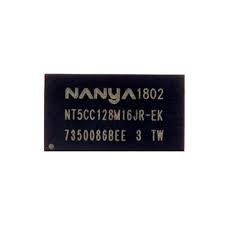
Based on Nanya's documentation, the NT5CC128M16JR-EK is a DDR3(L) 2 Gigabit (2Gb) J-die Synchronous Dynamic Random-Access Memory (SDRAM). It is engineered to deliver high-speed data transfer rates while adhering to JEDEC standards, allowing it to interface reliably with standard memory-controller hubs.
Key technical specifications include:
Density and Organization (128M x 16)
The chip has a total density of 2Gb, organized internally as 128 Megawords by 16 bits (128M x 16). The x16 bus width is frequently used in embedded systems and industrial computing, where board space is constrained, allowing designers to achieve the required memory bus width with fewer physical chips than x8 organizations.
Speed Grade (DDR3L-1866)
The -EK suffix indicates the speed grade. It operates at a maximum clock frequency of 933 MHz, providing a data rate of 1866 MegaTransfers per second (MT/s). It supports a CAS Latency (CL) timing of 13-13-13. While offering high-speed bandwidth, it is also backward compatible with slower system clocks such as 1600 MT/s or 1333 MT/s, providing flexibility for older boards.
Package Footprint (96-ball TFBGA)
The memory is housed in a 96-ball Thin Fine-Pitch Ball Grid Array (TFBGA). The standardized dimensions are 7.50 mm by 13.00 mm, with a 0.80 mm ball pitch. This exact physical footprint allows it to serve as a drop-in replacement for many competing memory chips without PCB modifications.
Voltage Standard (1.35V DDR3L)
As a Low-Voltage DDR3 (DDR3L) component, it operates at a nominal supply voltage of 1.35V (SSTL_135 interface). This characteristic reduces power consumption and heat generation compared with 1.5V standards, benefiting fanless enclosures and edge devices with limited thermal headroom.

Why NT5CC128M16JR-EK Is a Reliable Alternative
A functional alternative must not only boot the system but also maintain consistent performance under operational stress. The NT5CC128M16JR-EK serves as a practical Nanya 2Gb DDR3L option for several reasons.
First, as a mature J-die revision, the component is based on a refined manufacturing process. Mature dies generally provide consistent signal integrity and predictable thermal behavior. For long-lifecycle equipment deployed in remote or demanding environments, this predictability is highly valued by engineering teams.
Second, the component features programmable on-die termination (ODT) and driver impedance. The NT5CC128M16JR-EK allows the memory controller to dynamically adjust termination resistance values. This flexibility helps engineers fine-tune signal integrity to match the characteristics of a legacy PCB, reducing the risk of signal reflections or data errors at high frequencies.
Finally, Nanya Technology maintains a notable focus on the industrial and networking sectors. While the broader market shifts to next-generation memory, Nanya has a track record of supporting mature nodes, adding a layer of commercial stability to the sourcing process.
Cross-Reference and Alternative Comparison
When navigating allocation constraints, procurement teams frequently search for a MT41K128M16JT-125 cross reference or an IS43TR16128C equivalent.
Here is how the Nanya NT5CC128M16JR-EK compares to these widely used components.
Nanya vs. Micron (MT41K128M16JT Series)
Micron's 2Gb DDR3L components, such as the MT41K128M16JT-125 (1600 MT/s) and the MT41K128M16JT-107 (1866 MT/s), are common in legacy enterprise hardware.
The Nanya NT5CC128M16JR-EK closely aligns with the primary specifications of the Micron MT41K series. Both use a 128M x 16 internal organization and provide a 2Gb density. Both use a DDR3L 96-ball TFBGA package with a 0.8 mm terminal pitch, which means the Nanya chip matches the physical mounting requirements of the Micron chip.
Electrically, both are DDR3L standard parts operating at 1.35V. The Nanya -EK grade (1866 MT/s, CL13) can serve as a direct equivalent to the Micron -107. Because faster memory is backward compatible, the Nanya -EK can also replace the slower Micron -125 (1600 MT/s) by allowing the system's memory controller to clock it down to 1600 MT/s at CL11.
Nanya vs. ISSI (IS43TR16128C Series)
ISSI is another provider of long-lifecycle industrial memory, with the IS43TR16128C being a standard 2Gb DDR3 part.
When evaluating the Nanya part as an IS43TR16128C equivalent, the structural alignment is strong. Both feature the 128M x 16 architecture and 96-ball BGA packaging. Both support Auto Self-Refresh (ASR) and Self-Refresh Temperature (SRT) features, which help maintain data integrity across varying thermal conditions.
The Nanya NT5CC128M16JR-EK provides identical addressing and identical 2KB page size to the ISSI component. This alignment means the host memory controller can interact with the Nanya chip using the existing firmware and BIOS configurations.
Key Parameters Procurement and Engineering Teams Should Compare
Evaluating an NT5CC128M16JR-EK alternative requires coordination between procurement and engineering. Teams should verify the following parameters to ensure a smooth transition.
1. Density and Organization (Geometry)
A 2Gb chip organized as 256M x 8 cannot seamlessly replace a 2Gb chip organized as 128M x 16 without board redesign. The memory controller requires a specific number of data lines. The NT5CC128M16JR-EK's 128M x 16 structure provides the 16-bit wide data bus expected by many embedded processors. Always verify that both total density and megaword-by-bit organization match.
2. Package Type and Footprint
A DDR3L 96-ball TFBGA must be replaced with a compatible package. Engineers should verify the ball count, grid-array dimensions, and ball pitch (0.80 mm). Discrepancies in footprint will prevent the chip from aligning with the motherboard's solder pads.
3. Speed Grade and CAS Latency
The standard practice is that faster memory can replace slower memory. The Nanya NT5CC128M16JR-EK operates at up to 1866 MT/s (13-13-13). If the existing system requires 1333 MT/s (CL9) or 1600 MT/s (CL11), the Nanya chip will safely downclock to accommodate the system bus.
4. Temperature Grade and Refresh Requirements
The NT5CC128M16JR-EK standard commercial grade is rated for a case temperature (Tc) of 0°C to 95°C. Engineers must observe a critical JEDEC specification: if the operating temperature exceeds 85°C, the DRAM requires an external 2x refresh rate, dropping the interval from 7.8 microseconds to 3.9 microseconds. Nanya also provides wider-temperature and industrial-grade variations, such as -EKI or -EKW, if stronger environmental resilience is required.
Why 1.35V / 1.5V Compatibility Matters
A common consideration in legacy DDR3 sourcing is the electrical difference between DDR3 and DDR3L.
The L in DDR3L indicates Low Voltage. The Nanya NT5CC128M16JR-EK adheres to the SSTL_135 standard, running at a nominal 1.35V for both core and I/O. This lowers power consumption.
However, a key advantage for system maintenance is that the part is 1.35V DDR3 backward compatible.
Many older legacy systems use 1.5V power-management ICs. Sourcing a strict 1.35V-only chip for a 1.5V system could create integration issues. The Nanya NT5CC128M16JR-EK is designed to tolerate 1.5V logic levels, allowing it to function in older standard DDR3 systems. This dual-voltage capability can simplify inventory management, as a single part number can service both 1.35V and 1.5V product lines.

Lifecycle, Availability, and Legacy Support Considerations
Technical compatibility must be paired with supply-chain reliability. As major manufacturers dedicate resources to advanced nodes, the availability of legacy memory requires careful monitoring.
Nanya Technology has historically maintained support for standard DRAM and legacy nodes, providing densities across DDR3 and DDR3L lines. For procurement teams, transitioning to a supplier that actively supports the industrial sector can provide more stable lead times and reduce the frequency of end-of-life transitions.
Sourcing through authorized trading platforms also helps reduce the risks associated with the gray market, improving confidence that components meet the required quality standards.
What Buyers Should Check Before Recommending or Ordering a Replacement
To minimize risk when introducing a memory substitute, buyers and sourcing specialists should use the following checklist:

- Verify the alphanumeric suffix: The suffix indicates speed and temperature grades. Ensure the
-EK(1866 MT/s, commercial temperature) fits the application. If industrial temperatures are required, look for the-EKIvariant. - Confirm voltage rails: Check the motherboard schematic to confirm whether the system runs at 1.35V or 1.5V to ensure proper initialization.
- Check current availability: Standard lead times can be unpredictable. Use reliable component platforms to check stock and allocation pricing.
- Review lifecycle status: Check for recent Product Change Notifications (PCNs) to confirm the component aligns with your product's remaining lifespan.
- Acquire engineering samples: Before buying full tape-and-reel quantities, obtain a small sample batch to allow engineering teams to perform signal-integrity and thermal testing on the actual hardware.
FAQ
Can I use the NT5CC128M16JR-EK to replace a standard 1.5V DDR3 chip?
Yes. Although classified as a DDR3L (1.35V) component, it is designed to JEDEC standards that make it backward compatible with 1.5V power rails and logic levels. It can operate in older systems designed for standard DDR3 without hardware modifications.
My current system requires 1333 MT/s memory. Will this 1866 MT/s chip function correctly?
Yes. The NT5CC128M16JR-EK is rated for a maximum of 1866 MT/s (CL13), but standard memory controllers can downclock the module to slower speeds, such as 1600 MT/s (CL11) or 1333 MT/s (CL9). Faster memory modules are compatible with slower system buses.
What is the physical difference between a 96-ball TFBGA and an 84-ball BGA?
The ball count and layout dictate the physical solder connections to the motherboard. The NT5CC128M16JR-EK uses a 96-ball layout, standard for x16 organization memory. It cannot be used on a motherboard designed for an 84-ball or 78-ball chip without PCB redesign.
Why are standard DDR3 components experiencing supply constraints in 2026?
The memory market is reallocating manufacturing capacity. Major fabrication plants are converting production lines to manufacture HBM and DDR5 to meet new infrastructure demand, which restricts the supply of mature DDR3 and DDR4 components.
Is the NT5CC128M16JR-EK suitable for variable thermal environments?
The standard -EK suffix indicates a commercial temperature range (0°C to 95°C). If case temperatures exceed 85°C, the refresh rate must be adjusted to 3.9 μs. For more demanding environments, Nanya offers wider-temperature (-EKW) and industrial (-EKI) grades based on the same silicon family.
Conclusion
The 2026 memory market has turned legacy component sourcing into a more demanding task. As global wafer capacity shifts toward newer technologies, relying on historical supply patterns for legacy DDR3 memory is becoming less practical. Organizations increasingly need technically sound and supply-stable alternatives to maintain production continuity without forcing major redesigns.
The Nanya NT5CC128M16JR-EK offers a strong balance of technical fit and supply continuity. With its 1.35V / 1.5V compatibility, 96-ball TFBGA footprint, and 1866 MT/s speed grade, it supports the validation requirements of engineering teams while also helping procurement teams manage lifecycle risk. For companies maintaining long-lifecycle systems, qualifying this component can be a practical way to reduce sourcing pressure in a tightening memory market.
Comparison Tables
Table 1: Core Specifications of Nanya NT5CC128M16JR-EK
| Specification Parameter | Value | Engineering Relevance |
|---|---|---|
| Manufacturer | Nanya Technology | Established support for industrial memory lifecycles |
| Density | 2 Gigabit (2Gb) | Standard capacity required by many legacy systems |
| Organization | 128M x 16 | 16-bit wide data bus supports compact PCB layouts |
| Speed Grade | DDR3L-1866 | High bandwidth headroom; supports downclocking to 1600/1333 MT/s |
| CAS Latency | 13-13-13 | Optimized timing for 933 MHz clock frequency |
| Voltage (VDD/VDDQ) | 1.35V (SSTL_135) | Low power consumption; 1.5V backward compatible |
| Package / Footprint | 96-ball TFBGA | 7.5 x 13 mm, 0.8 mm pitch; standard footprint |
| Operating Temp (Tc) | 0°C to 95°C (Commercial) | Broad operational range; requires 2x refresh above 85°C |
Table 2: Cross-Reference Matrix (Nanya vs. Micron vs. ISSI)
| Feature | Nanya NT5CC128M16JR-EK | Micron MT41K128M16JT-125 | ISSI IS43TR16128C | Cross-Reference Status |
|---|---|---|---|---|
| Density | 2Gb | 2Gb | 2Gb | Match |
| Organization | 128M x 16 | 128M x 16 | 128M x 16 | Match |
| Package | 96-ball TFBGA | 96-ball FBGA | 96-ball BGA | Physically aligned |
| Voltage | 1.35V (1.5V tolerant) | 1.35V (1.5V tolerant) | 1.5V standard / 1.35V low-voltage variant | Electrically compatible |
| Speed Rate | 1866 MT/s | 1600 MT/s | 1600 MT/s | Higher speed grade; can downclock where supported |
| CAS Latency | CL13 | CL11 | CL11 | Compatible at reduced speed where supported |
Visualization Suggestions
Suggestion 1: Voltage Compatibility Venn Diagram
- Chart Title: DDR3L vs. DDR3 Voltage Compatibility Logic
- Chart Type: Venn diagram or overlapping range bar chart
- Purpose: To illustrate how the 1.35V Nanya part overlaps with 1.5V legacy power rails, providing quick clarification on backward compatibility
- Required Data Fields:
- DDR3 standard range: 1.425V to 1.575V (nominal 1.5V)
- DDR3L standard range: 1.283V to 1.45V (nominal 1.35V)
- overlap / tolerance zone indicating operational safety within 1.5V environments
Suggestion 2: Memory Lifecycle Timeline
- Chart Title: Legacy Memory Market Trajectory vs. Extended Support
- Chart Type: Diverging line chart / timeline
- Purpose: To illustrate the industry trend of diminishing standard DDR3 production compared with manufacturers committed to extended industrial lifecycles
- Required Data Fields:
- X-axis: years (2024 to 2028)
- Y-axis: relative supply volume
- line 1: general market legacy DRAM production trends
- line 2: extended industrial support trajectory
Suggestion 3: Cross-Reference Footprint Verification
- Chart Title: 96-Ball TFBGA Footprint Layout
- Chart Type: 2D layout grid graphic
- Purpose: To provide visual confirmation for layout engineers that the 96-ball, 0.8 mm pitch structure aligns with existing PCB pad requirements
- Required Data Fields:
- 96-dot grid
- labeled dimensions: 7.5 mm x 13 mm
- pitch spacing: 0.8 mm
Image Placement Suggestions
1. Immediately after the H1 title and before the introduction
- Purpose: Establish professional context and tone
- Suggested Image Theme: High-quality macro photograph of a DDR3 memory chip mounted on an industrial printed circuit board
2. After “Why the 2026 Memory Crisis Matters for Legacy Systems”
- Purpose: Represent the manufacturing and supply-chain environment
- Suggested Image Theme: Clean corporate image showing semiconductor wafers or an automated assembly line, subtly implying manufacturing capacity and allocation
3. Within “What NT5CC128M16JR-EK Is and Where It Fits,” after the key technical specification breakdown
- Purpose: Ground the technical specifications in physical engineering design
- Suggested Image Theme: Cropped engineering schematic or stylized mechanical drawing of a BGA package
4. Inside “Why 1.35V / 1.5V Compatibility Matters”
- Purpose: Illustrate a real-world application environment
- Suggested Image Theme: Photograph of an open industrial PC chassis or embedded networking hardware
5. Just before “What Buyers Should Check Before Recommending or Ordering a Replacement”
- Purpose: Signal the transition from engineering data to procurement and sourcing strategy
- Suggested Image Theme: Professional photograph of tape-and-reel packaging or warehouse inventory staging for electronic components
6. At the very end, accompanying the Soft CTA
- Purpose: Reinforce collaborative sourcing and validation
- Suggested Image Theme: Supply-chain team member reviewing a BOM on screen alongside hardware prototypes
Soft CTA
If your team is evaluating an NT5CC128M16JR-EK alternative or planning a replacement strategy for constrained DDR3 inventory, it helps to review both technical fit and current availability before the sourcing window narrows further.
You can use icallin.com to check NT5CC128M16JR-EK availability, compare current market conditions, and explore relevant cross-reference options for legacy memory support.
Recommended Internal Links
If your team is comparing legacy memory options or planning a replacement strategy around NT5CC128M16JR-EK, these pages may be useful:
-
Nanya Manufacturer Page
Explore Nanya’s broader memory portfolio and related manufacturer resources. -
Related Memory Search Results
Review similar memory search results for additional sourcing and comparison references. -
Request a Quote
Contact the team for pricing, availability, or support with legacy DDR3 replacement planning.


Top Recommended part